In late July, in the villages of Sivasagar, people heard a sound they could not place. Assam knows floods. The state has lived with them for as long as it has existed, and there is a rhythm to them that people understand — the slow rise, the days of watching, the familiar decisions about when to move the livestock and what to carry upstairs. This was not that. Survivors described a rushing current, arriving with force, taking everything with it. One family thought, at first, that it was a drain blockage.
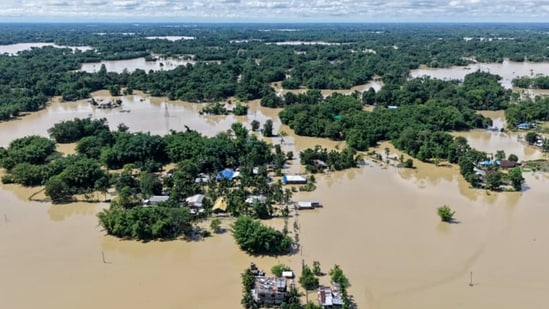
By early August the state's death toll stood at 95. Sivasagar alone accounted for 50. Over ten lakh people were affected, more than 44,000 pushed into relief camps, and nearly 17,000 hectares of standing crop went under — an entire year's harvest for families who eat from what they grow.
Now, the detail that has stayed with me since. The rain did not fall in Assam. It fell in Nagaland. Mokokchung district recorded rainfall 493% above normal. That water had to go somewhere, and where it went was down into the Assam plains — into riverbeds raised by decades of siltation, through catchments stripped of the forest that once slowed the runoff, into channels that no longer had the capacity to hold what arrived.
Upper Assam drowned because of water that fell in a neighbouring Indian state.
{{/usCountry}}Upper Assam drowned because of water that fell in a neighbouring Indian state.
{{/usCountry}}Sit with that, because it is not a story about a natural disaster. It is a story about an information failure.
Nobody was hiding the rainfall data. Nagaland is not a hostile power. There was no treaty dispute, no withheld hydrological readings, no adversary timing a release. The rain gauges recorded what they recorded. The satellites saw what they saw. The Indian Meteorological Department was, presumably, watching.
And still, a family in Sivasagar first understood what was happening when they heard the water.
Somewhere between a rain gauge in Mokokchung and a doorway in Sivasagar, the information stopped. Not because it did not exist — because nothing existed to carry it the last mile, in time, in a form a human being could act on.
That gap is measured in hours. And in July, those hours were measured in lives.
I want to be precise about what I am arguing, because it would be easy to turn this into a generalised complaint about governance, which helps nobody.
India is not short of data. This is genuinely one of the things this country does well. We run our own weather satellites. We have a dense network of rain gauges and automatic weather stations. We have Doppler radar, river gauges, and a Central Water Commission that monitors flow across the major basins. On the technology side, India is not a poor country in this domain. We are, by the standards of most of the world, well equipped.
What we do not have is the layer that sits on top of all that: a system that takes upstream rainfall, runs it against downstream river capacity, and converts the result into a specific, timely, actionable warning delivered to the specific people who are about to be hit.
We have the inputs. We have not built the pipeline.
I say this as someone who builds data pipelines for a living. My work is in political intelligence, not hydrology, but the underlying problem is one I recognise immediately, because it is the most common failure in data systems everywhere: the organisation has the data, the data is correct, and the data never reaches the person who needed it in time to do anything.
The technical components of a solution are not exotic. Rainfall telemetry, river-level sensors, a hydrological model that maps upstream inputs to downstream levels, a threshold-based alert engine, and a delivery mechanism — SMS, cell broadcast, sirens in vulnerable villages. None of this is research-grade work. Every component exists. Several countries with a fraction of our technical capacity run systems like this.
The failure is not scientific. It is architectural and institutional.
Here is where it gets uncomfortable, and where Assam stops being the story.
Rain that falls in one Indian state and kills people in another is not a peculiarity of the Northeast. It is the basic hydrology of this country.
Water falling in Nepal reaches Bihar. Rain over Himachal Pradesh and the Punjab hills comes down through Punjab and Haryana. The Godavari carries Maharashtra's rain into Telangana and Andhra. The Kosi, the Ghaggar, the Yamuna, the Mahanadi — almost every major flood-prone stretch in India sits downstream of rainfall that lands under a different administrative authority than the one responsible for the people who will drown.
Our rivers are organised by geography. Our disaster management is organised by state boundary. The water does not respect the boundary, and the information, too often, does not cross it fast enough.
That is not a criticism of any single state government. It is a structural mismatch, and structural mismatches only get fixed when somebody names them and takes ownership at the level where the mismatch lives — which, in this case, is national.
There is a second reason this matters, and it takes us from a domestic failure to a strategic one.
While Sivasagar was under water, a larger argument was continuing about the same river system. China is building an enormous hydropower project near the Great Bend of the Yarlung Tsangpo, upstream of where it becomes our Brahmaputra. India is accelerating its own dam and infrastructure plans in response. Much of the anxiety in that debate concerns exactly what we have been discussing: not whether Beijing can stop the river — it largely cannot — but whether it can influence timing, and whether it will share the hydrological data that tells us when a surge is coming.
That is a serious concern and it deserves the diplomatic weight it is now getting.
But July should give us pause. Because the water that killed ninety-five people came from inside our own country, from a state that was hiding nothing, with data that was freely available.
If we cannot yet convert upstream rainfall from a neighbouring Indian state into hours of usable warning for our own villages, what exactly is our plan for managing an upstream neighbour who owes us nothing and shares data only when relations permit?
We are, in effect, preparing for an adversary's information warfare while losing people to an information gap of our own making.
The domestic fix is entirely within our control. It requires no treaty, no negotiation, no geopolitical leverage. It requires deciding that this is a system worth building, funding it, and assigning somebody to own it.
I do not think this is hard. I think it is unowned.
Flood warning in India falls between the meteorological department, the Central Water Commission, the national and state disaster management authorities, and the district administrations who are expected to act on whatever reaches them. Each has a mandate. None owns the specific problem of converting an upstream rainfall reading into a timely alert at a downstream doorstep. It is nobody's core metric, so it is nobody's core failure.
If I were to argue for one concrete thing, it would be this: a national, basin-level early-warning system, owned by a single accountable authority, that operates on hydrological boundaries rather than administrative ones — and that is judged by exactly one number. Not data collected. Not bulletins issued. The average lead time between an upstream rainfall event and a usable, received warning in the downstream villages it will affect.
Measure that number. Publish it. Watch it improve.
Anything we do not measure, we do not fix. And this is a number nobody currently reports.
I grew up in Assam, in the tea gardens of Jorhat, close enough to these districts that the names in the casualty lists are not abstractions to me. I have written before about what it means to be from a part of India that is discussed more often than it is consulted.
But I want to be clear that this column is not a request for sympathy for Assam. Assam will rebuild, as it always does, with very little help and very little coverage.
It is an argument that what happened in Sivasagar in July was a preview. Not of a rare disaster, but of an ordinary and recurring failure that will happen again — in Bihar, in Punjab, in Andhra — every monsoon, in places where the rain falls in one jurisdiction and the dying happens in another.
Every hour of early warning is a family that reaches higher ground. Ninety-five people in Assam did not get those hours, and the reason they did not is not that the information was unavailable.
It is that we have not yet built the thing that carries it to them.
This article is authored by Nitesh Pandey, columnist and founder, Genius30.