India's most recent large-scale youth mobilisation under the banner of Cockroach Janta Party has illustrated that women’s political participation has increased in large numbers, both physically and digitally. It appeared as a huge feat for a country where women were subjugated for decades. Even during the protests, women issues surfaced demanding more rights and representation. While it was comforting to see women hold the banners and raise their voices, what was disheartening to see how the protests transformed into a performative spectacle, organised around viral trends, online engagement and algorithms.
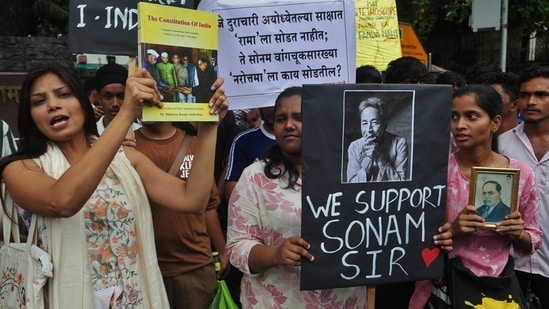
Women's presence in protests is not a present day, social-media-era phenomenon; throughout India's history, women have stood at the absolute forefront of peaceful mass mobilisations. During the freedom struggle, women participated in satyagrahas, civil disobedience, and mass marches, leading the non-violent resistance. Decades later, women led the Chipko movement to protect natural resources, organised sustained anti-rape campaigns following the 1972 Mathura custodial rape case, and mobilised in vast numbers during the 2012 protests to demand safety and systemic legal reform. More recently, female farm workers occupied Delhi's borders during the farmers' protest, and celebrated women athletes, including Olympic and Asian Games medal winners, sat in at Jantar Mantar to challenge institutional harassment. In all these instances, women demonstrated profound political participation and agency.
The digital feminist scholarship have documented real gains from social-media-enabled mobilisation from hashtag campaigns during the #MeToo which surfaced complaints that formal institutions had ignored for years; to the Delhi gangrape protests (2012) and Shaheen Bagh (2019–20) where both paired physical occupation of space with substantial online amplification. However, the nature of political mobilisation underwent a fundamental shift during the recent protests with the rise of social media algorithms, raising critical questions about what constitutes true political empowerment.
{{/usCountry}}The digital feminist scholarship have documented real gains from social-media-enabled mobilisation from hashtag campaigns during the #MeToo which surfaced complaints that formal institutions had ignored for years; to the Delhi gangrape protests (2012) and Shaheen Bagh (2019–20) where both paired physical occupation of space with substantial online amplification. However, the nature of political mobilisation underwent a fundamental shift during the recent protests with the rise of social media algorithms, raising critical questions about what constitutes true political empowerment.
{{/usCountry}}The right to protest in India is a carefully constructed constitutional framework rather than an isolated, absolute guarantee. It is derived from a composite reading of fundamental rights under Article 19(1). And operating alongside the fundamental right to life and personal liberty under Article 21, these rights form the bedrock of democratic dissent. However, the Constitution explicitly subjects these rights to reasonable restrictions under Articles 19(2) and 19(3). These restrictions empower the State to regulate public gatherings to preserve public order, sovereignty, national integrity, decency, morality, and to prevent defamation. This delicate architecture demonstrates that while expressing disagreement with government policies is vital to democracy, the Constitution never envisioned unrestrained speech impinging decency and morality at the cost of broader social harm.
A line must be drawn between constructive democratic criticism and outright defamation. Freedom of speech gives citizens the right to question policies, highlight systemic failures, and demand justice, but it does not give anyone a licence to use obscene, vulgar, or abusive language. The right to democracy and free speech under Article 19(1)(a) must be clearly distinguished from the deliberate defamation of individuals or constitutional offices. In Subramanian Swamy v. Union of India (2016), the Supreme Court affirmed that an individual's right to reputation and dignity is an inseparable component of the right to life under Article 21. Free speech does not grant a licence to defame or unprovokedly attack another person's honour and character. This protection applies universally to every individual, regardless of the position they hold whether a private citizen, an elected official, a judge, or the head of a constitutional office. No genuine democracy in the world equates profanity and abusive language with democratic freedom.
With the rise of social media, the recent protests eventually transformed itself into performative spectacles. The question is whether the participants were genuinely standing up for student rights and social justice, or simply creating content for online attention and followers. Real empowerment cannot be measured by likes, shares, or viral reach. True empowerment happens when public pressure leads to concrete, lasting change, such as better laws, stronger legal protections, improved safety, and institutional reform that actually impacts and creates a change for the better.
Furthermore, the duty to maintain dignity and civility in public discourse cannot be placed solely on women. Women in public life are often targeted with personal and sexualised abuse online, while simultaneously being expected to remain calm and restrained when they speak up. It is crucial to note that women are targeted physically also. Even during the protest, a clip went viral showcasing high handedness by a few police officials. Which is unacceptable and thereby strict action is expected. Dignity and respect are not one-sided obligations; they must apply equally to everyone involved, regardless of their gender, ideology, or political affiliation. Abusive language or physical abuse should never be justified.
Indian women are reaching historic heights; from winning gold medals at Commonwealth Games to breaking barriers in science, sports, and business, women are overcoming several challenges to claim their rightful and equal space. To honour the legacy of women who have fought for genuine social progress, democratic participation must remain grounded in respectful, substantive, and constitutional engagement that delivers real institutional results. It is important to question whether the visibility during these protests has converted into institutional change. Because when visibility on digital platforms becomes the primary metric of success, there is a huge risk of replacing serious demands and reforms with performative content designed for online traction. Using social media to raise awareness and challenge injustice is a powerful tool, but conflating abusive language with democratic freedom diminishes the seriousness of genuine civil resistance and misrepresents the core meaning of women's empowerment.
(The views expressed are personal)
This article is authored by Cchavi Vasisht, associate fellow, Chintan Research Foundation, New Delhi.