The discussion on BRICS and the dollar has become much too centered on replacement. Concepts like local currency settlements, alternative payment systems, and cryptocurrencies are usually described as strategic moves towards a global new financial order. However, the real problem for BRICS is quite different: BRICS has gathered a number of alternative financial instruments, but faced a serious challenge in integrating them all into a coherent system that can be used by enterprises and banks.
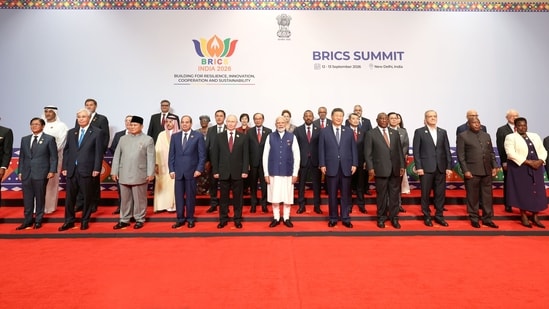
The Indian administration is working towards greater connectivity of BRICS central bank digital currencies (CBDCs) to solve cross-border payment issues. The plan is more about finding a real-life solution to a weakness of international finance than about making a competitor to the dollar because international transactions are more time-consuming, costly and complex compared to domestic ones.
Thus, the problem is not only in the dollar dominance but also in the limited possibilities of alternatives. The BRICS already has local currency exchange processes, national payment systems, CBDC trials, and the New Development Bank, which leaves the question of connectivity open.
One of the major hindrances facing BRICS is that of interoperability. Though BRICS nations are equipped with advanced payment systems, the effectiveness of domestic payment systems does not imply that they will be able to make transactions across borders. Doing business internationally requires a compatible payment messaging system, an arrangement for settlement, a virtual identity, specific data standards, adequate cybersecurity measures and anti-money laundering practices.
Consequently, the main objective should be to establish connections between systems instead of creating the BRICS bloc-wide payment platform. The UPI-PayNow system developed by India and Singapore shows that even different national payment systems can be connected while keeping their characteristics intact.
{{/usCountry}}Consequently, the main objective should be to establish connections between systems instead of creating the BRICS bloc-wide payment platform. The UPI-PayNow system developed by India and Singapore shows that even different national payment systems can be connected while keeping their characteristics intact.
{{/usCountry}}Moreover, this will also solve the fragmentation problem. If payments must be done with different payment systems having their own rules and regulations, banks and companies will have to comply with various regulations and spend money on many integrations. Although using many payment systems is a good idea, it is not useful without unification of transactions.
Another problem is liquidity. The use of local currencies is not going to work only because the government is willing to do it. The country receiving rupees, reais, and other BRICS currencies should be able to use them for trade purposes. Without proper liquidity, businesses will anyways end up using a more liquid currency.
In this regard, India is in a favourable situation. The effectiveness of a rupee-based settlement system will be significantly improved by the ability of foreign companies to hold, sell, or invest their rupees. Hence, the success of the local currency depends on the availability of domestic financing along with payment instruments.
The third challenge is achieving resilience in times of financial distress. If an alternative payment mechanism works only under normal market conditions, it has little strategic significance. Sudden swings in currency values, periods of foreign currency liquidity shortages, and interruptions of correspondent banking operations may make settlement impossible exactly when alternative methods are most needed.
BRICS countries should investigate the tools that make it possible to get liquidity in stressful situations. Currency swaps, foreign currency facilities, as well as the proper market-making mechanisms may ensure operational local currency payments even in times of trouble.
The fourth hurdle is institutional trust. Financial infrastructure relies on trust in the regulations governing it. Banks require certainties about settlement finality, regulatory fault, data security, dispute resolution, and compliance. Technology may speed up transactions, but it does not resolve the issue of the party responsible for negative outcomes.
BRICS’ expanded membership complicates things further. The members are subjected to different monetary systems and capital controls and are regulated in accordance with various laws and regulations. The prospects of the full involvement of every member in every financial project are unlikely in near term.
India ought to respond with the help of modular cooperation. Countries that are technologically advanced should connect to CBDC first and others should follow when they are ready. Pilot corridors can clarify if the arrangement delivers on its promise of lowering costs and speeding up settlement.
Such an approach provides a path for financial integration without requiring complete regulatory and political harmonisation. The New Development Bank can be an additional element of the architecture. Its purpose should be not to displace current multilateral organisations, but to broaden the availability of financing options for BRICS countries. The amount of local currency financing could be expanded where it makes business sense.
Financial markets are similarly significant. A currency gains additional utility in the world when people are able to invest and hedge it in liquid markets. This is why the existence of deep enough bond markets, good instruments for investments and predictable regulations play an integral role in financial architecture.
During its presidency in BRICS, India must transform these priorities into actions that have results. First, BRICS needs to create a common interoperability system that will include elements such as payment systems, APIs, digital identities, cybersecurity and regulatory compliance. Secondly, liquidity arrangements should follow local-currency settlement. Currency swaps, foreign-exchange market-making and ways to invest surplus balances in local currencies could ensure commercial viability of settlement.
Thirdly, BRICS countries should choose a modular model regarding cooperation in payments and CBDCs. The countries willing to create corridors could try successful patterns of cooperation and develop further for others. Fourthly, there should be clearly defined criteria. The relative costs of the transactions, time of transactions, exchange spreads, volume of payments, participating companies, as well as financing in local currencies would give a much clearer assessment of the progress made than the number of announcements made during summits. Fifthly, BRICS have to stay in line with international standards in terms of technology and regulation. Financial diversification can allow increasing the number of channels for settlements but should not create an isolated system.
This agenda creates a credible option for India to boost the international usage of the rupee. One cannot merely rely on payment deals to internationalize a currency. Foreign companies will use and keep rupees only if India is exporting in bulk and has attractive financial markets, investment options, and regulatory policies.
This indicates that internal policies must be part of India's international financial strategy. The nation must be competitive in its exports, it needs to have strong financial markets, a well-regulated financial environment, and to provide as much rupee-denominated financial assets as possible.
The primary goal for BRICS should be resilience and not disintegration. In a diversified financial system, it is not necessary that all members eliminate their current currencies, institutions or payment channels. The system only needs to maintain the necessary number of links between alternative systems to prevent any disruption in one part from leading to disruption in all other parts of the economy. Therefore, BRICS should focus on integration instead of new inventions. The group has created many components required for such integration. Its task is to make them work together. The efficiency of this process should be evaluated based on real transactions. If the process of making payments connected with the operations of BRICS is simple and inexpensive, then the diversification of finance has taken the necessary shape.
For India, this represents a more pragmatic view concerning financial independence. The goal is not to substitute one dominant financial system with any other, but to create a range of reliable, connected options that will enable businesses and governments to withstand political and financial shocks better.
(The views expressed are personal)
This article is authored by Kanav Sharma, research scholar, Jammu & Kashmir.