
 E-Paper



India-New Zealand FTA: Limited trade, yet larger signals
This article is authored by Araudra Singh, research assistant, Council for Strategic and Defence Research, New Delhi.

 Prefer HTon Google


After concluding Free Trade Agreements (FTAs) with Oman and the UK in 2025, India finalised negotiations for an FTA with New Zealand on December 22—nine months after talks commenced in March. This makes it one of India’s fastest-concluded FTAs, reflecting strong political intent on both sides.
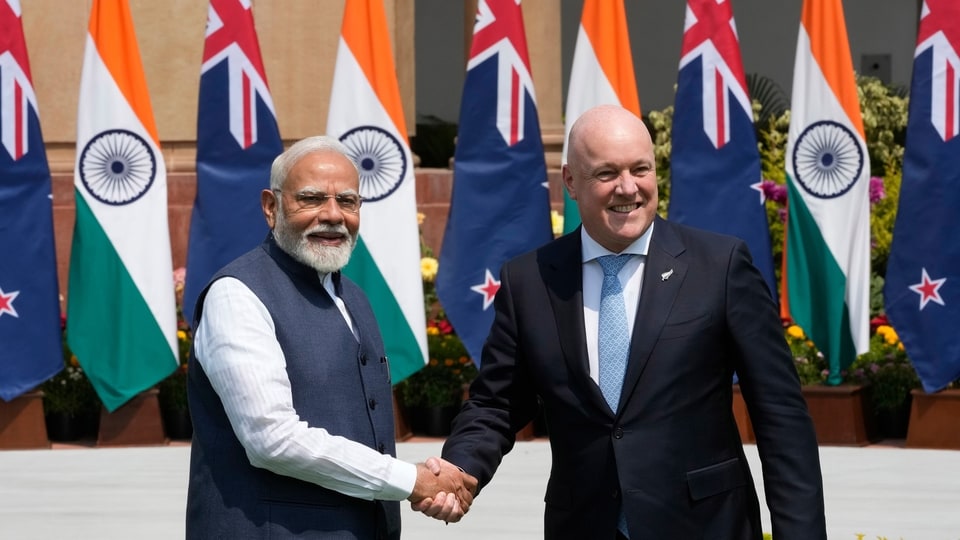
One of the elements of the agreement that gained traction in India is the elimination of duties on 100% of Indian exports to New Zealand. This includes the immediate removal of tariffs on 8,284 New Zealand tariff lines. Existing New Zealand tariffs—averaging around 10% on key Indian exports such as textiles, leather goods, ceramics, and automobiles will be eliminated, besides the average applied tariff rate of 2.2%. The agreement enhances India’s market access across labour-intensive and manufacturing segments, including textiles, leather, footwear, several types of engineering goods, pharmaceuticals, and agricultural products. The zero-duty access is likely to particularly benefit the Indian MSMEs in export-oriented sectors.
From New Zealand’s perspective, India has offered market access on 70.03% of tariff lines, covering approximately 95% of New Zealand’s exports, while excluding 29.97% of tariff lines which are protected sectors. The protected sectors include dairy and animal products agricultural, arms and ammunition, gems and jewellery, among others. Of the Indian tariff lines, 30% will see immediate duty elimination; 35.60% of tariff lines will undergo phased tariff elimination over 3, 5, 7, and 10 years; and 4.37% of products will witness tariff reductions. The FTA, thus serves as a good example of how such Indian redlines can be respected in trade talks vis-à-vis excluding, and promoting lower tariffs in sensitive sectors.
Beyond trade in goods, New Zealand has committed to investments worth $ 20 billion in India over the next 15 years. The agreement also includes maiden annex on traditional medicine services, alongside a key annex on Student Mobility and Post-Study Work Visas. Meanwhile, PM Modi and his New Zealand counterpart have welcomed the FTA, as a catalyst to potentially double bilateral trade within five years. The legislation for FTA is expected to be introduced in the New Zealand parliament this year.
The third FTA concluded by New Delhi this year reflects India’s ongoing efforts towards trade diversification, and to ease exporters’ pain hit by US tariffs (notwithstanding the marginal effect of the FTA given minimal export volumes). When viewed alongside India’s two other recently concluded FTAs, the New Zealand FTA also carries a value in geopolitical signalling to Washington, indicating India’s ability to cultivate enduring economic partnerships beyond the US. This is particularly salient even as impasse over bilateral trade agreement negotiations with the US continues.
At the same time, the agreement highlights enduring features of India’s trade negotiating posture. The complete exclusion of politically sensitive sectors such as agriculture and dairy—an issue that has attracted political opposition within New Zealand, echoes long-standing complaint by partners like the US regarding India’s use of non-tariff barriers (NTBs) and limited reciprocity in sensitive sectors. India’s consistently staunch stance over ‘protecting’ these sectors is also evident by the fact that this is New Zealand’s first FTA that entirely excludes the dairy sector, and despite agriculture accounting for the largest share of New Zealand’s exports to India and representing its single largest export sector globally. This has generated mixed reactions within New Zealand’s ruling coalition. New Zealand First party, and foreign minister Winston Peters have expressed strong reservations over immigration and dairy, and agriculture sector access, calling it “neither free nor fair”. Whereas, owing to huge market base, opposition Labour Party and several industry groups have endorsed the agreement, despite acknowledging its limitations.
Notwithstanding its political and strategic signalling value, the FTA’s utility for expanding Indian exports is likely to remain limited. While the agreement signals Delhi’s intent to reduce ‘over-concentration’ in export markets, it is unlikely to mean a considerable increase in exports given the minimal bilateral trade and exports worth $ 1.3 billion, and $ 711 million respectively.
Sectoral reading further underscores this constraint. In agriculture and dairy—together accounting for around 17% of all product tariff lines and forming the largest sector within India’s export basket to New Zealand—existing tariffs are merely 5% applied to exports worth around $ 700 million. Similarly, engineering goods face tariffs of 10% on exports valued at just $ 68 million. These figures suggest that tariff liberalisation offers very limited benefits for Indian exporters owing to already low applied tariffs by New Zealand. Moreover, over 58% of tariff lines 11 were already duty-free prior to the agreement.
Accordingly, the agreement’s value for India lies not in tariff reductions, but in regulatory alignment, particularly in pharmaceuticals, chemicals, auto components, and machinery. New Zealand’s regulatory regime in these sectors is highly stringent, overseen by specialised agencies enforcing rigorous safety, efficacy, and quality standards. Importers requires official approvals through extensive technical documentation on product safety and performance. Importers must also submit detailed justifications, including design registrations, to demonstrate that risk profiles remain uncompromised when products do not fully meet prescribed benchmarks. Hence, the FTA is likely to shape the composition and quality of India’s exports rather than significantly expanding volumes.
Concurrently, the limited provision of 5,000 temporary employment visas underscores New Zealand’s constraints as an alternative destination for Indian overseas employment, amid Delhi’s diversification efforts. While the annex (New Zealand’s first) signals growing confidence in India’s skilled workforce, it remains marginal relative to Indian employment in the US and Canada. This is particularly significant amid US H-1B visa fee hikes and the 2026 expiry of Canadian work permits, which could render up to a million Indian workers undocumented.
While PM Christopher Luxon expects to get sufficient parliamentary support to make the FTA a law, New Zealand First has decided to vote against any such legislation. Nonetheless, its likely to get ratified since the party just has eight seats in the parliament.
The FTA brings certain silver linings, including greater predictability in goods, services, mobility and investment, and is likely to avoid a part of the usual criticism levelled at FTAs— of widening of trade deficits. It is also a constructive framework for deepening engagement with one of India’s most underdeveloped economic relationships in the Indo-Pacific. Moreover, criticism within New Zealand regarding the labour mobility provisions as “deeply unwise”—owing to domestic unemployment does not appear reasonable. New Zealand faces well-documented skill shortages in several sectors including those covered under the mobility annex i.e., health care, engineering, IT, construction, and education. So, the mobility arrangement could instead potentially function as a necessary complement to New Zealand’s workforce needs.
The success of the FTA would also depend on its utilisation. India has been known to exhibit a low utilisation rate in FTA’s of about 25%, in contrast with developed economies touching 70%-80%. Herein, knowledge and actualisation of New Zealand’s regulations by Indian exporters, including MSMEs would be key. Relatedly, optimally leveraging the trade pact, would warrant sharing of responsibility amongst businesses, and policymakers to build awareness and use dialogue mechanisms for resolving potential challenges. Moreover, consideration of direct flights and expedited visa processes by the two countries would likely aid in actualising the objectives of the mobility annex.
Overall, while the FTA would not significantly boost trade volumes in the short term, its value lies in the long-term. It is likely to expand India’s trade footprint in the Indo-Pacific. Engaging a high-standard based economy also serves to indicate India’s ability to sign ‘high-standard FTAs’ to the international community.
This article is authored by Araudra Singh, research assistant, Council for Strategic and Defence Research, New Delhi.


