India is assuming the BRICS residency at a time when its geostrategic uncertainty with the US is rapidly unfolding. This is significant as BRICS helps India engage with both China and Russia, while the US remains one of its key economic, tech, and strategic partners. India finds itself navigating a difficult contradiction as it needs the US, but cannot afford to depend exclusively on it. The continuing tensions in the relationship with the US may force India to employ a new diplomatic strategy based on cooperation with rival great powers in order to secure greater strategic manoeuvrability. The diplomatic relations between India and the US have been stable for a long time, only undergoing phases of smoothness and adversity. What differentiates the current stage is that rifts have become broader than just being political. Trade, tariffs, Russian oil, the Indian diaspora, and different views on strategic arrangements are increasingly emerging as sources of discord. One of the major causes of the drift in relations between the two countries is a difference in expectations. The US expects India to act as a stronger partner in its ongoing confrontation with China, whereas India maintains that cooperation with the US should not come at the cost of its strategic autonomy.
India understands that neither China nor Russia can replace the US as an economic partner. When it comes to bilateral trade relations between the two countries, the US looks at India as the world’s largest consumer market. In contrast to this, India-US trade volume has significantly increased to around $150 billion as of July 2026, with a trade surplus of more than $32 billion in India’s favour. The US remains an important market for Indian goods and services, while India represents one of the world’s largest consumer markets for American businesses. This economic interdependence provides a strong structural foundation for the relationship.
Considering its access to a range of advanced weapons and technology, the US still has far more reliability than Russia, provided that Russia has already exhausted its significant stocks of weaponry system in the Ukraine war. Nevertheless, Russia has traditionally been one of India’s principal defence suppliers, but the geostrategic circumstances surrounding the relationship have changed. The war in Ukraine has placed considerable pressure on Russia’s defence-industrial capacity, while Moscow’s increasing dependence on Beijing has created additional complications for India’s strategic calculations. Russia remains important to India, particularly in defence and energy, but its ability to function as an independent counterweight to China has become more constrained.
Neither China nor Russia can provide India with the same economic opportunities as the US. China is unlikely to purchase Indian goods and services on the scale that America does, while Russia cannot realistically be expected to help India balance China, given that Moscow, post-Ukraine war, itself maintains close relations with Beijing. Russia is unlikely to jeopardise its relationship with China solely to accommodate Indian interests. Consequently, despite its difficulties, the India-US relationship continues to possess considerable strategic value.
{{/usCountry}}Neither China nor Russia can provide India with the same economic opportunities as the US. China is unlikely to purchase Indian goods and services on the scale that America does, while Russia cannot realistically be expected to help India balance China, given that Moscow, post-Ukraine war, itself maintains close relations with Beijing. Russia is unlikely to jeopardise its relationship with China solely to accommodate Indian interests. Consequently, despite its difficulties, the India-US relationship continues to possess considerable strategic value.
{{/usCountry}}However, the difficulty is that this strategic interdependence has increasingly been accompanied by uncertainty under the Trump Administration 2.0. President Trump’s first term witnessed significant political engagement with India. The personal equation between Prime Minister (PM) Narendra Modi and Trump witnessed considerable visibility, with both leaders sharing the stage together at major public events. The most interesting thing about diplomatic engagement between the two countries was that they developed greater convergence on China, defence cooperation and the Indo-Pacific. However, the political environment during Trump’s second term has been considerably more unpredictable. Trump’s approach towards trade, tariffs and the Indian diaspora has generated political sensitivities in India. The problem for the Indian government is not merely individual statements or policy measures, but the wider uncertainty surrounding American intentions. When a strategically important partner becomes increasingly transactional, the other side has an incentive to reduce its dependence by expanding its external options.
This is particularly relevant to the Indo-Pacific. India has a major interest in maintaining a favourable balance of power in the region, while the US has regarded India as an important component of its broader regional strategy. Since Quad has also emerged as a significant platform for cooperation between India, the US, Japan and Australia, the Trump admin 2.0 has shown very little interest in Quad. In addition, the US has recently renamed Indo-Pacific Command to its original name ‘Pacific Command’, marking a partial departure from the Indian Ocean and possibly paving the way for China’s increasing influence in the region. Any weakening of American commitment to the Indo-Pacific, or uncertainty about the future of such arrangements, could, therefore, confuse India’s geostrategic calculations. And this is what has recently forced India to increase its diplomatic engagement with the countries located in the Indian Ocean and Pacific region--be it Mauritius, Indonesia, Singapore, Japan or New Zealand.
There is no doubt that India and the US have had strong diplomatic relations for decades, but in recent years, they have seen several ups and downs. Considering the current diplomatic relations between the two countries, it would not be wrong to compare and argue that both countries seem to be in a toxic relationship, where neither partner is happy to be together but is forced to remain so for some reason. While India does not have a better option than the US when it comes to taking security and economic advantages, it is equally important for the US from the perspective of implementing its offshore balancing policies in Asia. The Trump administration should not forget that Indian foreign policy is highly driven by national interest, which is shaped by broader public opinion; if President Trump does not stop bullying India for his domestic political gain, the diplomatic relations between the two countries may experience a sharp decline in the future. Therefore, the reliability of the bilateral relationship between India and the US seems to be changing, taking a new turn, with India possibly willing to pursue a diplomatic hedging strategy. In a diplomatic hedging strategy, a country tries to avoid choosing a single ally and taking a rigid side. It always tries to sit between balancing and band-wagoning, aiming to build ties with multiple competing great powers.
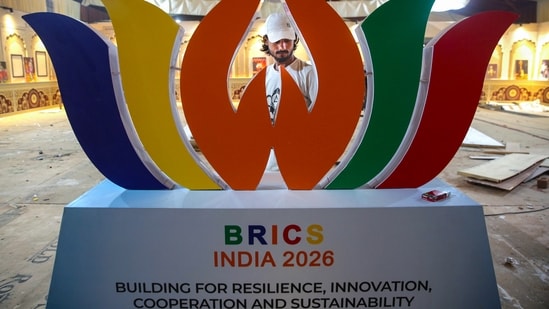
UN president, Antonio Guterres, recently stated that “peace is not secured through fear and might, but is built through trust”. This quote reminds us of the famous speech by the former PM Atal Bihari Bajpayi, delivered at the Indian Parliament: “You can change your friends but not your neighbour”. Considering the broader context of the above-mentioned diplomatic outreach, India is planning to host Chinese President Xi and Russian President Putin, possibly to diversify its trade basket. In the context of India hosting the BRICS presidency this year, the recent visits of national security advisor Ajit Doval and foreign minister S Jaishankar to China and Russia, respectively, may be seen as India, disappointed by Trump’s foreign policy, hedging its diplomatic engagement with competing great-power patrons. Therefore, in a fast-changing international order, diplomatic hedging may be India’s most practical expression of strategic autonomy at this time.
(The views expressed are personal)
This article is authored by Sanjay Turi, doctoral candidate, Centre for West Asian Studies, School of International Studies, Jawaharlal Nehru University, JNU, New Delhi and Janvi Singhi, researcher, foreign policy and strategic affairs.