In the wake of a closely watched BRICS summit in Brazil, Prime Minister (PM) Narendra Modi’s maiden visit to Namibia on July 9 has captivated global attention, marking the culmination of a landmark five-nation state visit that included Ghana, Trinidad & Tobago, Argentina, and Brazil. The state visit, beginning in Ghana and ending in Namibia, underscores India’s renewed commitment to Africa and the broader Global South framework. On the other hand, high-level cross-continental itinerary, spanning Latin America to Africa, highlights
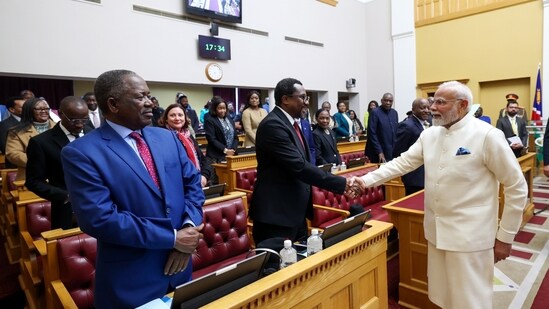
In the wake of a closely watched BRICS summit in Brazil, Prime Minister (PM) Narendra Modi’s maiden visit to Namibia on July 9 has captivated global attention, marking the culmination of a landmark five-nation state visit that included Ghana, Trinidad & Tobago, Argentina, and Brazil. The state visit, beginning in Ghana and ending in Namibia, underscores India’s renewed commitment to Africa and the broader Global South framework. On the other hand, high-level cross-continental itinerary, spanning Latin America to Africa, highlights India’s strategic intent to rekindle historic ties and build solidarity among Global South nations — especially at a time when the G77, the largest bloc of developing nations, is seen as increasingly irrelevant.
PM Modi’s State visit to sub-Saharan region is came at a time when several other western leaders were scheduled or expected to visit the sub-Saharan region. Around the same time, Washington is engaging the West African leaders and contemplating new ways to strengthen ties with Africa, unnerved by Chinese influence in the continent.
Although India has historic ties with Namibia – there’s a serious gap in State level visit and this heads of government level visit occurs after 27 years. Sam Nujoma, the leader of SWAPO (the party behind independence struggle) and founding president of Namibia, who visited India several times acknowledged India’s help during the liberation process. While in Windhoek, Namibia, PM Narendra Modi and Namibian President Netumbo Nandi-Ndaitwah tabled areas of cooperation such as agriculture, critical minerals, education, digital technology, defence and security, and health care.
Earlier this year, Chinese foreign minister Wang Yi began his State visit from Namibia — a nation with bilateral trade with China totalling approximately $1.4 billion. The BRI signatory nation is laying Trans-Kalahari Railway and several other infra and connectivity projects, mandating the One China Policy. China accounts about 30% of the nation’s foreign trade.
Although there’s a sharp rise in India’s bilateral trade with Namibia the is about $ 600 million. The two countries have pushed for the conclusion of Preferential Trade Agreement between India and South African Customs Union (SACU). Followed by this visit, the two nations are expected to work on boosting trade of items like oil and gas, hydrocarbons, petrol chemicals, crude digital health and critical minerals.
The maiden visit of PM Modi to this uranium-rich Namibia was at a time when New Delhi is actively seeking to expand its uranium imports to support its growing nuclear energy drive. Namibia is largest producer of uranium in the world, and it has lithium, zinc, and some other rare earth metals to offer.
India has announced plans to import at least 9,000 metric tonne units of uranium between 2025 and 2033 to supply new reactors under the National Nuclear Energy Mission. India has a plan to expand nuclear power capacity to 100 GW by 2047 and the low quality of its domestic reserves is part of a broader effort to strengthen energy security and reduce dependence on fossil fuels. The nation has recently discovered oil and gas reserves, particularly in its offshore Orange Basin. India has a deep interest to explore collaboration in the sphere.
The two nations have more to explore areas such as diamond trading. There’s a serious issue in direct diamond trading between India and Namibia – Indian side is working to make a way for direct diamond trading. Currently, India sources diamonds from the region via intermediaries such as Dubai, London, or third countries.
India and Namibia the two are aspiring nations in the reserving culture and promoting heritage. The Himba tribe in Namibia’s Kunene has earned fame for preserving their traditional lifestyle, clothing, and beliefs, remaining unaffected by modern influences.
During the visit of PM Modi, India and Namibia signed two MoUs on the setting up of the Entrepreneurship Development Centre in Namibia and Cooperation in the field of Health and Medicine. Namibia also announced starting of a digital payment system by end of the year and entering to India-led Coalition for Disaster Resilient Infrastructure and Global Bio Fuel Alliance.
During his visit, PM Modi was conferred with the Order of the Most Ancient Welwitschia Mirabilis, Namibia's highest civilian award. There is also an interesting personal connection between Prime Minister Modi and Namibia: On September 17, 2022, his 72nd birthday, India welcomed its first batch of eight cheetahs from Namibia, marking the historic return of the species to Kuno National Park after decades of local extinction. The release of these cheetahs was overseen by Modi. The nation deserves a very significant place – when India is forming Big Cat Alliance to save tigers.
Uranium, critical minerals, digital payment and diamonds are poised to infuse new vitality into the bilateral relationship between New Delhi and Windhoek, illuminating the path for deeper cooperation.
Namibia is the second least densely populated country in the world but as the same time it is world’s one of most arid countries, with just one per cent territory being arable. In the north of the nation, there’s a culture of farming cowpea and millet. India and Namibia may find ways to bring result on irrigation, scarce water management and hybrid-agriculture. India is in a position to help Namibia for innovative agricultural practices to address food insecurity in sub-Saharan region.
Under the leadership of first female President Nandi-Ndaitwah, who comes with her foreign ministerial experience the nation is vocal about a chair for Africa at the United Nations Security Council. As both nations look toward meaningful reforms in global governance, this visit has rekindled the bonhomie between New Delhi and Windhoek, laying the foundation for a partnership defined by shared ambition, and a commitment to the progress of the Global South.
This article is authored by Ayanangsha Maitra, journalist and programme coordinator, Center of Geoeconomics for the Global South, UAE.
One Subscription.
Get 360° coverage—from daily headlines
to 100 year archives.
Archives
HT App & Website