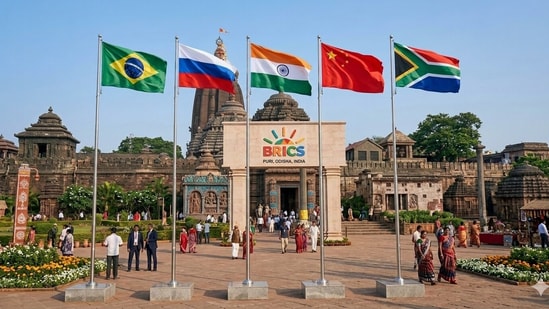
India is ready to host the BRICS summit on September 12-13, 2026. Two central Asian countries, Kazakhstan and Uzbekistan are partner countries and their heads of State are expected to attend the summit in New Delhi. Against this context, it’s important to understand Central Asia’s geopolitical ambitions from the organisation. Central Asian countries approach engagement with BRICS primarily through a pragmatic, interest-driven lens rather than ideological alignment. Kazakhstan and Uzbekistan, the region’s two largest economies, became official BRICS partner countries effective January 1, 2025, following the 2024 Kazan Summit, which formalised the new partner country category. Other Central Asian States have participated in BRICS Plus and Outreach formats. Full membership has been deliberately avoided or postponed, especially by Kazakhstan, which has repeatedly affirmed it has no plans to join as a full member in the foreseeable future. This reflects a careful hedging strategy rooted in long-standing multi-vector foreign policies that seek to balance relations with Russia, China, the West, Turkey, the Gulf states, and others without exclusive alignment to any single power or bloc.
The five Central Asian republics- Kazakhstan, Kyrgyzstan, Tajikistan, Turkmenistan, and Uzbekistan, are landlocked, resource-rich, and infrastructure-constrained. Their interest in BRICS centres on concrete developmental gains while preserving sovereignty and balanced external relations. The Central Asian States seek tangible benefits across several interconnected areas. They pursue economic growth, trade diversification, and alternative financing through enhanced access to markets of major BRICS economies such as China, India, Russia, and the newer members, along with investment free from the strict political or governance conditionalities often associated with western institutions. BRICS members already account for a substantial share of regional trade—nearly half of Kazakhstan’s foreign trade turnover in recent years and more than $25 billion with Uzbekistan, which rose 27% in 2023. Partner status and, in Uzbekistan’s case, accession to the New Development Bank open doors to infrastructure loans, project financing including discussions of multi-billion-dollar packages for irrigation modernisation, mining expansion, energy projects, and transport development, as well as reduced reliance on traditional lenders. This financing is particularly attractive because it comes with fewer intrusive preconditions, offering greater flexibility for national development priorities.
As landlocked countries, they prioritize improved connectivity and infrastructure, focusing on transport corridors including the Middle Corridor or Trans-Caspian route that links China to Europe via the Caspian Sea, the South Caucasus, and Türkiye. They also emphasise energy infrastructure and logistics networks. BRICS platforms complement China’s Belt and Road Initiative and support efforts to develop alternative routes that reduce over-dependence on any single transit country, especially in light of disruptions linked to the war in Ukraine and sanctions on Russia. This diversification of transit options strengthens regional resilience and economic independence.
{{/usCountry}}As landlocked countries, they prioritize improved connectivity and infrastructure, focusing on transport corridors including the Middle Corridor or Trans-Caspian route that links China to Europe via the Caspian Sea, the South Caucasus, and Türkiye. They also emphasise energy infrastructure and logistics networks. BRICS platforms complement China’s Belt and Road Initiative and support efforts to develop alternative routes that reduce over-dependence on any single transit country, especially in light of disruptions linked to the war in Ukraine and sanctions on Russia. This diversification of transit options strengthens regional resilience and economic independence.
{{/usCountry}}Technological cooperation, the green transition, and sustainable development form another key set of aspirations. Central Asian governments show clear interest in technology transfer, digital economy initiatives, renewable energy, efficient resource utilisation, and environmental projects such as water management and desertification control. Uzbekistan has highlighted digital cooperation and the alignment of industrial standards to facilitate market access, while the region as a whole seeks support for green economy transitions that address long-term challenges of the climate crisis and resource scarcity. Greater voice and stability in a multipolar order also matter. Participation offers a platform to engage middle and rising powers, contribute to discussions on global governance reform, food and energy security, and regional political stability without the binding commitments of full membership. It further facilitates deeper ties with non-traditional partners such as India and others beyond the traditional Russia-China axis, helping the region amplify its collective interests on the international stage.
Partner status allows participation in high-level meetings, summits, and technical coordination while avoiding full political entanglement or the multi-stage membership process. Kazakhstan has emphasised practical, results-oriented cooperation in trade, investment, transport connectivity, and innovation while reaffirming its multi-vector approach and strong support for the United Nations. Uzbekistan has advanced further by joining the New Development Bank as the first Central Asian shareholder, unlocking financing opportunities while continuing engagement with the West through the C5+1 platform, WTO accession talks, and European Union partnerships, as well as ties with the Gulf States and Turkey. This selective engagement fits the region’s broader evolution toward acting as middle powers: leveraging geography and resources for autonomy, promoting regional cooperation through C5 and expanded C6 formats that now include Azerbaijan, and balancing major powers rather than aligning exclusively with any bloc.
Central Asian states remain wary of over-dependence—whether on Russian security structures, Chinese debt and investment dominance, or western conditionality. BRICS engagement is viewed as one tool among many for diversification, not a zero-sum choice against western institutions. Challenges include the still-evolving nature of partner status, limited decision-making influence compared to full members, and the need to navigate internal BRICS dynamics involving China, Russia, and India. Full membership could constrain the flexibility that multi-vector policies require, especially at a time when the region is actively building greater collective agency and reducing historical over-reliance on any single external power.
Finally, Central Asia’s aspirations from BRICS are fundamentally developmental and pragmatic: faster economic growth through diversified markets and financing, better infrastructure and connectivity, technological and green advancement, and an amplified voice in global affairs—all while safeguarding strategic autonomy and multi-vector foreign policies. Partner status currently offers the optimal balance, allowing the region to extract value from the grouping without compromising its carefully cultivated independence in an increasingly multipolar world.
(The views expressed are personal)
This article is authored by Pravesh Kumar Gupta, associate fellow, Vivekananda International Foundation, New Delhi.