
 E-Paper



UN’s role in the reconstruction and rebuilding of Gaza
This article is authored by Mehdi Hussain, teaching fellow, Ashoka University.

 Prefer HTon Google


The United Nations continues its efforts to foster peace and negotiate a truce amid the ongoing war in Gaza. Its role in the Israel-Palestine conflict has long focused on facilitating the peace process and supporting an end to the occupation—a mission that persists more than thirty years after the Oslo Accord. The ultimate aim remains a two-State solution, with Israel and a sovereign Palestinian State coexisting peacefully within internationally recognised borders. This vision is grounded in international law, UN resolutions, and prior agreements, with the pre-1967 lines as the reference and Jerusalem serving as the shared capital of both states.
Historically, the UN proposed partitioning Palestine into two States—a Palestinian Arab State and a Jewish State—with Jerusalem under international administration. This plan became the basis for the two-state solution. However, numerous UN-led initiatives have failed to achieve lasting peace. UN Secretary-General António Guterres has warned that the peace process is “at risk of vanishing altogether.” The high-level UN conference on July 28, 2024 was convened against this backdrop and in response to ongoing humanitarian violations in Gaza.
A significant obstacle to UN-led peace efforts is the extensive political and military support provided by western powers to Israel, often justified under the notion of “the right to self-defence.” While Israel has increasingly disregarded the two-State framework, the Palestinian leadership has broadly welcomed it, contributing to recurring cycles of conflict. Nevertheless, the UN conference’s concept note reaffirmed that international consensus on the two-State solution “still enjoys near-universal support.”
Beyond diplomacy, the UN plays a critical role in Gaza’s reconstruction. It coordinates humanitarian assistance, mobilises international donors, facilitates aid delivery, and implements long-term recovery programs aimed at restoring essential infrastructure, including housing, schools, hospitals, and water and electricity networks.
Various UN agencies have been deeply involved in these efforts over successive conflicts. Following the 2009 Israeli military operation “Cast Lead”, which resulted in over 1,300 Palestinian deaths and extensive destruction of homes and schools, UNRWA provided temporary shelters, food assistance, and emergency education, while UNDP focused on rebuilding infrastructure, livelihoods, and public services. After the eight-day escalation in November 2012, UNICEF worked to repair water and sanitation facilities, and the UN Secretary-General called for an immediate ceasefire.
During the 2014 conflict, which left over 2,200 Palestinians dead and around 18,000 homes destroyed, the UN again played a leading role. The Cairo Conference on Palestine: Reconstructing Gaza, held in October 2014 and co-organised by Egypt and Norway, mobilised $5.4 billion in pledges. In September 2014, the Gaza Reconstruction Mechanism was established to balance Israel’s security concerns with urgent reconstruction needs, with UNDP and UNRWA supporting thousands of families in rebuilding their homes by 2017.
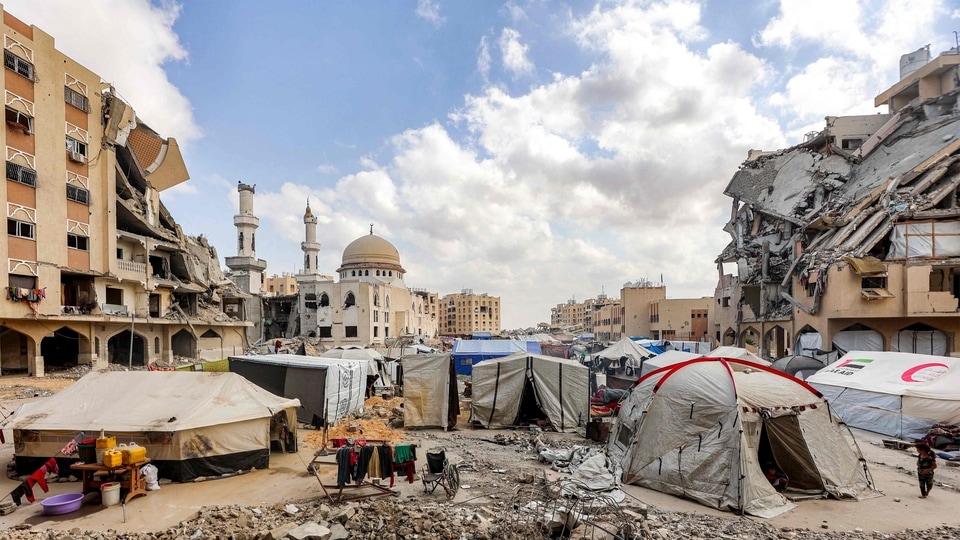
Following the 2021 conflict, which displaced approximately 113,000 Palestinians and damaged infrastructure, including power plants, sewage systems, and schools, UNRWA issued a $95 million emergency appeal for humanitarian and reconstruction needs. The post-October 2023 military campaigns inflicted unprecedented devastation: as of mid-2025, over 65,000 Palestinians were killed, and more than 1.9 million were displaced. A recent UN damage and needs assessment report states that over 60 per cent of homes (around 292,000) and 65 per cent of the road network have been destroyed across Gaza’s roughly 360-square-kilometre territory, producing some 51 million tons of rubble across former residential and commercial districts.
Israeli blockades, restricted access, and attacks on humanitarian convoys have complicated the UN’s work. In 2024, UNICEF described Gaza as “the most dangerous place in the world to be a child,” yet continues to deliver clean water, vaccines, and essential services. The UN has repeatedly called for safe humanitarian corridors, which remain largely unestablished. With 88% of Gaza under evacuation orders or within militarised zones, UN relief and reconstruction efforts face severe limitations, leaving over two million Palestinians confined to approximately 46 square kilometres without adequate services. Last August, one in five children diagnosed with acute malnutrition also required life-saving nutritional support and treatment from UNICEF. Moreover, the severity of the problem intensified in August, with 23% of children admitted for treatment of severe acute malnutrition from 12% six months earlier.
As a signatory to the UN Convention on the Prevention and Punishment of the Crime of Genocide, Israel’s ongoing violations in Gaza remain a serious concern. The UN General Assembly resolution in October 2023 called for an “immediate, durable, and sustained humanitarian truce” and an end to hostilities. SG António Guterres emphasised that “ending the immediate crisis is not enough,” stressing the need for a political framework to underpin Gaza’s recovery, reconstruction, and lasting stability.
Moving forward, the UN must continue to strengthen coordination among international donors, regional partners, and Palestinian authorities to ensure reconstruction efforts are comprehensive, sustainable, and resilient to future conflicts. Establishing secure humanitarian corridors, lifting access restrictions, and prioritising essential services will be critical for the survival and dignity of Gaza’s population.
Equally important is the reinforcement of a political framework that restores trust, supports a viable two-State solution, and provides a clear roadmap for lasting stability. Investment in education, health care, and infrastructure, coupled with targeted support for children and vulnerable populations, will help build the foundations for a self-sustaining society. On September 16, the UN Independent International Commission of Inquiry on the Occupied Palestinian Territory declared that Israel has committed genocide against Palestinians. It has been called for its end under international law. However, the UN SC failed to pass a ceasefire resolution for the sixth time due to the US veto against it, while 14 other UN SC members voted in favour.
The dedication of UN staff and humanitarian workers remains central to these efforts, but their impact depends on sustained international solidarity, adequate funding, and political commitment from all stakeholders. The international community’s isolation of Israel through a formal recognition of a two-State solution, including its closest allies—Britain, Canada, Australia (France and others are likely to announce soon), is a significant development in ending the Israeli onslaught and clearing a path to humanitarian intervention. Now, almost 160 of the 193 UN member States have recognised a Palestinian state. These countries should break the blockades against humanitarian aid by combining immediate relief with forward-looking reconstruction and peace initiatives. The UN framework, having vast experience in providing humanitarian assistance to conflict-affected people, can help transform Gaza from a landscape of devastation into one of hope, resilience, and opportunity for future generations.
This article is authored by Mehdi Hussain, teaching fellow, Ashoka University.


