On June 23, 2026, Chief Justice of India Justice Surya Kant and Chairman of the Supreme Court of the Russian Federation Igor Krasnov signed a Memorandum of Understanding (MoU) in Moscow to promote judicial cooperation in Moscow. This agreement focuses on exchanging legal knowledge, best practices in court administration, judicial training, digital justice, artificial intelligence in courts, and upholding the rule of law with human judgment at its core.
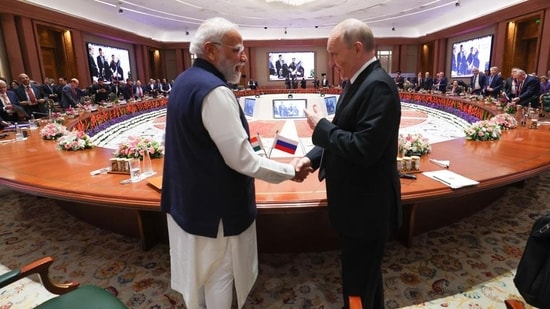
While it may appear technical, this development carries substantive weight for bilateral relations, economic resilience, and the evolving architecture of global governance. In an era of geopolitical fragmentation, judicial ties represent a quiet but powerful layer of institutional depth.
India and Russia share a relationship often described as a “special and privileged strategic partnership,” built on decades of defence, energy, nuclear, and diplomatic cooperation. This judicial MoU extends that partnership into the legal sphere, moving beyond traditional high-politics into the operational domain of dispute resolution, cross-border transactions, and institutional modernisation.
Existing frameworks, such as the bilateral treaty on mutual legal assistance in civil and commercial matters, already provide for access to courts, recognition of judgments, and legal aid. The new MoU builds on these by fostering direct institutional dialogue between the apex courts. It signals a commitment to proactive collaboration rather than reactive problem-solving.
Bilateral trade has surged, driven largely by discounted Russian oil, but also expanding into other sectors. As economic relations scale up, legal friction points multiply: Contract enforcement, sanctions-related force majeure clauses, choice of governing law, arbitration, and cross-border insolvency. Without aligned judicial practices, these issues risk becoming bottlenecks.
{{/usCountry}}Bilateral trade has surged, driven largely by discounted Russian oil, but also expanding into other sectors. As economic relations scale up, legal friction points multiply: Contract enforcement, sanctions-related force majeure clauses, choice of governing law, arbitration, and cross-border insolvency. Without aligned judicial practices, these issues risk becoming bottlenecks.
{{/usCountry}}Experts have noted that deeper legal harmonisation is now essential as ties shift “from exploratory trade into sustained cooperation at scale.” A standing interface between judiciaries can reduce uncertainty, clarify enforcement mechanisms, and build confidence for businesses. In a sanctions-heavy environment, reliable bilateral legal channels help insulate practical commerce from broader geopolitical headwinds.
Without the signing of a mobility agreement between the two countries, judicial cooperation will provide practical benefits extending to family law (e.g., child custody across borders), commercial disputes, and enforcement of arbitral awards. Enhanced cooperation lowers transaction costs and risks, making deeper economic engagement more feasible for Indian firms in Russian markets and vice versa.
Both countries operate large, complex judicial systems facing similar pressures: case backlogs, the need for digital transformation, integrating AI tools responsibly, and balancing efficiency with judicial independence. The MoU’s emphasis on court administration, technology, and training offers mutual gains.
India has advanced e-courts initiatives and virtual hearings, accelerated post-pandemic. Russia has pursued its own digital reforms. Exchanging experiences on AI-assisted case management, data privacy in judicial records, and maintaining public trust in tech-enabled justice can accelerate progress in both nations. Crucially, the agreement underscores that technology should augment, not replace, human judgment— a timely reminder amid global debates on algorithmic decision-making.
Such exchanges also strengthen judicial independence and the rule of law as shared values, even as legal traditions differ (common law influences in India versus civil law foundations in Russia). Dialogue fosters mutual understanding without harmonising systems wholesale.
In a world increasingly divided into blocs, this MoU exemplifies India’s strategic autonomy and preference for diversified partnerships. It keeps Russia constructively engaged without isolating it, aligning with New Delhi’s vision of a multipolar order. Cooperation through forums like BRICS and SCO gains practical substance when backed by judicial-level ties.
It also counters narratives of rigid East-West divides. Judicial diplomacy is less visible than defense deals but builds long-term resilience and trust. High-level visits by chief justices humanise institutions and create networks that endure political shifts.
For Russia, deeper ties with India provide a vital link to the Global South and economic and geopolitical alternatives. For India, they diversify options in energy security, defence technology, and international law perspectives on issues like maritime rights or sanctions regimes.
Implementation will determine impact. MoUs are frameworks, not guarantees. Differences in legal systems, language barriers, and varying priorities on issues like data localisation or enforcement standards require sustained effort through joint working groups, judge exchanges, and academies. Geopolitical risks persist. Western sanctions complicate banking, insurance, and logistics, testing the resilience of legal arrangements. Success depends on translating high-level intent into workable protocols for lower courts and practitioners. Broader questions remain about balancing cooperation with universal norms on human rights and due process, though the agreement centres on technical and administrative collaboration.
This judicial MoU is more than symbolic. It equips a vital strategic partnership with better legal infrastructure for the 21st century. By addressing practical needs in trade, technology, and dispute resolution while fostering institutional empathy, it contributes to relationship stability amid global turbulence.
In an interconnected yet contested world, robust judicial bridges matter. They reduce friction in commerce, accelerate justice system modernisation, and quietly reinforce the multipolar architecture both nations champion. As CJI Surya Kant’s visit demonstrates, investing in judicial diplomacy is a prudent, forward-looking choice—one that recognises law as both a mirror of state relations and a foundation for their future depth.
(The views expressed are personal)
This article is authored by Pravesh Kumar Gupta, associate fellow (Eurasia), Vivekananda International Foundation, New Delhi.