Starting today to April 21, 2026, South Korean President Lee Jae Myung will visit India. He will be accompanied by First Lady Kim Hea Kyung and a high-level delegation comprising ministers, senior officials, and business leaders.
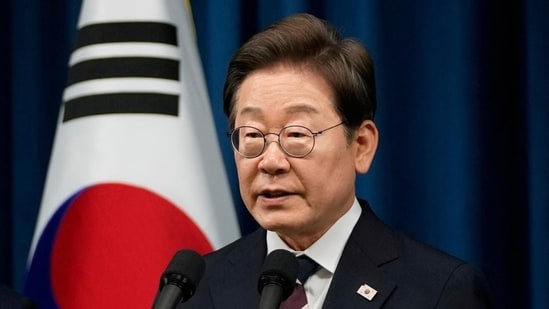
His visit is expected to emphasise on India-Korea cooperation in maritime and shipbuilding, finance, AI, semiconductors, critical and emerging technologies, defense, energy supply chains, and cultural exchanges.
President Lee’s visit to India is noteworthy, as it comes after a gap of seven years since the last president or prime minister (PM) level visit. In 2019, PM Narendra Modi visited Seoul at the invitation of then-President Moon Jae-in. In the years following that visit, engagement at leadership level has remained limited. First, the visits were constrained due to the pandemic. Second, under the conservative Yoon Suk Yeol administration (2022-2025), South Korea’s foreign policy centered upon the US-ROK (Republic of Korea) alliance and cooperation with Japan. On the other hand, progressive governments of Moon Jae-in (2017-2022) and Lee Jae Myung (2025~) pursued diversification beyond East Asia.
High-level diplomatic engagement is crucial to maintain the momentum of bilateral relations. However, since there was no push from both countries to do so, joint initiatives of both countries began to lose traction. The break-off has had ripple effects in key areas such as trade. Even after over 12 rounds of negotiations, both countries have failed to resolve their differences and upgrade the Comprehensive Economic Partnership Agreement (CEPA), in effect since 2010. India and South Korea trade still hovers around $ 21.5 billion (as of October 2025), way below their ambitious goal of reaching $ 50 billion by 2030.
{{/usCountry}}High-level diplomatic engagement is crucial to maintain the momentum of bilateral relations. However, since there was no push from both countries to do so, joint initiatives of both countries began to lose traction. The break-off has had ripple effects in key areas such as trade. Even after over 12 rounds of negotiations, both countries have failed to resolve their differences and upgrade the Comprehensive Economic Partnership Agreement (CEPA), in effect since 2010. India and South Korea trade still hovers around $ 21.5 billion (as of October 2025), way below their ambitious goal of reaching $ 50 billion by 2030.
{{/usCountry}}Furthermore, when Seoul unveiled its Indo-Pacific Strategy in December 2022, it disappointed Indian analysts as Southeast Asia received relatively larger focus than India in South Korea’s engagement in the Indo-Pacific. Even in 2023, the year that marked the 50th anniversary of India-South Korea diplomatic relations, there was no commemorative bilateral summit. This reinforced the discourse that India and South Korea lack political will of convergence.
Moreover, both continue to face challenges in defense cooperation. Despite the broad array of dialogues, proposals, and MoUs, India-South Korea defence collaboration has not been able to yield outcomes beyond the K9 Vajra-T Howitzers. Several ventures such as the minesweepers deal or the procurement of advanced diesel-electric attack submarine with the AIP systems, were stalled or cancelled due to bureaucratic divergences. Also, there remains issues related to trust deficit, market perceptions, and technology transfer.
Against such backdrop, President Lee’s visit to India can serve as a turning point for India-South Korea relations. This visit has the potential to frame the bilateral ties as India-South Korea Relations 2.0. The visit has the ability to push India and South Korea to go beyond their traditional frameworks and strengthen cooperation in strategic areas such as shipbuilding, AI, clean energy, and critical technologies.
Given the rising economic uncertainty due to the US tariff adventurism and the current ongoing energy supply disruptions, middle powers are diversifying with like-minded partners. In April 2025, both India (26%) and South Korea (25%) were impacted by the US’ reciprocal tariffs. Since then, both are seeking partners that can help insulate their supply chains and also reduce dependency on any single power.
In this context, India and South have found renewed relevance to reinvigorate their ties. While India is diversifying, South Korea is looking beyond Northeast Asia. For instance, a month after swearing as president, Lee Jae Myung sent a special envoy delegation to India, alongside the EU, France, and the UK in July 2025. By placing India in the same bracket as the key western partners, South Korea highlighted the importance of India as its strategic partner.
India and South Korea share a Special Strategic Partnership since 2015. Nonetheless, the paucity in their relations and the absence of sustained attention toward each other have questioned the special nature of their ties. However, President Lee’s trip to India along with more than 200 South Korean companies, has the potential to make the partnership both special and strategic.
While there are diverse areas of cooperation, one of the most important areas of collaboration is shipbuilding. Both have already signed several MoUs on the same. For instance, in 2025, Cochin Shipyard Limited (CSL) signed a comprehensive MoU with South Korea’s HD Korea Shipbuilding & Offshore Engineering Co. Ltd. (KSOE). The MoU goes beyond commercial agreement and focuses on long-term cooperation, technology sharing, and joint global opportunities. In December 2025, ministry of defence and ministry of ports, shipping, and waterways, BEML Limited signed MoU with HD KSOE and HD Hyundai Samho Heavy Industries (HSHI). The MoUs will bring both countries to jointly design, develop, manufacture, next-generation maritime and port crane ecosystem in India.
Also, in April 2026, the ministry of ports, shipping and waterways signed a Plan of Implementation with Korea International Cooperation Agency (KOICA) for strengthening skill development in India’s shipbuilding sector under Maritime Amrit Kaal Vision 2047. To further support such initiatives, the Indian government has announced a Maritime Development Fund and has planned clusters across Maharashtra, Andhra Pradesh, Gujarat, Odisha, among many others.
While shipbuilding cooperation will reduce India’s exposure to foreign vessels, it will also provide South Korea a competitive manufacturing base, proximity to major global trade routes, skilled workforce, and an opportunity to expand its global shipbuilding footprint beyond East Asia.
The discussions are also expected to centre upon cooperation in clean energy as in March 2026, India’s Reliance Industries Limited (RIL) and Samsung C&T Corporation entered into a long-term binding Supply and Purchase Agreement (SPA). As per the agreement, India will export green ammonia to South Korea, which aligns with India’s National Green Hydrogen Mission (NGHM).
Such agreements mark a second wave of Korean investments in India and helps South Korea expand beyond automobiles and electronics.
The visit holds the potential to fast track halted negotiations and resolve differences at pace. For instance, India and the European Union Free Trade Agreement (FTA) sets an example of overcoming political differences and stalled negotiations to move agreements forward quickly. It yet remains to see whether India and South Korea would be able to turn the crisis into opportunity and recalibrate their engagement.
Even if both countries manage to revitalise their relations, then for how long can both continue to maintain the momentum. Currently, the turbulent world order is creating a window for both to revive their relations. However, the real challenge lies when the uncertainty fades away and things become normal.
As India and South Korea move forward with strategic cooperation, both must also focus on people-to-people ties. Connections build cultural understanding, reduce mental gaps, and develops strong bonding, which will help India and South Korea sustain the diplomatic momentum even in the absence of external shocks.
(The views expressed are personal)
This article is authored by Torunika Roy, research associate, Korea Chair, Council for Strategic and Defence Research (CSDR), New Delhi.