The greatest vote of no confidence in India’s education system is cast not in Parliament but by millions of parents every year. They pay taxes to support public education, school fees to educate their children and, increasingly, substantial sums for private coaching because they no longer believe that schooling alone is enough. Few realities expose the weaknesses of Indian education more starkly than this. A nation that compels families to seek a second education after the first has already admitted that something fundamental is wrong.
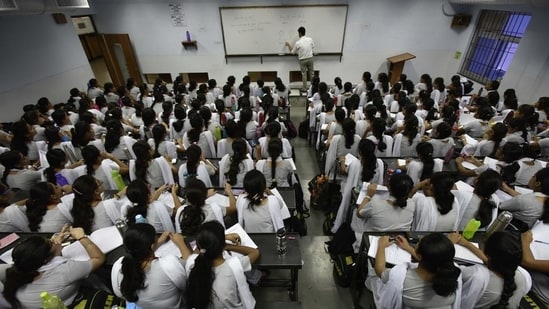
The spectacular rise of coaching centres is often celebrated as an entrepreneurial success story. They have undoubtedly helped many students achieve their aspirations and filled important gaps in a highly competitive environment. Yet their extraordinary growth also reveals a deeper institutional failure. Coaching was conceived as supplementary academic support. Today, it has evolved into a parallel education system that shapes how students study, how parents invest, how examinations are approached and, increasingly, how success itself is defined. When society places greater faith in commercial coaching than in formal schooling, the problem is no longer about private enterprise; it is about the declining authority of the classroom.
Schools were never meant to function merely as gateways to competitive examinations. Their purpose is to develop curiosity, critical thinking, communication, ethical judgment and intellectual independence alongside academic competence. Coaching institutes serve a different objective. They specialise in helping students maximise performance in specific examinations through disciplined preparation and strategic practice. Both have legitimate roles, but they are not interchangeable. The danger arises when examination preparation begins to replace education itself. Learning gradually becomes synonymous with scoring marks, while imagination, creativity and deeper understanding are pushed aside because they do not immediately improve rankings.
The consequences are visible across the country. Students increasingly organise their lives around entrance examinations rather than education in its broader sense. Endless mock tests, performance charts and percentile comparisons often replace intellectual exploration. Sports, literature, the arts and meaningful social engagement are treated as distractions because they do not contribute directly to examination success. The purpose of education quietly shifts from nurturing capable human beings to producing successful candidates. That may improve rankings, but it cannot alone build the innovative, adaptable workforce that a knowledge economy requires.
{{/usCountry}}The consequences are visible across the country. Students increasingly organise their lives around entrance examinations rather than education in its broader sense. Endless mock tests, performance charts and percentile comparisons often replace intellectual exploration. Sports, literature, the arts and meaningful social engagement are treated as distractions because they do not contribute directly to examination success. The purpose of education quietly shifts from nurturing capable human beings to producing successful candidates. That may improve rankings, but it cannot alone build the innovative, adaptable workforce that a knowledge economy requires.
{{/usCountry}}This culture also imposes a heavy social cost. Families routinely spend a significant share of their income on coaching because they fear their children cannot compete without it. Students grow up believing that every examination determines their future and that every setback is irreversible. Such relentless pressure inevitably contributes to anxiety, emotional exhaustion and an unhealthy understanding of success. An education system should cultivate confidence and resilience, not leave young people convinced that their worth depends entirely upon a rank or percentile.
The coaching economy has also complicated the idea of merit. Competitive examinations are designed to reward talent and hard work, yet expensive coaching has increasingly become an unwritten prerequisite for success in many fields. Students from affluent families can access multiple coaching programmes, personalised mentoring and sophisticated learning resources, while those from less privileged backgrounds often rely solely on schools with limited academic support. Merit, therefore, risks becoming inseparable from purchasing power. Equal opportunity begins to weaken long before the examination hall is reached.
Equally concerning is the recurring loss of public confidence caused by repeated paper leak scandals. Investigations into several major examination leaks have exposed organised criminal networks seeking to profit from high-stakes tests. In some cases, individuals connected to the broader coaching ecosystem have also come under investigation. It would be unfair to portray the entire coaching industry as complicit, as the overwhelming majority of institutes operate lawfully. Nevertheless, these episodes reveal how an examination system carrying enormous financial and social rewards can create incentives for organised malpractice. The lesson is not that coaching causes paper leaks, but that a high-stakes ecosystem without robust safeguards becomes vulnerable to corruption.
India's education debate often celebrates ambitious reforms, competency-based learning and holistic development. These are important goals, but they will remain incomplete unless schools regain the confidence of students and parents. Stronger classrooms, better teacher support, fairer examinations that reward conceptual understanding, uncompromising examination security and sensible regulation of the coaching sector are no longer optional reforms; they are essential to restoring faith in education itself.
India does not need fewer coaching institutes. It needs schools that are so academically rigorous and trusted that coaching once again becomes an option rather than a necessity. The true measure of educational success will not be the number of ranks produced by coaching centres but the day an ordinary student can walk into an ordinary classroom with complete confidence that excellent schooling alone is sufficient to compete with the very best.
(The views expressed are personal)
This article is authored by Debika Dutta, columnist, Mangaldai, Assam.