
 E-Paper



India scale-up summit charts the future of evidence-driven change
This article is authored by Aparajitha Nair, research scholar, Jamia Millia Islamia, Delhi.

 Prefer HTon Google


The India Scale-Up Summit, held on September 23 at the India Habitat Centre in New Delhi under the aegis of J-PAL South Asia’s ASPIRE initiative, positioned itself as more than a gathering of experts. It became an exercise in interrogating the deeper structures through which evidence, politics and institutions interact to produce lasting developmental outcomes. In a policy environment often dominated by the rhetoric of innovation and disruption, the summit asked a more difficult question: What does it take to translate promising interventions into durable systems of change?
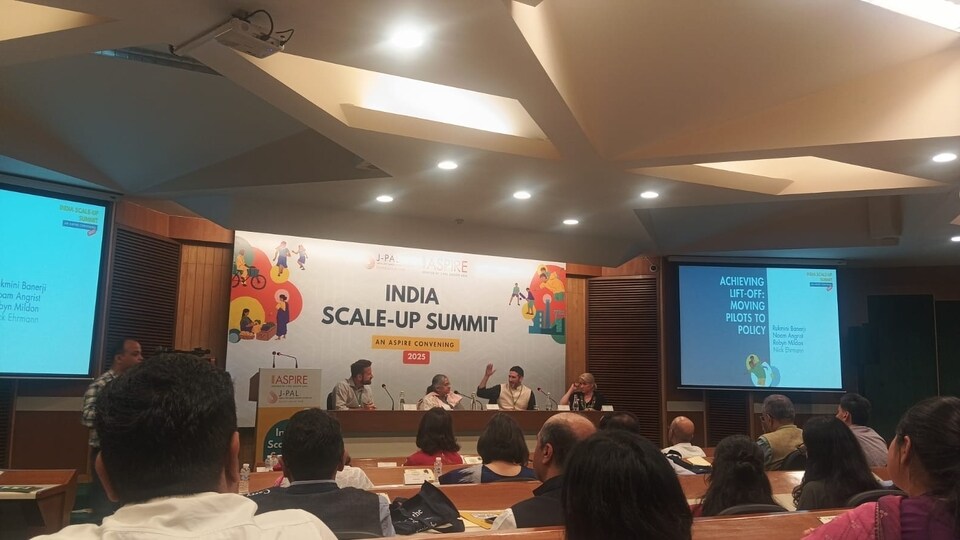
The initial conversations framed scale not as an act of replication but as a dynamic process of embedding tested interventions into evolving public systems. Speakers such as S Krishnan, Iqbal Dhaliwal and Shobhini Mukherji underscored that the measure of success is not the multiplication of pilots but the institutionalisation of evidence within bureaucratic, political and civic structures. The analytical shift here lies in recognising that scale is less about numbers and more about governance: Evidence must inform design, delivery and iterative adaptation, thereby transforming the State’s capacity to learn. Such a framing departs from the conventional assumption that innovations can simply be “rolled out.” Instead, it stresses that scale demands a living infrastructure of accountability and feedback, where policy itself becomes experimental and reflexive.
Equally revealing was the emphasis on the human and institutional negotiations that determine whether an innovation survives beyond its trial phase. The discussion among practitioners, funders and policymakers in the session “Pracademically Speaking” foregrounded how motivations, credibility and resources intersect in often unpredictable ways. The summit’s design implicitly acknowledged that social change is not a technocratic exercise. Rather, it is mediated by actors who must constantly reconcile professional incentives organisational constraints and the limited elasticity of public finance. Evidence, in this context, is necessary but insufficient. It requires the scaffolding of trust, legitimacy and coalitions across the fragmented spaces of state and society.
J-PAL’s own ASPIRE framework, presented in detail during the summit, illustrates an attempt to systematise this process. By identifying interventions with demonstrable promise, supporting them through the uncertainties of institutional adoption and sustaining them across political cycles, ASPIRE represents an evolving model of how external actors can align research with governance. Yet even here, the challenge lies in balancing rigour with adaptability. The very notion of “cracking the code of scale” hints at the tension between codifying processes and recognising that context-specificity resists universal templates. The Indian developmental landscape, with its diversity of State capacities, political will and civic engagement, only sharpens this paradox.
A particularly rich discussion emerged when the summit turned to the problem of fidelity. As Rukmini Banerji’s reflections on Pratham’s Teaching at the Right Level demonstrated, scaling entails the constant risk of dilution: the wider an intervention spreads, the greater the pressure to adapt, simplify or compromise. Yet fidelity to the core mechanism of success must be preserved. The broader lesson here is that scaling requires not merely administrative expansion but a deep pedagogical effort—clarifying what is non-negotiable in a model and what can be reconfigured. Comparative insights from international participants such as Robyn Mildon and Noam Angrist showed that this dilemma is not uniquely Indian but part of a global struggle to prevent innovation from becoming hollow when institutionalised.
Capital, occupied a central place in these debates. The summit’s exploration of philanthropy moved beyond a transactional view of funders as resource providers. Instead, philanthropy was reimagined as catalytic, capable of absorbing risks that governments cannot, convening diverse actors and bridging the chasm between isolated success and system-wide adoption. Yet the conversation also surfaced the fragility of such arrangements. Misaligned funding, donor-driven agendas and short political cycles can destabilise even the most promising interventions. Thus, while philanthropy may lubricate the machinery of scale, it cannot substitute for institutional resilience. The more fundamental question becomes how systems can outlast the ebbs and flows of capital, whether philanthropic or state-based.
Technology and digital infrastructure also emerged as sites of experimentation. The discussions around digital public goods illustrated an increasingly important trajectory for Indian governance: the creation of platforms that enable co-creation between state, market and civil society. But the summit’s framing implicitly suggested that digital tools are not neutral. They embody governance choices about who participates, who is excluded and how accountability is distributed. To invoke platforms as playgrounds, as Shankar Maruwada did, is to highlight their potential as well as their politics. Scale mediated through technology must therefore be analysed not only in terms of efficiency but also equity.
The India Scale-Up Summit’s achievement lay in resisting the temptation of triumphalism. By foregrounding the tensions—between evidence and politics, fidelity and adaptation, capital and sustainability—it offered a more nuanced vision of development. For India, a country where inequality and diversity complicate every effort at policy design, this vision is especially pertinent. Scale, the summit suggested, is neither a sprint nor a blueprint. It is a relay across institutions, actors and contexts, measured not in numbers but in whether the systems that remain are capable of learning, adapting and enduring.
This article is authored by Aparajitha Nair, research scholar, Jamia Millia Islamia, Delhi.


