
 E-Paper



Rebuilding Gaza: Aid as a pathway to peace
This article is authored by Gunwant Singh, scholar, international relations and security studies, Jawaharlal Nehru University, New Delhi.

 Prefer HTon Google


The images from Gaza today are haunting reminders of what war does to people and places. Entire neighborhoods lie flattened, hospitals run on dwindling fuel supplies, and children stare blankly at rubble that was once their home. In such a landscape, the words aid, reconstruction, and rebuilding go beyond development jargon; they become the difference between survival and collapse, between despair and a fragile hope for peace. Yet, delivering humanitarian assistance to Gaza is not merely a matter of resources; it is entangled in political, logistical, and ethical dilemmas that test the conscience of the world. The moral urgency is undeniable: victims require immediate relief, but the road to effective aid and long-term reconstruction is littered with formidable obstacles.
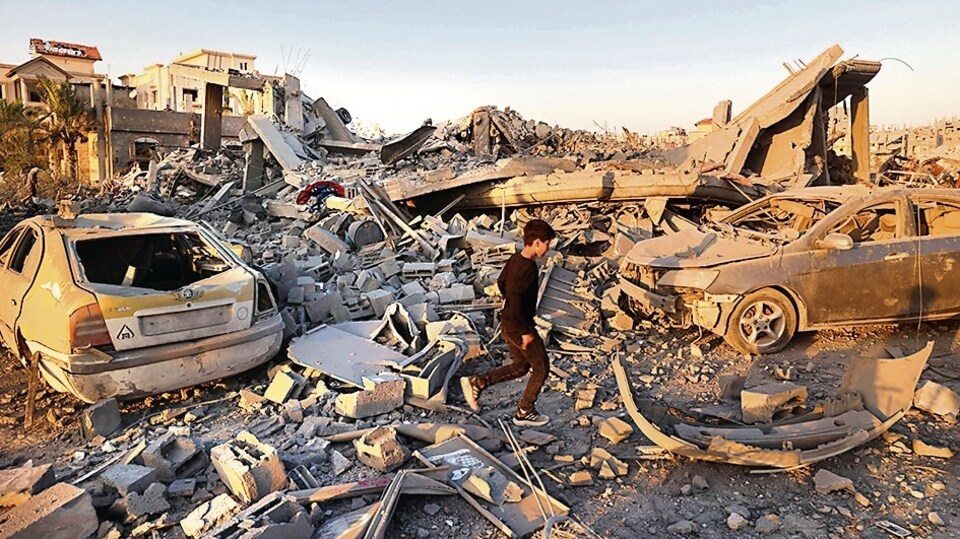
Providing humanitarian assistance in Gaza has long been a challenge, but the present crisis has made it exceptionally difficult. Humanitarian agencies face blockades, security restrictions, and a volatile environment where ceasefires are fragile at best. Convoys of food, medicine, and shelter materials often wait at checkpoints for days, sometimes weeks, before being allowed entry. In the meantime, families without clean water and hospitals without surgical supplies continue to suffer. The difficulty of delivering aid in this context is compounded by the sheer density of Gaza’s population. With over two million people crammed into a narrow strip of land, even minor disruptions in supply chains cause severe humanitarian consequences. The urgency of aid is therefore not just about quantity but also about timeliness, as every delay deepens the suffering.
Another core challenge is the politicisation of aid. In conflict zones, humanitarian assistance is rarely neutral in the eyes of warring parties. In Gaza, aid convoys are often suspected of being exploited for political gain or diversion, and international donors worry about their resources being co-opted by armed groups. This dilemma places aid agencies in a precarious position, as they are compelled to navigate between upholding humanitarian neutrality and operating within a highly securitised and politicised environment. For victims on the ground, this means that vital supplies can be weaponised in the conflict, turning the right to humanitarian relief into a bargaining chip rather than a guarantee.
The devastation in Gaza also poses the massive task of reconstruction, which is far more complex than simply rebuilding physical structures. Entire schools, residential areas, power plants, and hospitals have been destroyed or rendered inoperative. Rebuilding them requires not only vast financial investment but also assurances of sustained peace and stability conditions that remain elusive. Experience shows that rebuilding without addressing the root causes of conflict risks a cycle of destruction and reconstruction that drains resources and prolongs trauma. Hence, the challenge lies in ensuring that reconstruction efforts do not simply restore the status quo ante but instead lay the foundations for resilience, dignity, and hope.
Equally daunting is the challenge of psychosocial rebuilding. Beyond the visible rubble, there is the invisible wreckage of human lives. A generation of children has grown up amidst repeated bombardments, their education disrupted, their sense of normalcy shattered. Aid in Gaza, therefore, cannot be limited to food parcels and tents. It must include long-term investment in education, mental health support, and community resilience programmes. Without this, the physical rebuilding of Gaza will remain hollow, as the scars carried by its people will continue to fester. Yet such programs are often the first to be cut when resources are scarce, as emergency relief understandably takes priority.
The international community must also grapple with questions of responsibility and coordination. Humanitarian efforts in Gaza involve a myriad of actors UN agencies, non-governmental organisations, regional states, and global donors. Coordination among these actors is often inadequate, leading to duplication of effort in some areas and neglect in others. The absence of a comprehensive political settlement further complicates matters, as aid agencies cannot rely on stable governance structures to oversee distribution or manage reconstruction. In this vacuum, the victims of war are left at the mercy of fragmented and uneven relief efforts.
Despite these challenges, the case for sustained aid and reconstruction in Gaza remains compelling. It is not simply a matter of charity but of international responsibility. The Geneva Conventions and customary international law affirm the right of civilians in conflict zones to humanitarian relief. Beyond legal obligations, there is a deeper moral imperative: the world cannot remain a passive witness while an entire population is caught in the crossfire of geopolitical disputes. Providing aid is not equivalent to taking sides in the conflict; rather, it is about upholding the fundamental principle of humanity in the face of unimaginable suffering.
If aid and reconstruction are to succeed, they must be tied to a genuine effort to secure peace, however tentative. Truces and ceasefires, even temporary, provide the breathing space needed for humanitarian corridors to function. Every day without fighting is a day when food trucks can move, hospitals can receive supplies, and children can go back to learning. Such truces may be fragile, but they are indispensable stepping stones toward larger political solutions. Peace does not emerge overnight, but humanitarian relief can create the conditions under which dialogue and reconciliation become possible.
India’s own experience with humanitarian assistance, whether in natural disasters or in regional crises, underlines the importance of coupling immediate relief with long-term capacity-building. For Gaza, this means that the international community must look beyond short-term emergency shipments to a vision of sustainable development. Investments in renewable energy, local agriculture, and small-scale industries could reduce Gaza’s dependency on external aid and provide livelihoods to its people. Such an approach would not only rebuild Gaza but also empower it to withstand future shocks.
Ultimately, the challenge of aid and reconstruction in Gaza is not just a logistical or financial one, it is a test of our collective humanity. Wars destroy not only buildings but also trust, hope, and the social fabric of communities. Rebuilding therefore requires more than bricks and mortar; it requires a commitment to justice, dignity, and peace. While political solutions remain contested and distant, the immediate imperative is clear: to alleviate suffering, to rebuild lives, and to remind the people of Gaza that they have not been abandoned.
The haunting images from Gaza demand not silence, but action. Humanitarian aid, reconstruction, and rebuilding are not panaceas, but they are necessary acts of compassion and responsibility. They offer the possibility of restoring a measure of dignity in a land where despair threatens to take root. If the world can mobilise not only resources but also the political will to ensure sustained relief and reconstruction, then perhaps Gaza can look toward a future where peace is more than a fleeting truce, and rebuilding becomes not just an act of necessity, but a foundation for hope.
This article is authored by Gunwant Singh, scholar, international relations and security studies, Jawaharlal Nehru University, New Delhi.


