Alzheimer’s disease, for those genetically at risk, runs on a clock. The brain changes that cause it begin years, often more than a decade, before memory begins to falter. Two new drugs can slow the disease, but only if a doctor catches the pathology early enough to use them. A blood test cleared in the US last year, and now available in India, reads those biomarkers. But it may not be for everyone.
India has an estimated 8.8 million people over 60 living with dementia — the most common cause of which is Alzheimer’s — and the number is expected to rise sharply as the population ages. For most, the diagnosis comes too late, if one arrives at all.
Two kinds of people in India are now booking the test. One has heard about it — often because a parent has dementia — and is wondering whether to run a preventive check. The other has symptoms, or lives with someone who does. What the test can honestly do for those two people is not the same.
How the disease works
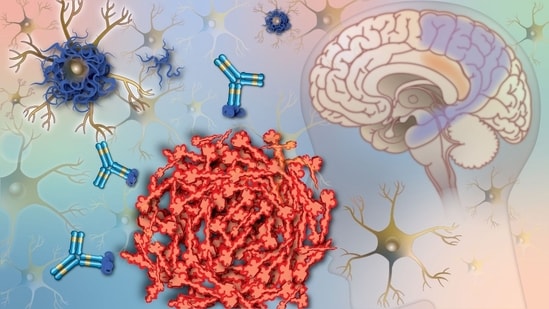
Alzheimer’s disease involves two processes in the brain that unfold over years, often well before symptoms appear. The first is the accumulation of a protein called beta-amyloid, which misfolds and clumps into plaques between brain cells. These plaques are not themselves the damage — they are the early sign that something has gone wrong. The second is the tangling of a structural protein called tau inside the neurons themselves. When tau tangles, neurons die. That is the damage. The two processes are linked — amyloid plaques typically come first, tau tangles follow — and there can be a gap of years between them.
{{/usCountry}}Alzheimer’s disease involves two processes in the brain that unfold over years, often well before symptoms appear. The first is the accumulation of a protein called beta-amyloid, which misfolds and clumps into plaques between brain cells. These plaques are not themselves the damage — they are the early sign that something has gone wrong. The second is the tangling of a structural protein called tau inside the neurons themselves. When tau tangles, neurons die. That is the damage. The two processes are linked — amyloid plaques typically come first, tau tangles follow — and there can be a gap of years between them.
{{/usCountry}}Diagnosis has rested, until now, on clinical assessment — cognitive testing, an account of decline from a family member, and imaging to rule out other causes such as stroke or tumour. The disease is inferred from the pattern of symptoms and the exclusion of alternatives, rather than seen directly in scans, and that inference, by the nature of how it is arrived at, tends to come too late for the clinical interventions that would slow the disease.
The new test — the Lumipulse G pTau 217/β-Amyloid 1-42 Plasma Ratio, made by the Japanese diagnostics company Fujirebio — reads the trace of both processes in a single blood draw. When amyloid is accumulating as plaques in the brain, a specific fragment of it — called Aβ 1-42 — falls in the blood. When neurons are being damaged by tau tangles, a fragment of tau — called pTau 217 — rises. The ratio between the two tracks closely enough with what is happening in the brain that the FDA cleared the test in May 2025 as an aid to diagnosis in adults aged 50 and older presenting at a specialised care setting with signs and symptoms of cognitive decline. Some Indian diagnostic labs have begun offering it in the past year, with home sample collection.
Also Read | Study reveals men's brains shrink faster than women with age, shares what it means for Alzheimer's risk
Not a screening test
The FDA’s own label says the test is “not intended as a screening or stand-alone diagnostic test.” The reason sits in how the trial figures were produced. When it was cleared, the test agreed 92 per cent of the time with a positive amyloid PET or spinal-fluid result, and 97 per cent with a negative one. Those results, however, came from trials in people already referred to specialist memory clinics for symptoms of cognitive decline — a population in which amyloid pathology is far more likely to be present to begin with, and in which the test therefore performs at its sharpest.
In December 2025, at a conference in San Diego, a Mayo Clinic team reported what happened when the same test was run in an ordinary memory clinic. In 252 patients, it still caught most of those who had amyloid pathology in the brain, but confoundingly it also called positive nearly a quarter of those who did not. In a smaller research cohort of 101, the trial figures held. Why the test behaves one way in a trial and another way in a clinic is still being worked out.
Dr Nitin Kumar Sethi, chairman of the PSRI Institute of Neurosciences in Delhi, put the concern plainly: “In the absence of symptoms, these test results may carry a higher risk of false positives.” Dr Ritu Verma, director of nuclear medicine and PET-CT at Mahajan Imaging in Delhi, said the test is “more precise for those who have been diagnosed with cognitive decline symptoms”; those without them have “higher chances of the test giving a false value.”
For those with symptoms
For those with real symptoms, or living with someone who has them, the test matters because two anti-amyloid drugs — donanemab and lecanemab — have arrived in India this year, both approved by the Central Drugs Standard Control Organisation for mild cognitive impairment or mild dementia due to early Alzheimer’s, and both requiring confirmed amyloid pathology before a doctor starts them.
In the US and Europe, doctors can order a different, and more definitive, test after the blood biomarker: either an amyloid PET scan, which uses a radiotracer that binds to amyloid plaques in the brain, or a lumbar puncture to sample cerebrospinal fluid for the same proteins the blood test measures. Sethi and Dr Rajinder K. Dhamija, director of the Institute of Human Behaviour and Allied Sciences (IHBAS) in Delhi, separately said that amyloid PET is not currently available in India, and that spinal-fluid amyloid testing is not routine here.
None of the three amyloid PET tracers used internationally — florbetapir, florbetaben, flutemetamol, the compounds that bind to amyloid plaques and make them visible on the scan — has been approved by CDSCO, and no Indian centre currently offers amyloid PET as a routine clinical service. Cerebrospinal-fluid amyloid and tau panels have begun to be offered by two commercial reference labs in the past year.
Which is to say: the anti-amyloid drugs the blood test is now most useful for pointing towards are on the shelf in India, but both drug labels require confirmed amyloid pathology before a doctor starts the drug, and the blood test’s own label says it is not, on its own, a diagnosis. The second, more definitive test that would confirm the blood result — an amyloid PET scan, or a spinal-fluid panel — is not yet routine here.
For someone without symptoms — asking because a parent had dementia, or because a headline caught their eye — the proven action for Alzheimer’s prevention still lies where has held it for a while now: in blood-pressure management, hearing-loss treatment, physical activity, social and cognitive engagement, sleep. None of it involves a blood draw.
Where symptoms are present, the clinical process runs through specialist assessment first — cognitive testing, family history, imaging to rule out other causes. If a blood biomarker test belongs in the workup, it enters as one piece of it, ordered for a clinical reason.
(Vital explains the science and conversations at the frontier of health and wellness. It isn’t medical advice — what to do with it is a conversation for you and your doctor.)