Fashion has always been political.
But the cannon statement got a colloquially-attested and very mainstream stamp of riot with first, the Scandi-scarf gate pinned around the whole Ibiza-aesthetic - believed by many South Asians to be an unacknowledged rip-off, of their long-standing tradition of 3D-embroidery. Prada's Kolhapuri chappals of course made the sentiment front page news, followed by another mishap in the shape of their Chai-inspired spritz.
And now, Louis Vuitton could very well be in the line of fire.
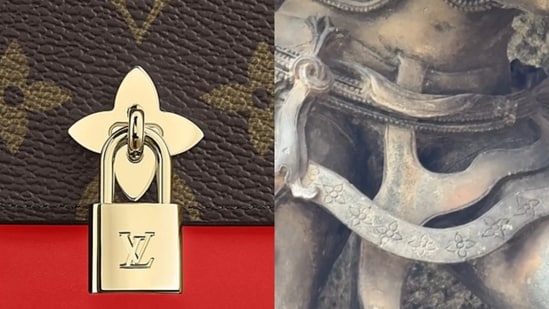
If you believed the entire (very well deserved) hullabaloo around Prada to have been a never-ending storm, what would you say to possibility of the iconic Louis Vuitton flower, being a direct lift from a 12th century Karnataka temple? Australian travel influencer Liam Richards has the first set of receipts.
The lowdown
In an Instagram reel which has now accrued almost 2 million views and over a 100,000 likes, Liam makes quite a damning discovery during his visit to the Chennakeshava Temple in Belur, Karnataka. With a million-dollar camera zoom in to supplement his claims, he said, "I've made a great discovery, groundbreaking in the world of fashion. I found where Louis Vuitton gets their little flower symbol from except they don't credit ancient Indians. It's carved here in stone, 1,000 years ago." And there it is, on the wrist band adorning one of the dancing stone statues, the exact flower motif, which adds to its legacy and gold-dunked price tags of Louis Vuitton. The match is unmistakable.
About the emblem
According to Louis Vuitton, its iconic monogram was conceptualised back in 1896 by Georges Louis Vuitton. The pattern combined stylised floral motifs with the interlocking 'LV' initials as an homage to his father, Louis Vuitton, who had passed away 4 years prior. The house may have never claimed complete artistic autonomy of the emblem - but the historical references no where mention the Karnataka relic. Instead, the listed references span Art Nouveau, Japonism and elements of Gothic heraldry.
What contests it
{{/usCountry}}According to Louis Vuitton, its iconic monogram was conceptualised back in 1896 by Georges Louis Vuitton. The pattern combined stylised floral motifs with the interlocking 'LV' initials as an homage to his father, Louis Vuitton, who had passed away 4 years prior. The house may have never claimed complete artistic autonomy of the emblem - but the historical references no where mention the Karnataka relic. Instead, the listed references span Art Nouveau, Japonism and elements of Gothic heraldry.
What contests it
{{/usCountry}}Well, history, considering, the Chennakeshava Temple, also referred to as Keshava, Kesava or Vijayanarayana Temple of Belur, is a 12th-century Hindu temple. It was commissioned by King Vishnuvardhana in 1117 CE, on the banks of the Yagachi River in Belur, an early Hoysala Empire capital. The temple was built over three generations and took 103 years to finish. Additionally, the temple is also a part of UNESCO’s Sacred Ensembles of the Hoysalas, inscribed in 2023.
Do you believe this to be a coincidence, or another chapter in today's unearthing of colonised fashion?