With nine days of dancing, fasting, and late nights, Navratri season demands plenty of preparation. This year, however, the prep began early with the arrival of a new ritual, one that has less to do with what you wear and more to do with what goes into your bloodstream. A recent viral Reel (1.4M views) by Dr Monika Tibrewal spotlighted IV drips as a way to stay refreshed through the celebrations.
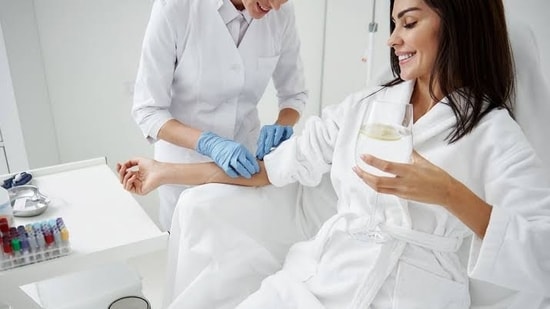
From hydration and vitamin C to B-complex, magnesium, glutathione and NAD infusions, the menu of IV wellness treatments is expanding. But while clinics report growing curiosity around these pre-event infusions, doctors stress that an IV remains an invasive medical procedure and is not entirely a must-have for powering through Navratri.
Beyond weddings
The pre-event IV isn’t entirely new. It has already found a place in the wedding wellness ecosystem, with treatments now extending beyond the brides and grooms to include guests as well. Pooja Doshi, managing director of the wedding design company Elusive Dreams by Pooja Doshi, says, “At destination weddings, where celebrations can stretch across days of late nights, travel, dancing, and alcohol, hosts are looking for better ways to make their guests. This is where IV drip stations come in. The idea is to keep guests refreshed and ready to enjoy every celebration.... Wellness is no longer being treated as a separate, clinical experience, but is being integrated into the hospitality of the wedding itself.”
{{/usCountry}}The pre-event IV isn’t entirely new. It has already found a place in the wedding wellness ecosystem, with treatments now extending beyond the brides and grooms to include guests as well. Pooja Doshi, managing director of the wedding design company Elusive Dreams by Pooja Doshi, says, “At destination weddings, where celebrations can stretch across days of late nights, travel, dancing, and alcohol, hosts are looking for better ways to make their guests. This is where IV drip stations come in. The idea is to keep guests refreshed and ready to enjoy every celebration.... Wellness is no longer being treated as a separate, clinical experience, but is being integrated into the hospitality of the wedding itself.”
{{/usCountry}}What’s changing now is the occasion. The pre-event wedding ritual is now expanding beyond its circuit to become a part of the festive preparation.
Pick your potion? Not quite
There is no one-size-fits-all “Navratri drip”. Dr Deepali Bhardwaj, dermatologist and founder, Elska Clinics, Delhi, says, “Hydration-based drips, vitamin C, B-complex/B vitamins, NAD, magnesium and glutathione are among the commonly requested formulations. The exact combination ideally depends on the person’s health, diet, symptoms and medical requirements rather than following a standard ‘cocktail.’”
These drips often use saline or dextrose (‘sugar’) IV fluids as the base, which are commonly used in medical settings to address dehydration or provide fluids and, in some cases, glucose.
For Dr Karuna Malhotra, cosmetologist, Dr Karunas Cosmetic Skin & Homeo Clinic, Delhi, the demand also reflects different expectations from the treatment. “Hydration-based drips remain popular, especially when people anticipate long days, dancing or travel. Vitamin C, B-complex formulations and glutathione are also frequently requested. Some clients specifically seek antioxidant or skin-focused formulations before events,” she says.
Is the drip necessary?
The idea of prepping for nine nights of dancing may sound appealing, but doctors stress that being healthy and hydrated doesn’t automatically warrant an IV.
Dr Akriti Gupta, founder and chief dermatologist, Jivisha Clinic, Delhi, says, “For a healthy person, there is no automatic medical requirement for an IV simply because of Navratri. Adequate fluids, appropriate nutrition, electrolytes when required and sufficient rest are more important. An IV should address an actual medical requirement, rather than being used as preventive preparation for festival fatigue.”
Dr Bhardwaj agrees, saying, “IV fluids can be useful when there is genuine dehydration or an inability to adequately hydrate orally, or vitamin deficiency, etc but they should not be treated as a shortcut for sleep, nutrition or recovery.”
Dr Bimalpreet Mohan, women’s health expert at Capital Health Clinic, Delhi, says, “Proper hydration, balanced nutrition, adequate rest and recovery remain the foundation for sustaining energy through nine physically demanding nights. If an IV is being considered, it should be based on an individual medical assessment rather than simply following a wellness trend.”
How much does it cost?
Experts say that a single IV session can cost around ₹5,000– ₹18,000, depending on the formulation, ingredients, and the clinic. There is no fixed number of sessions needed for Navratri, but some clinics recommend festive packages with a course of 4–6 sessions, with one session a month, depending on individual needs.
Medical reality check
Despite being packaged as wellness experiences, doctors warn that IV procedures come with risks.
“An IV should have a clear clinical reason behind it and the appropriate drip should be selected based on available clinical reports. Administering IV randomly can have serious side effects such as dizziness, pale face, cramps and high fever,” warns Dr Akanksha Singh, senior cosmetologist, SENS Clinic, Delhi. Dr Bhardwaj adds, “IV therapy is not risk-free. There can be pain, bruising, phlebitis, infection, allergic reactions, fluid or electrolyte disturbances and, depending on the ingredients and dose, effects on the kidneys, heart or other organs. The risks increase when high doses or unnecessary combinations are used.”
Despite it being marketed to keep you going through the festive season, it does guarantee sustained energy for nine nights. Staying hydrated, eating well, getting enough electrolytes and sleeping adequately still matter most.