Special judge Pranjal Das, who ordered his release, said that blockades might cause inconvenience to people but they do not constitute a terrorist act if unaccompanied by incitement to violence.
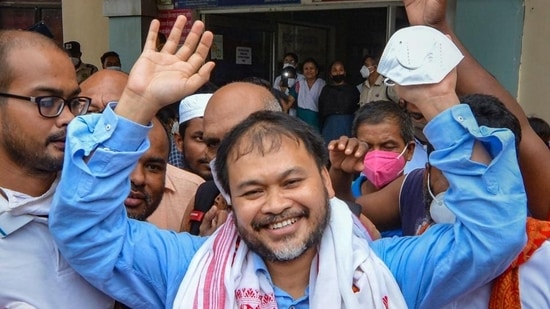
Assam’s 45-year-old activist-politician Akhil Gogoi walked free after 18 months in captivity on Thursday after a National Investigation Agency (NIA) court discharged him in connection with a second case under the anti-terror law related to protests against the Citizenship Amendment Act (CAA).
MLA from Sibsagar and RTI activist, Akhil Gogoi after a special National Investigation Agency (NIA) court discharged him from the remaining case in Guwahati on Thursday. (PTI)
{{^htLoading}} {{/htLoading}}
Special judge Pranjal Das, who ordered his release, said that blockades might cause inconvenience to people but they do not constitute a terrorist act if unaccompanied by incitement to violence. Das also said the conduct and approach of NIA and the prosecution was “discouraging”.
{{^usCountry}}{{/usCountry}}
“Ordinary bandhs, blockades, shut downs as part of some protests, unaccompanied by incitement to violence would not come under the ambit of the expression- ‘threatening the economic security of India’ under section 15(1) of Unlawful Activities (Prevention) Act,” special judge Das said in his verdict. “Protests in a democracy are sometimes seen to take the form of blockades also, even causing inconvenience to citizens. However, it is doubtful whether such blockades for temporary periods, if unaccompanied by any incitement to violence, would constitute a terrorist act within the meaning of section 15 of UA(P) Act,” the court order added.
{{^htLoading}} {{/htLoading}}
{{^usCountry}}
On June 22, special judge Pranjal Das discharged him in the first terror case against him in connection with the anti-CAA protests. The NIA is yet to react to the verdict.
{{/usCountry}}
{{#usCountry}}
On June 22, special judge Pranjal Das discharged him in the first terror case against him in connection with the anti-CAA protests. The NIA is yet to react to the verdict.
{{/usCountry}}
NIA filed two cases against Gogoi, accusing him of violating provisions of the Indian Penal Code and the Unlawful Activities (Prevention) Act relating to sedition, promoting enmity between groups on grounds of religion and race, assertions against national integrity and support to terrorist organization.
A seasoned senior journalist, I have nearly three decades of experience across print, digital, and online platforms, covering political transitions, insurgencies, environmental issues, and development stories in India and Nepal. I am skilled in breaking news, leading editorial teams and launch of newspaper editions. I am adept at leveraging digital trends and social media to expand global reach, with a strong ethical foundation and a reputation for impactful journalism. An alumnus of Asian College of Journalism, I joined Hindustan Times in New Delhi as a trainee reporter in May 1997. Over the years, I have been posted in Dehradun, Kathmandu (Nepal) and Guwahati. Currently, as Senior Assistant Editor at Hindustan Times, I lead a team reporting on India’s northeastern states. My work involves in-depth analysis, and engaging multimedia storytelling across formats, including text, photo, video, and interactive content. I am skilled in producing timely, shareable content, leveraging digital platforms and social media to engage global audiences. Throughout my career with the Hindustan Times, I have led diverse editorial teams, designed capacity-building activities, and supported reporters in developing strong story ideas, ethical reporting practices, digital skills, and fact-checking techniques. As Senior Assistant Editor for Northeast India, I have been responsible for guiding correspondents through complex political, humanitarian, and community-level stories using multimedia formats. Earlier, as Foreign Correspondent in Nepal, I produced extensive reporting during Nepal’s democratic transition and the 2015 earthquake and its aftermath.
Get Latest News, breaking headlines, and top India News, and today real-time updates from across the nation. Stay informed on politics, government policies, crime, Today Weather, and major developments on Hindustan Times
Get Latest News, breaking headlines, and top India News, and today real-time updates from across the nation. Stay informed on politics, government policies, crime, Today Weather, and major developments on Hindustan Times