E-Paper



40 years of Assam Accord: A lookback at gains and unfulfilled clauses
Clause 6 promised “constitutional, legislative and administrative safeguards” to protect the identity and heritage of “Assamese people”

 Prefer HTon Google


On Tuesday, leaders from Assam Jatiya Parishad (AJP), a regional party in Assam, met Congress MP and leader of opposition in Lok Sabha Rahul Gandhi, in Delhi. Also present were Assam Congress president and the party’s deputy leader in Lok Sabha, Gaurav Gogoi, and two other Congress MPs from the state Pradyut Bordoloi and Rakibul Hussain.
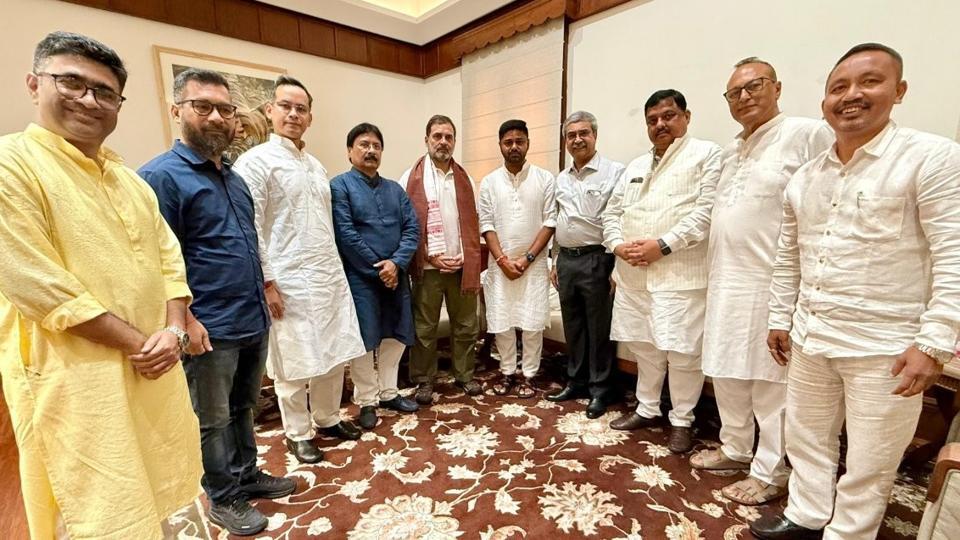
Among other issues including next year’s assembly polls in the northeastern state and a likely alliance between AJP and Congress, the leaders discussed the Assam Accord and its implementation. The regional party’s president Lurinjyoti Gogoi later told journalists that he urged Gandhi to raise the issue of non-implementation of critical clauses of the accord in Parliament.
The accord, which was signed on August 15, 1985 to mark the end of a six-year agitation against illegal immigrants (especially those from Bangladesh), to which Gandhi’s father, the then Prime Minister Rajiv Gandhi, was also a signatory, will complete 40 years this Friday.
The accord signed by the union government and All Assam Students Union (AASU) and All Assam Gana Sangram Parishad (AAGSP), the two organisations from the state that had spearheaded the 1979-1985 agitation, is considered as the most important deal to stop illegal immigration, detect and deport foreigners residing in the state and give constitutional, legislative and administrative safeguards for Assamese people.
Over the past four decades many of the clauses in the accord have been fulfilled. But the core issues of fencing the entire border with Bangladesh to prevent entry of illegal immigrants, detection and deportation of all foreigners who entered the state after March 25, 1971 (the day Bangladesh came into being) and providing constitutional safeguards to Assamese people remain unfulfilled despite assurances by successive governments from different political parties including Congress, Asom Gana Parishad (formed after signing of the accord) and Bharatiya Janata Party. Assam has a separate government department, set up in 1986, to implement the accord
The agitation and the accord
The Assam Agitation started in 1979 after names of several thousands of dubious citizens got included in the electoral rolls of Mangaldai constituency ahead of the 1980 Lok Sabha polls. This led to fears among indigenous groups that if the influx from Bangladesh continued unabated, it would lead to political, social and demographic sidelining of the original inhabitants.
The protests over the next six years were led by AASU and organisations like AAGSP and saw participation from all sections of society. Though the agitation was mainly non-violent, over 800 people were killed in police action and nearly 2,000 killed in a single night in 1983 when members of indigenous groups attacked villages in Nellie of Bengali-speaking Muslims with origins in Bangladesh. The agitation came to an end following signing of the accord.
“Foreigners who came to Assam on or after March 25, 1971 shall continue to be detected, deleted and expelled in accordance with law. Immediate and practical steps shall be taken to expel such foreigners,” stated one of the main clauses of the agreement.
Also Read: Congress top leadership holds key meeting ahead of 2026 Assam assembly elections
It added that the international border (with Bangladesh) shall be made secure against future infiltration by erection of physical barriers like walls. barbed wire fencing and other obstacles at appropriate places. Strengthening of security arrangements to prevent future infiltration adequate number of check posts would be set up, it mentioned.
Clause 6 of the accord stipulates, “Constitutional, legislative and administrative safeguards, as may be appropriate, shall be provided to protect, preserve and promote the cultural, social, linguistic identity and heritage of the Assamese people”.
Over the past decades some of the demands raised by AASU and few included in the accord have been met. Establishment of the sprawling Srimanta Sankardeva Kalakshetra in Guwahati for preservation, promotion and upliftment of culture of the people of Assam is one. Setting up of the Numaligarh Refinery Limited, the Indian Institute of Technology (IIT) in Guwahati and two central universities, Tezpur University in Tezpur and Assam University in Silchar are other such completed projects.
But issues like fencing the 267-km border Assam shares with Bangladesh, which is crucial to put an end to infiltration from the neighbouring country, is yet to be completed. Of the total border around 61 km, most of which falls in riverine areas, remain unprotected. Minister for implementation of the accord, Atul Bora, told the state assembly that fencing has been completed while the rest 39-40 km still remain open.
Also Read: Assam launches scheme for indigenous people in ‘vulnerable areas’ to get arms licence
Implementation of another prominent clause regarding detection and deportation of illegal immigrants also remains partial. While there is no exact number of such persons residing in Assam some estimates say they could be anywhere from 1 to 4 million or even more.
The final report on updation of the National Register of Citizens (NRC) for the state, which was supervised by the Supreme Court with the aim of weeding out illegal immigrants and got over in August 2019, had left out 1.9 million applicants. But that figure is debated, the list is yet to be ratified by the Registrar General of India and several petitions are pending in the apex court seeking partial or complete overhaul of the 5-year-long exercise.
In the same reply to the assembly in February, Bora had mentioned that since signing of the accord, and until December 31, 2024, at least 165,531 illegal immigrants residing in Assam had been detected and declared as foreigners by tribunals specially set up for that purpose--cases against nearly 85,000 others who are suspected to be illegal foreigners are still pending. Bora had told the assembly that of those detected 30,115 were deported. Details on the rest are sketchy. In May this year, chief minister Himanta Biswa Sarma had stated that nearly 30,000 of those declared foreigners by tribunals had gone missing with no details of their whereabouts at present.
Contentious Clause 6
But the most highlighted and controversial of all things in the accord is Clause 6 that promised “constitutional, legislative and administrative safeguards” to protect the identity and heritage of “Assamese people”. But since the accord doesn’t clearly define who would be considered as “Assamese people”, there’s confusion on who would enjoy the constitutional safeguards.
Implementation of Clause 6 remained in the backburner for over three decades till the BJP-led government in Centre formed a committee in 2019 to suggest recommendations. The 13-member committee headed by Justice (Retd) Biplab Kumar Sarma had submitted its report to the then chief minister Sarbananda Sonowal in February 2020.
It had stipulated 1951 as the cut-off date to determine who an Assamese is (those who themselves or their ancestors were living in the state in that year). Other recommendations of the committee include protection of the state’s culture, heritage and languages, job safeguards (100% reservation in Grade III and IV jobs and 70% in Grade I and II jobs for Assamese people), protection of land of indigenous people as well reservations in parliamentary and assembly seats for indigenous people.
The recommendations again took a backseat for five years till the state government and AASU reached an agreement in February this year on implementing 38 of the 52 recommendations of the committee. CM Sarma stated that those would include mandatory inclusion of Assamese language as a subject in all schools of Brahmaputra Valley and Assamese and Bodo languages as subjects in all schools in the Bodoland Territorial Region (BTR). Similarly, all schools will have to teach students about Assam’s history and geography mandatorily till Class 8.
It was decided that the state government and AASU would continue deliberations on how to implement the rest of the recommendations and also urge the Centre to find ways to take forward some other recommendations like reservations in Lok Sabha and assembly seats for indigenous people, which don’t fall under purview of the state government.
With elections happening in few months and issues like illegal immigrants, evictions of ‘suspected Bangladeshis’ from government and forest lands, rights of indigenous people coming to focus again, the Assam Accord and its implementation will again hit headlines with parties doling out assurances and blaming rivals for the long delay in reaching its stated objectives.