...
...
Next Story

45 years after conviction, Supreme Court acquits 3 men in 1977 murder case

Of the 6 men convicted in 1981, only 3 lived to hear the court pronounce on their innocence on Wednesday.

Updated on: Jul 16, 2026, 08:03:54 IST
Advertisement

Supreme Court Acquits Surviving Appellants
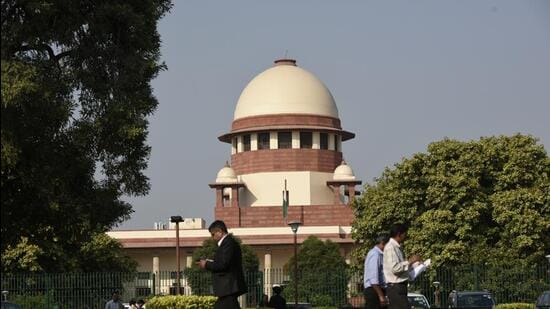
A view of the Supreme Court building in New Delhi (Burhaan Kinu/HT FLE PHOTO)

Nearly half a century after a murder in a Uttar Pradesh village, and 45 years after six men were sentenced to life imprisonment in connection with the killing, the Supreme Court on Wednesday finally brought the criminal case to a close, acquitting three surviving appellants in a judgment that lays bare the extraordinary delays that continue to plague India’s criminal justice system.

Frequently Asked Questions

What was the outcome of the Supreme Court ruling?

The Supreme Court acquitted the three surviving appellants—Lal, Bux and Subedar—holding that the prosecution had failed to establish their guilt beyond reasonable doubt.

How long did the case take to resolve?

The case took 49 years to traverse the judicial hierarchy, from the murder in 1977 to the Supreme Court's verdict in 2023.

What concerns did the Supreme Court express regarding criminal appeals?

The Supreme Court expressed concern over the mounting backlog of criminal appeals across high courts and the apex court, with long-pending cases often resulting in appellants spending years in prison or remaining on bail for decades.

What initiatives has the Chief Justice of India proposed to tackle legacy litigation?

The Chief Justice has launched a special initiative including a new roster with four dedicated benches to hear the Supreme Court’s oldest civil and criminal matters.
Powered ByAsk HT
 
ABOUT THE AUTHOR
Utkarsh Anand

Utkarsh Anand is the National Legal Editor at Hindustan Times, where he leads the newspaper's coverage of the Supreme Court, constitutional law, the judiciary and the Union law ministry. He joined Hindustan Times in 2020 after stints at Press Trust of India (PTI), The Indian Express and CNN-News18, and has over two decades of experience reporting on law, governance and public policy. His work has focussed on some of India's most consequential constitutional and legal developments, including the Supreme Court's judgments on Article 370, marriage equality, decriminalisation of homosexuality, the Babri Masjid dispute, electoral reforms and judicial appointments. He specialises in making complex legal proceedings and judgments accessible to readers while examining their wider social and political impact. Beyond daily reportage, Utkarsh has led investigative projects and enterprise reporting that have shaped public debate and prompted institutional responses. His work has received several journalism awards, including the Ramnath Goenka Excellence in Journalism Award. As National Legal Editor, he has also played a key role in expanding Hindustan Times' legal journalism footprint, mentoring reporters and strengthening coverage across platforms. A Chevening South Asia Journalism Programme Fellow, Utkarsh regularly writes analyses on the judiciary and constitutional issues, and his reporting is widely followed by lawyers, judges, policymakers, academics and readers seeking clarity on India's evolving legal landscape.

Get the latest India News, breaking headlines and real-time updates from across the country. Stay informed about politics, government policies, crime, weather major national developments and Karnataka Bandh LIVE.
SHARE THIS ARTICLE ON
Hindustantimes wants to start sending you push notifications. Click allow to subscribe