In July 2012, Vishal Kumar, a public relations agent, helped a political outfit called the Uttar Pradesh Navnirman Sena organise a press conference. It was supposed to be a routine day, but it ended with him and six others, including a journalist, and political activists who reportedly vandalized a statute of former Uttar Pradesh chief minister Mayawati, being charged with sedition and damaging public property. Kumar, now 35, was sent to the Lucknow district jail, where he stayed as an undertrial for 47 days. The sedition charge was dropped in 2016, and the charge sheet filed by the investigating officer offered no evidence of his involvement. However, the case is still going on — the next date of hearing is November 27.
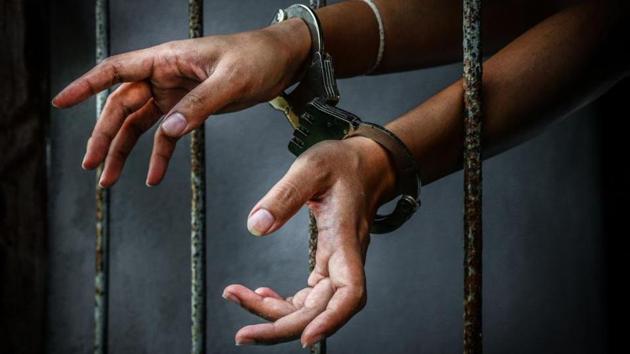
Recalling his time in prison, Kumar said, “The inmates get a rug to sleep on and utensil to eat in. Convicts are provided with jail uniform, the undertrial inmates usually wear the dress they carry with them. Food is provided twice a day.” Due to the lack of adequate prison staff, barracks are filled with prisoners though there may be free ones in the complex.
“This enables the staff to keep an eye on the prisoners easily,” Kumar added. His own cell had close to 70 people, he recalled. The capacity was 30.
Number crunching
According to the recently released India Justice Report 2019 (IJR), the state of prisons in India is abysmal. Across the country, the average occupancy is 114%. One plausible cause for this is the high number of undertrials housed in the prisons. In 2016, 67.7% of India’s prison population was undertrial prisoners; higher than it was even a decade ago. And Uttar Pradesh contributed 23% to this number, with over 68,000 undertrial inmates. To give a sense of scale, this number is nearly two and a half times more than Bihar, another state with over 50% undertrial inmates. In fact, in a district jail of Uttar Pradesh, the occupancy was a staggering 498%.
According to the data available on the website of the UP Prisons Administration and Reform Services, at least 63 of the 72 jails across Uttar Pradesh are overcrowded, one of them by as much as 498% of the capacity. The state has three special prisons, five central and two sub-jails, besides 62 district jails. Of these, only nine are not overcrowded. The data further revealed that the total capacity of the UP jails was 60,305 but around 105,111 inmates were lodged in them. Lucknow district jail, where Kumar was housed in 2012, has an occupancy of over 100%, but the top most overcrowded district jail in the state is Moradabad (498%) where the inmates of Sambhal and Amroha districts are housed too, followed by Jaunpur (408%), Lalitpur (402%), Saharanpur (336%) and Mathura (327%).
{{/usCountry}}According to the data available on the website of the UP Prisons Administration and Reform Services, at least 63 of the 72 jails across Uttar Pradesh are overcrowded, one of them by as much as 498% of the capacity. The state has three special prisons, five central and two sub-jails, besides 62 district jails. Of these, only nine are not overcrowded. The data further revealed that the total capacity of the UP jails was 60,305 but around 105,111 inmates were lodged in them. Lucknow district jail, where Kumar was housed in 2012, has an occupancy of over 100%, but the top most overcrowded district jail in the state is Moradabad (498%) where the inmates of Sambhal and Amroha districts are housed too, followed by Jaunpur (408%), Lalitpur (402%), Saharanpur (336%) and Mathura (327%).
{{/usCountry}}Director General (DG) of UP Prisons Administration and Reform Services Anand Kumar told Hindustan Times that seven jails were in the process of being constructed, most of them in the newly formed districts of the state, as a measure to reduce the pressure on existing prisons. The process of land acquisition and financial clearance has been initiated, he said. The department was also renovating old jails in certain districts to increase their holding capacity. In all, the capacity of the prisons will increase by at least 15,000 with all these measures. However, as the numbers reveal, this is a drop in the ocean. The problem cannot be solved by building more prisons alone. The number of cases before the courts will need to be reduced, and for that, better legal aid by the state will need to be provided.
As the IJR points out, ideally each jail should have a legal services clinic of its own. Among the larger states, which have a population of more than 10 million, Uttar Pradesh, Kerala and Maharashtra have half the number of legal clinics required. Lack of access to legal aid has a direct bearing on the pendency of cases in lower courts. It also means that undertrials remain languishing in prisons. The human impact of this can be seen in the number of children below the age of six years, who stay in jail with their imprisoned mother.
As many as 416 children are growing up in jail with 373 imprisoned mothers in the state, as per the National Crime Records Bureau (NCRB) data for 2017. Of these, only 70 women are convicts. The rest are undertrials.
As per Supreme Court guidelines, these children must be provided with facilities inside jails, and transferred to shelter homes after age 6, so that they can be sent to school. However, experts feel the atmosphere inside jails is traumatic for them.
“Whatsoever facilities are provided, jails can never be shelter homes for the children. More efforts are needed to facilitate children inside the jails, who have been living with their imprisoned mothers,” says Sangeeta Sharma, member of the Child Welfare Committee, Lucknow.