Cases of crime against women in cities were down by 8.3% in the year 2020 when compared to 2019, even though nearly 77 rape cases were reported across the country on an average every day that year, data released by the National Crime Records Bureau (NCRB) showed.
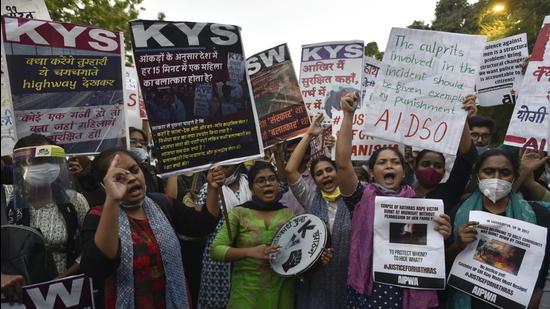
In its latest report on Tuesday, the NCRB, which functions under the Union home ministry, said that a total of 371,503 cases of crime against women were reported across the country last year in comparison to 405,326 in 2019 and 378,236 in 2018.
Among states and Union territories, Uttar Pradesh topped the list with maximum number (49,385) of such cases followed by West Bengal (36,439), Rajasthan (34,535), Maharashtra (31,954) and Madhya Pradesh (25,640).
Crimes against women includes cases of rape, outraging modesty, dowry deaths and harassment, acid attacks and kidnapping.
“Majority of cases under crime against women were registered under ‘Cruelty by Husband or his Relatives’ (30.2%) followed by assault on women with intent to outrage her modesty’ (19.7%), kidnaping and abduction of women (19.0%) and rape (7.2%),” the report said.
Of the total cases of crimes against women during the Covid pandemic-induced lockdown, there were 28,046 incidents of rape involving 28,153 victims. Out of the total victims, 25,498 were adults, while 2,655 were below the age of 18 years, the report stated.
{{/usCountry}}Of the total cases of crimes against women during the Covid pandemic-induced lockdown, there were 28,046 incidents of rape involving 28,153 victims. Out of the total victims, 25,498 were adults, while 2,655 were below the age of 18 years, the report stated.
{{/usCountry}}The number of rape cases, as defined in Indian Penal Code section 376, stood at 32,033 in 2019, 33,356 in 2018 and 32,559 in 2017. The figure for 2016 was 38,947, as per NCRB data from corresponding years.
With 5,310 cases, Rajasthan reported the maximum number of rapes in 2020 while Uttar Pradesh reported 2,769 cases, Madhya Pradesh 2,339 cases, Maharashtra 2,061 cases and Assam 1,657 cases.
However, Rajasthan saw a decline of 11.45% in rape cases last year when compared to 2019. Similarly, it also saw a dip in crimes against women by 16%.
“It is our government’s mandate that none of the complainant, especially women, should return without lodging a complaint. Rape cases are increasing but around 42% are found false after probe or sometimes, the victim forms an agreement with the accused and don’t want to pursue the case,” Rajasthan’s additional director general of police, crime, Ravi Prakash Meharda, said.
In case of rape of minors, Madhya Pradesh recorded the most number of incidents with 3,259 cases followed by Maharashtra (2,875) and Uttar Pradesh (2,630). The state saw a mere 1% dip in rape of minors unlike other states such as Uttar Pradesh and Rajasthan were the decline ranged from 5% to 10%. Madhya Pradesh also reported the maximum number (17,008) of crimes against children.
As the accused in majority of the rape cases known to the victim, a senior police officer on condition of anonymity said it was not a “problem of law and order but a social problem.”
“The number is high because of 100% reporting of cases,” said Madhya Pradesh additional director general of police Pragya Richa Shrivastava.
Women activists such as Sarika Sinha, convener of Action Aid (an organisation which helps destitute and victims of crime against women), said a poor conviction rate was a major reason behind the high crime rate against children.
“Despite making strict laws, including capital punishment, for raping a minor of less than 12 years, the number of cases is not coming down significantly. One of the major reasons is delay in justice and a lower conviction rate,” she said.
The NCRB data also showed the rate of crime against women in two Tamil Nadu cities -- Coimbatore and Chennai -- were the lowest when compared to 19 other metro cities.
“When there is a declining trend, we have to see through the data from various intersections. Are they complaining? If so, is their report being considered and registered or dismissed? Even in urban areas for gender-based crimes, there isa stigma against reporting and some women get used to this and fail to report,” Sandhiyan Thiyagaran, founder of AWARE (Awareness for Women to Advocate their Rights and Empowerment) India, said, adding: “However, compared to other metros in the country, in Tamil Nadu, the law enforcement agencies help prevent crimes against women such as by patrolling and installing CCTVs. We have a few deterrents that other metros may not have in equal measure.”
Among the 19, cities which reported the highest chargesheet rate under the IPC are Surat (96.7%), Coimbatore (96.6%) and Ahmedabad (96.3%). Among states, it is Gujarat (97.1%), Kerala (94.9%) and Tamil Nadu (91.7%).
The crime rate is calculated for per one lakh of population.