As we put Dasara behind us and prep for Deepavali, that familiar year-end feeling – a distaste for work and healthy diets, a barely suppressed panic that another year has slipped through our fingers, and a desire to put aside good behaviour and ‘live a little’ – is upon us. Crafty merchants of every stripe, knowing that ‘living a little’ often equates to ‘spending a lot,’ are up to their capitalist tricks, giving us FOMO even about traditions that aren’t quite local – like buying gold coins on Dhanteras (what even is Dhanteras?).
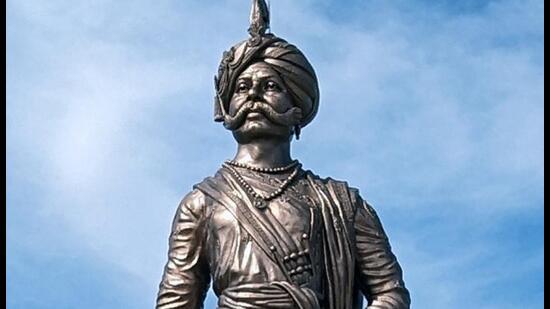
Still, Dhanteras provides the perfect opportunity to talk about coins, the very first minted in this city, which got their noble minter, Kempegowda I (KG I), the founder of Bengaluru, into a rather hot mess. How a popular leader who was well-regarded by his emperor, the great Krishna Deva Raya of Vijayanagara, came to cool his heels in jail is a tale worth telling.
The rise of KG I as chieftain of Yelahanka, an agricultural region at the southern border of the empire, began in the 1520s, when Krishna Deva Raya reigned supreme over the southern peninsula. After the emperor’s death in 1529 CE, KG I, only a vassal but very ambitious, ingratiated himself with the late emperor’s brother and successor, Achyuta Deva Raya, and had received, by 1532, imperial permission to build himself a new capital. That capital, completed in 1537, was the fort-town of Bengaluru.
By 1542, Achyuta Raya was dead. In the next six months, his son and heir, Venkata Raya I, had been assassinated through the machinations of his maternal uncle, the treacherous Salakaraju, who then declared himself king. In 1543, Aliya Rama Raya, the son-in-law of Krishna Deva Raya, slew Salakaraju, and crowned Sadasiva Raya, the nephew of Achyuta Raya, king.
{{/usCountry}}By 1542, Achyuta Raya was dead. In the next six months, his son and heir, Venkata Raya I, had been assassinated through the machinations of his maternal uncle, the treacherous Salakaraju, who then declared himself king. In 1543, Aliya Rama Raya, the son-in-law of Krishna Deva Raya, slew Salakaraju, and crowned Sadasiva Raya, the nephew of Achyuta Raya, king.
{{/usCountry}}While the eminences in Vijayanagara were consumed by palace intrigue, the Nadaprabhu (Lord of the Land) of Yelahanka and Bengaluru was steadily expanding his sphere of influence. A farmer himself, KG understood the needs of an agricultural community and built several interconnected tanks and canals for irrigation. He also extended and refurbished old temples, winning important brownie points with those whose livelihoods depended on the capricious weather gods. Recognizing the truth of the maxim ‘Location, location, location’ centuries before a Chicago copywriter put it into a real estate ad in 1926, he leveraged Bengaluru’s position, equidistant from the eastern and western coasts, to pitch it as the ideal trading centre. (That tradition of enacting policies to entice traders and entrepreneurs to set up shop here, which KG I began almost 500 years ago, has continued unabated to this day.)
And then Kempegowda crossed a bridge too far – he began to mint his own coins. Perhaps he nurtured a grand dream of a farmer’s republic holding its own against the military might of Empire. Perhaps he had noticed that his fellow-vassal, Sadashiva Nayaka of the Keladi Nayakas, who controlled the Malenadu region from Shivamogga, had issued his own coins with no backlash, and decided to jump on the bandwagon. Whatever it was, it didn’t work for KG. The sight of the Bhairava – for that was the name of his coin – got his already envious neighbours from Devanahalli and Channapatna dancing the tandava. Off they went to Sadasiva Raya, carrying tales of a devious chieftain who had undermined the emperor’s suzerainty by – the gall! – issuing his own coins.
Retribution was swift. Sadasiva, still far from secure in his position and not willing to take any chances, put KG safely away in Anegundi prison. But politics is a long and changeable game – once Sadasiva had seen the light five years later, Kempegowda returned to Bengaluru. He did not mint any more coins, but he continued to rule and flourish, until his death in 1569.
(Roopa Pai is a writer who has carried on a longtime love affair with her hometown Bengaluru)