Abujhmad (Bastar): Deep inside the emerald embrace of Abujhmad, where the dense forest provided perfect cover for Maoists for decades, is a unique residential school in the village of Rekavaya.
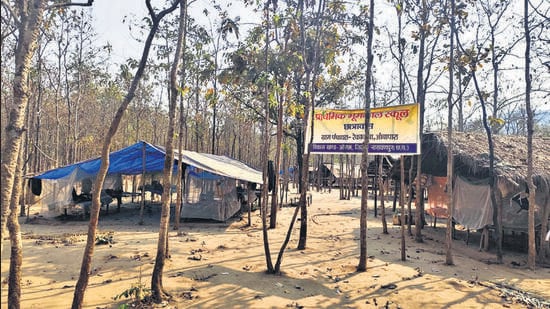
It is located 30km off the main road and one has to cross the mighty Indravati river and walk for about five hours to reach Rekavaya. The narrow and dusty muddy path to the village still has signs of dismantled spike holes dug by Maoists to target security forces.
Abujhmad (Bastar): Deep inside the emerald embrace of Abujhmad, where the dense forest provided perfect cover for Maoists for decades, is a unique residential school in the village of Rekavaya.
It is located 30km off the main road and one has to cross the mighty Indravati river and walk for about five hours to reach Rekavaya. The narrow and dusty muddy path to the village still has signs of dismantled spike holes dug by Maoists to target security forces.
The primary school has 112 students in 12 temporary structures that house classrooms, a kitchen, hostels, and staff quarters. It is the only school serving 12 villages in the region. Until recently, it was run by the villages, which took over the school from the Maoists in 2021. It is now run by the state government which took it over last year and has started work on a new permanent school building.
Abujhmad, between Maharashtra and Chhattisgarh, is known as ‘unknown hill’ as the 6,000 sq km of thick forest has not been surveyed since the British era. The jungle is the epicentre of Maoist activities and about a dozen senior cadres of CPI (Maoist) are believed to be hiding there.
The primary school has four teachers from Rekavaya; only one of them is a graduate.
Pradeep Venjam, 18, who has studied up to Class 10 is a teacher in the school. He says he gets ₹4,000 per month as remuneration, the same as the other three. “Each village collects ₹3,000 every month and donates it to the school. We get ₹36,000 and run the school with that money.”
Apart from the money, the villagers also donate rice and vegetables for the students living in the residential school. The school employs three cooks — one male and two female.
According to government records, a school existed in the village since 1989. But it was first demolished by the Maoists who then decided, in 2009, that they would reopen and run it, indoctrinating young people in their philosophy. They ran it until 2020 when the local panchayat urged them to hand over the school.
The school was housed in a concrete building but the Maoists demolished it. “The Maoists did not allow any concrete structure in their area as they feared that security forces could occupy it and develop it as a camp,” said a village resident, requesting anonymity.
“They (Maoists) used to teach Hindi, English, Mathematics and Arts apart from teaching Maoist ideology,” added this person.
Senior cadres used to come in uniform and talk about jal, jungle, zameen (water, forest and land), he said.
Lakshman Oyam, who now teaches mathematics, actually attended the school when it was run by Maoists and said the focus was on exerting control over young minds. “The syllabus was elementary.”
When the security forces started establishing themselves in the region, the Maoists left, but a second village resident suspects they have a school deeper in the forest now.
With the influence of the Maoists waning in the Bastar region, the Chhattisgarh government has reopened 105 schools out of the 133 demolished schools according to the state government officials. The Rekavaya school would be the first to be re-opened in Narayanpur district and also the first Maoist school to be taken over by the state.
The Narayanpur district collector hopes the new academic session will start in the new building.
“The school in Rekavaya was taken over by the district administration in October 2024. A school building was sanctioned under the district mineral fund (DMF) and is currently under construction. Our objective is to start the next academic session in the new building,” said Prathishta Mamgain, district collector, Narayanpur.
“We are hoping that the school will be built before it rains because once the rains start, it will be impossible to reach the village,” said Sukku Okam, another resident.
One Subscription.
Get 360° coverage—from daily headlines
to 100 year archives.
Archives
HT App & Website