E-Paper



A long, hard journey with roots in tribal agitation
52% of the 18th Lok Sabha comprises first time members spanning political ideologies, parties and regions.

 Prefer HTon Google


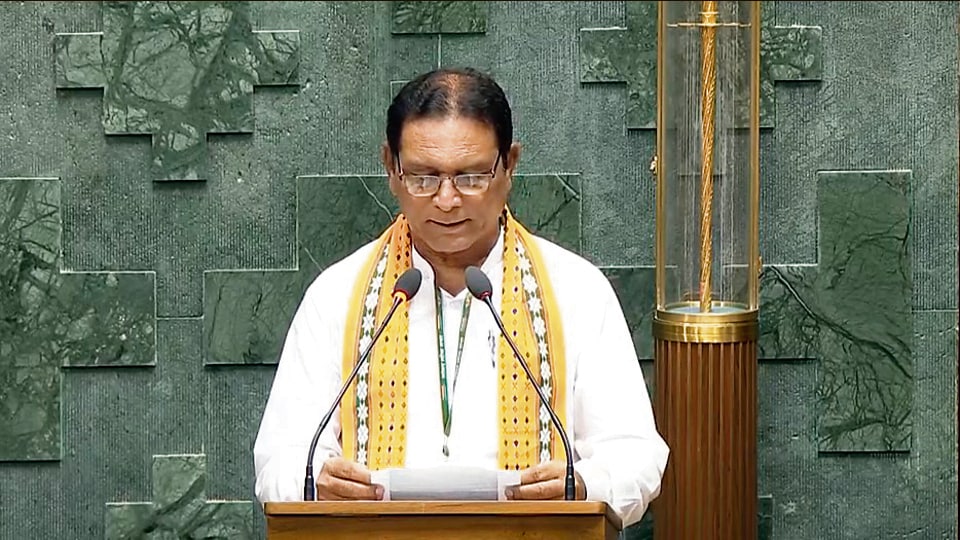
From the small village of Mahuldiha, Naba Charan Majhi’s first tryst with politics had little to do with Odisha. In fact, the first slogans a young Majhi shouted, in his twenties in a college in Rairangpur, were for “Greater Jharkhand.” Four decades later, he is now sitting in Parliament, having won his first election from Odisha’s Mayurbhanj, one of the five seats in the state reserved for scheduled tribes, and of them, the most well known. For, Mayurbhanj is also home to Droupadi Murmu, the first tribal woman to ascend the steps of Rashtrapati Bhavan and become President of India. His victory by 219,000 votes was also representative of the BJP’s fierce inroads into the eastern state where it once struggled to find a foothold and its strengthening grip on the tribal communities.
The son of a marginal farmer, the 1980s were a heady time in Mayurbhanj. The region was part of Odisha, but had historically been underdeveloped, had little connectivity or road networks, and a deep sense of alienation from the rest of the state. This was also the time when Shibu Soren, a Santhali tribal like Majhi, was leading the call for a Greater Jharkhand, where the tribal identity would find greater resonance. While the stir for a separate state largely centred around Bihar, there were protests in Odisha’s bordering districts such as Mayurbhanj that wanted in.
“We were in college in the mid 80s and found the call for Greater Jharkhand very appealing. The district was extremely underdeveloped, had no irrigation, and we felt cut off from the rest of the world. We always felt that successive central and state governments had a step-motherly attitude towards Mayurbhanj in matters of health, education, employment, electrification and water supply. When Suraj Singh Besra started the All Jharkhand Students Union in 1986, I along with Sudam Marandi and others joined the movement fired by the imagination of a Greater Jharkhand,” said Majhi, who took oath as MP in Santhali language on Monday.
In many ways, in 2024, his political life came full circle —for the man he defeated to become an MP for the first time, was Sudam Marandi of the Biju Janata Dal.
As the call for a Greater Jharkhand took root, particularly among the Santhals who form around 60% of the tribal population in the district, Majhi and other tribal students formed the Mayurbhanj Adivasi Students Association in 1990. He was gaining popularity by the day, and in 1990, as a young 29 year old, he contested the assembly elections from Rairangpur as an independent candidate supported by the All Jharkhand Students Union. He lost, but by a slim margin of less than 5,000 votes to Janata Dal strongman Chaitanya Prasad Majhi.
Just when it looked like his political star was on the ascent, there was a setback. He joined the Jharkhand Mukti Morcha in 1994, and fought the election from Rairangpur again in 1995, but came third.
In 1998, the five-decade long movement for a Jharkhand state collapsed after the Atal Bihari Vajpayee government announced its intent to carve out a Vananchal state comprising 18 districts of southern Bihar. The BJP emerged as the strongest political force, winning 11 of the 14 Lok Sabha seats of Jharkhand in 1998 Lok Sabha elections; it amounted to rejection of the demand of Jharkhand state.
“Many leaders of Mayurbhanj including me who were in the JMM found the idea of districts from Odisha being part of the Greater Jharkhand politically infeasible. It did not make any sense to be in JMM,” said Majhi.
That year marked his political nadir. But then, he got another lifeline.
Majhi decided to leave the JMM and join the BJP, a party that was laying the foundations in Odisha; foundations that bore fruit on June 4, 2024 when the BJP swept both the assembly and Lok Sabha elections.
In Rairangpur, Majhi steadily grew close to the other prominent Santhal leader in the region — a fiery politician called Droupadi Murmu, who had become vice-chairperson of the Rairangpur Notified Area Council in 1997.
“She took a liking to the reticent Naba Charan and encouraged him in the party. Droupadi Murmu thought that he was a promising politician,” said Rabindra Patnaik, a local Rairangpur resident.
Manjhi, too, acknowledged his debt to Murmu and said she had played a “big role” in his career. “That a tribal woman from Mayurbhanj can become President was a huge honour. On top of that, she supported my candidature,” he said.
Their homes were close-by, and Majhi became the political associate closest to her. In 2008, with Murmu’s backing, Majhi became both councillor and chairperson of Rairangpur municipality. Eleven years later, with Murmu at the time the governor of Jharkhand, he was given the BJP ticket from Rairangpur assembly again with some support from Murmu. This time, he had a party backing him, and while the fight was tough, he prevailed over the BJD’s Basanti Marandi by less than 3,000 votes.
In the middle of his term, Majhi’s fortune was to shine again. In July 2022, Droupadi Murmu became the President of India. In that one decision, Majhi’s assembly constituency went from remote to important; and Rairangpur became a political fortress. Patnaik said that between 2019 and 2022, while Majhi was accessible, his development record was tardy.
“It was certainly not extraordinary enough to necessarily cement a second term. But when Murmu became President of India, Rairangpur changed overnight. There are now five passenger trains to Kolkata from the just one before, there is a skill development hub and a bypass has been sanctioned for the Ranchi-Vijaywada expressway,” he said.
When the assembly elections came around, the Mayurbhanj Lok Sabha constituency was seen as one, both leaders from both the BJP and the BJD, where the former had a clear edge. Majhi got the ticket ahead of incumbent MP and Union minister Bisweswar Tudu, and won comfortably.
Majhi’s rise to Parliament was also aided by the BJP’s campaign to wean away Odisha’s tribal community from the BJD; a campaign that has seen rewarding results. Its first political success in the parliamentary seat was in 1998, when Salkhan Murmu, a trade union leader, won the elections and then followed it up with another win in 1999. For two decades after that though, the BJD and JMM won the seat, until Bisweswar Tudu broke through in 2019.
In Odisha, through most of the campaign, Prime Minister Narendra Modi and the top brass consciously spoke of tribal assertiveness and attacked the Opposition for being lukewarm to their nomination of Droupadi Murmu as president. There were clear results. In the 2024 assembly elections, of the 33 seats reserved for tribals, the BJP won 18. Of the five Lok Sabha seats that are reserved, the BJP won four. In Mayurbhanj, they won all nine assembly segments.
Majhi said that his priority over the next five years was three fold with a focus on increasing Rairangpur’s connectivity. “I want to work on a plan to connect the Rupsa-Bangriposi rail line with the Tatanagar-Badampahar line. This will increase the connectivity to New Delhi. The second project is a rail link between Budhamara station in Mayurbhanj and Chakulia station in Jharkhand that will reduce the distance between Puri and Delhi by around 150 km. The third thing Rairangpur must have is a super speciality hospital,” Majhi said.
Jatindra Nath Besra, a professor at the North Odisha University in Mayurbhanj, said that Majhi’s rise was down to two key factors — the BJP’s push in Odisha and the backing of his mentor, Droupadi Murmu. “Murmu holding the high office was a matter of huge honour among the tribals of the constituency who saw her as an inspiring figure. Modi in Mayurbhanj harped on the fact that a tribal woman from Mayurbhanj was commandeering three armed forces of the country and this clearly played on the sentiments of the tribals,” he said.
Despite the spotlight, Besra says there is much to reform in Mayurbhanj still. There are issues of an acute lack of employment, a broken bridge over the river Budhabalanga, a lack of colleges, and continued poor irrigation. But despite the challenges, Mayurbhanj now has two powerful voices in the corridors of Delhi. One is in Rashtrapati Bhavan. The other, Naba Charan Majhi, in Parliament.