The arrest of 22-year-old Disha Ravi in connection with editing a toolkit that offered suggestions on how to support the farmers’ protests has thrown light on a tool often employed by the non-profit sector, advocacy groups, and even the United Nations to carry out digital activism over a range of issues.
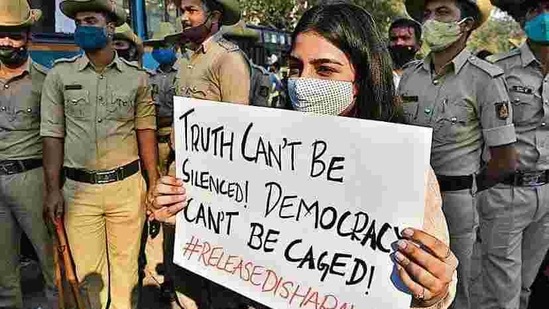
Activists from various organisations said they routinely used toolkits or resource kits, which were a standard operating procedure for advocacy and media outreach and did not constitute a crime as it was entirely up to people whether or not to follow what toolkits suggested.
“The toolkit is the means to get a campaign going. It is all about social media as that is the medium of the young… These paperless campaigns in the digital format grab attention. So if you are trying to warn people not to use toolkits that is absurd,” said Goa Foundation director Claude Alvares who has been part of the Save Mollem campaign which started after the National Board for Wildlife approved the felling of 59,000 trees for development projects in and around the Bhagwan Mahaveer Wildlife Sanctuary and Mollem National Park last April.
Goa Foundation also filed a Public Interest Litigation (PIL) in the High Court challenging these approvals.
{{/usCountry}}Goa Foundation also filed a Public Interest Litigation (PIL) in the High Court challenging these approvals.
{{/usCountry}}The campaign which began in June was conducted over several months — taking the shape of Facebook Live events, citizens’ letters to the authorities, signature campaigns, Twitter storms, artworks and performances, demonstrations and even a weekly documentary series on the wildlife of Goa.
Toolkits were also created in the duration of the campaign, including one for citizens, which provided an overview of the proposed projects, a primer on the laws that governed protected forests, the official email addresses of the authorities to whom citizens could write to, and pointers on what their letters needed to address.
Also Read: Effort to mislead global community- Pakistan on visit of foreign envoys to J-K
According to Divya Narayanan, the campaigns director at Jhatkaa.Org, a digital platform to drive public engagement and volunteer movements on a range of issues, creating a toolkit is standard practice for running campaigns, especially social media campaigns.
“A toolkit for a digital campaign is essentially a document that has information about the issue or a campaign and lays out ways in which people can lend support to the movement and solidarity online and offline. Social media posts are pre-drafted by campaigners/experts so that it’s easy for people to amplify the issue online without having to create content from scratch.”
Also Read: Bengaluru counters Delhi Police on Disha Ravi’s arrest, say they were told later
Narayanan said that toolkits are often created in collaboration with civil society groups that come together for an issue. “We have co-created sample tweets, and other social media content with citizen groups to amplify issues like urban deforestation or air pollution in India,” she said.
Meera Sanghamitra, an activist with the National Alliance of People’s Movements, said that movements utilised pamphlets and letters much before toolkits as a way to broaden their outreach and spread awareness over social justice issues.
“Toolkits are a compilation of material available in the public domain. Oftentimes, everyone may not have the wherewithal to find the material and understand the issue, which is why campaigns and activists do the labour of putting together the material in an easy and accessible way, which is fact-based and verified,” Sanghamitra said.
Also Read: In Kerala, protests against backdoor appointments in govt jobs intensifies
“This criminalisation of ‘toolkit solidarity’ is outlandish. Primarily, it’s a clampdown on any form of solidarity between people,” she added.
Asmita Ghosh, a communications specialist who has worked with both national and international non-governmental organisations over campaigns pertaining to gender and access to education, among other things, said that people are free not to comply with the asks in a toolkit if it does not speak to their concerns or align with their own values.
“There can be a number of ways that a person can take part in any kind of activism. A social media toolkit may give sample posts or tweets, and this doesn’t mean that the integrity of a movement is compromised because, in today’s busy world, we campaigners need to make as easy for people to understand an issue and take action about it. Once they read and decide that they agree with what the message of the campaign is, we make it easier for them to take action by giving them sample tweets or Facebook posts that they can copy-paste to show their support for a movement,” Ghosh said.
However, toolkits can also be used to spread disinformation and thus it is incumbent on a reader to be mindful of whether the toolkit is seeking participation in constitutional objectives, said Internet Freedom Foundation executive director Apar Gupta, who was one of the members of the Save the Internet campaign conducted some years ago on the issue of net neutrality.
“It’s the objectives which define the desirability of a toolkit. For instance, if it’s towards a goal of climate justice or supporting the rights of farmers to protest, these are all constitutional objectives. If, on the other hand, a toolkit is advocating a high degree of disinformation or trying to create a fissure within society, then it’s not a goal that is not desirable for the proper functioning of a society,” Gupta said.
Toolkits help unify the message which is necessary for any kind of amplification over social media platforms on account of their algorithms, Gupta added.
“A social media platform prizes a certain level of conversation for it to then become visible to people who are not part of that conversation. It is important to unify in certain core ways through the use of hashtags, for instance, for the platform’s algorithm to prioritise it. If people tweet above a certain volume, it shows as a trend on Twitter, which then feeds the larger media ecology in which people can comment and participate in conversations… [and thus] become visible to constituencies which you want to sensitise to the cause you are espousing. In fact, the United Nations itself also communicates through toolkits that it has built around a range of issues like adolescent health care, access to education,” Gupta said.