
 E-Paper



AES threat looming, Bihar’s medical infra scrambles to keep up
AES is a neurological illness that causes convulsions and fever among young children, with a high fatality rate of 28.54% in Bihar.

 Prefer HTon Google


It is 11 am, and 54-year-old Dr Gopal Shankar Sahni is anxious, his brow furrowed with worry, as he steps out of one of the paediatric intensive care units of the Bihar government-run Sri Krishna Medical College and Hospital in Muzaffarpur. Inside the 100-bed PICU, there are 70 children, two of whom are in a battle for their lives with an old, deadly enemy, one that Muzaffarpur and other districts in Bihar have become all too familiar with.
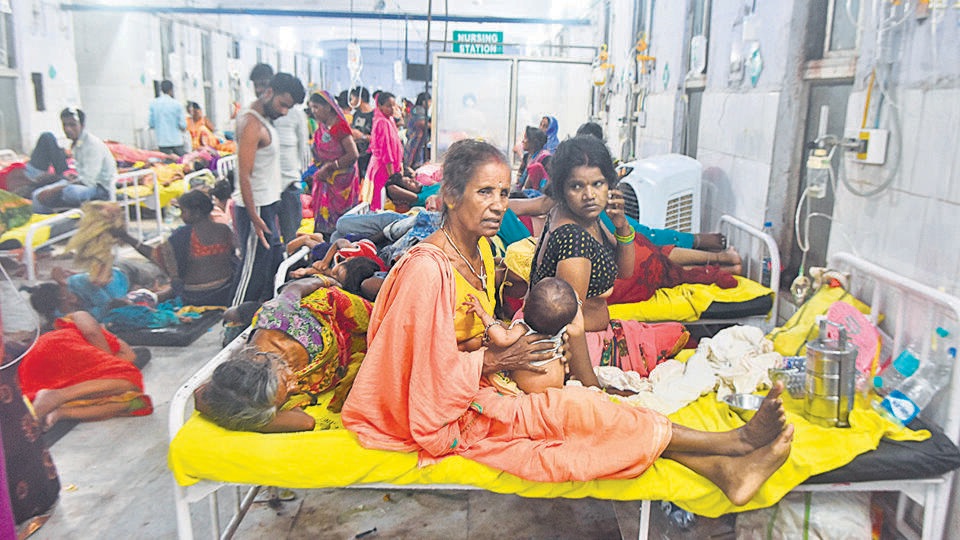
In the year 2019, Muzaffarpur saw a wave of acute encephalitis syndrome (AES), locally known as the “chamki bukhaar”, sweeping through its 16 blocks, leaving 111 children dead, and 431 reported cases, with 101 of those deaths between June 1 and 21. AES is a neurological illness that causes convulsions and fever among young children, with a high fatality rate of 28.54% in Bihar.
This year, till May 31, 43 cases of AES have been reported at the Muzaffarpur hospital, with two deaths. Eighteen cases of AES were admitted at the SKMCH in April; 17 in May; three in January and two in March. These numbers worry Sahni, because the deaths have come early. “AES cases peak in June and the worst may still not be over. We need to be careful,” said Dr Sahni, associate professor and head, paediatrics, SKMCH.
But if Muzaffarpur is the epicentre, the rest of Bihar has been far from untouched. From 2008 to 2021, data from the National Vector Borne Disease Control Programme (NVBDCP) of the Union ministry of health and family welfare, says that there were 5,293 children affected by AES, of which 1,511 children between the ages of one and 14 lost their lives. In 2021, Bihar saw 102 cases and 27 deaths. This year, till May 30, there have been 56 cases and three deaths.
AES is no stranger to Bihar; it is an outbreak that the state knows it must fight every year. In the middle of May, HT travelled to four districts in Bihar to look at the preparedness of its hospitals, right from the PHC (primary healthcare centre) level, the first port of call, to district hospitals and medical colleges. Our reportage found that while some progress has been made, there are still conspicuous infrastructure gaps and a desperate staff crunch that limit the state’s ability to combat the killer illness.
Drugs and tests
In the year 2013, the state government created a standard operating procedure (SOP) for the treatment of AES, revising it in 2018 and 2021 after outbreaks. The SOP includes a list of 29 essential drugs that must be kept at the level of PHC, referral and subdivisional hospitals. There is a larger stock of 43 drugs that district hospitals and medical colleges are mandated to keep.
At the Rosera subdivisional hospital (SDH), 110 kilometres from Patna, HT found that drugs such as Artesunate (anti-malarial drug), Frusemide (to treat oedema or fluid retention), Lorazepam (to treat seizures) injections, vitamin A and vitamin E syrups, Carnitine (a micronutrient) were not available. Other primary health centres in Muzaffarpur district such as Bochahan, Kanti, Katra, Kudhni and Sahebganj did not have vitamin E drops.
Thiamine (vitamin B1), an essential micronutrient, was not available at the Gaighat and Kanti PHCs in Muzaffarpur district, while Biotine (vitamin B7) tablets were not available at Muzaffarpur’s Kanti, Katra and Kudhni PHCs as per a gap assessment analysis done by the district between April 25 and May 5.
Rosera and other SDHs, including the one at Muzaffarpur, lacked the facility for some basic investigations for the management of AES, including the liver function test (LFT), kidney function test (KFT), serum electrolyte (sodium, potassium and calcium test) and C-reactive protein (to check for inflammation in the body).
The district hospital in East Champaran and the Chakia SDH did not have facilities to check for serum blood sugar. “Equipment and reagents have arrived; only the EDTA tubes for blood sedimentation are awaited. All necessary investigations related to AES will commence soon,” said Vijay Jha, hospital manager of the East Champaran district hospital.
The AES ward at Rosera (Samastipur) and Chakia (East Champaran) district hospitals did not have a dedicated, functional electric suction machine, also known as an aspirator, primarily used to remove obstructions from a person’s airway.
Dr BK Sharma, state programme officer for the National Vector Borne Disease Control Programme said, “Our district and sub-divisional hospitals do not have the desired level of capacity. We are gradually trying to develop this at district hospitals. Our medical college hospitals, however, have all such facilities, including those for laboratory investigations. So we have advised doctors at peripheries and district hospitals to stabilise and refer all AES cases to medical colleges.”
Human resource shortages
Even where tests and drugs are available, hospitals across Bihar have also long been understaffed. To be sure, these shortages affect medical services across the board, and not just AES. But they do exacerbate the mitigation of outbreaks such as the “chamki bukhaar”.
In 2021, the shortage of doctors in the state was at 33%, according to the state health department. This year, this number has grown to 36%. There exists a 64% shortage of clinical specialists against 5,341 sanctioned posts and an 8% shortfall of medical officers against 6,820 sanctioned post.
The shortage of doctors was 66% at the level of sub-divisional hospitals, as 547 were in place against 1,595 sanctioned posts, and 36% in district hospitals, with 668 vacant positions against 1,872 sanctioned posts, the Rural Health Statistics report 20-21, released recently by the ministry of health and family welfare (MoHFW) said.
It was not surprising then that HT found just one doctor drafted to manage the outdoor patient department (OPD), AES/JE ward, sick newborn care unit (SNCU) in the district hospitals of Samastipur, East Champaran, Sitamarhi and Muzaffarpur. “There is an overall shortage of doctors across the state. We cannot have paediatricians to man every work station at the paediatrics department,” said Dr Umesh Chandra Sharma, civil surgeon of Muzaffarpur.
The District Hospital in Samastipur had six ventilators, but no anaesthetists against a sanctioned strength of eight, or even trained staff to operate them, reducing the utility of the life-support machines to cosmetic value.
At smaller healthcare centres, the problem is even more dire. The shortage of specialist doctors was at a staggering 87% at community heath centres in rural Bihar, as 730 of the 836 sanctioned posts were vacant in 2021 , as per the Centre’s Rural Health Statistics report. In fact, the situation had deteriorated in comparison to March 2020, when there were 124 specialists at community health centres as against 106 in March 2021.
What this means is that there are often delays during treatment, or a delay in getting medical attention at the first port of call. And this often makes all the difference between life and death. “AES, a neurological condition, requires immediate medical intervention of a specialist or else a patient slips into coma before it turns fatal,” said Dr Nigam Prakash Narain, 72, former professor and head of the department of paediatrics, Patna Medical College Hospital (PMCH).
Information dissemination and out of pocket expenses
In April 2020, the Bihar government issued an advisory, called “Chamki ko Dhamki”, with a list of dos and don’ts. These talk of compulsorily feeding children at night, checking for convulsions or consciousness immediately after they wake up and rushing them to a health facility immediately if the child loses consciousness.
At hospitals, village crossings and community centres across the four districts HT went to, posters and hoardings of this advisory were plastered all over. Yet, there is much confusion among those worst affected, underlining a problem in communication.
Standing outside the PICU at the SKMCH in Muzaffarpur, 26-year-old Rakhaur Dasis watching his one-year-old daughter, Soniya, tubes everywhere in her body. “The one thing we understood from the government advisory was that we must feed the child at night. But she still fell ill on May 12, beginning to convulse at around 9 am, two hours after waking up,” he said.
“The government should continue its information, education and counselling (IEC) activities at the school panchayat and ward level throughout the year. Unfortunately, the government machinery activates itself only during three months of the AES season from April to June and fails to effectively deliver its message to the rural masses, where most of the cases of AES are reported from,” said Dr Narain.
Right next to Soniya, was another one-year-old called Ayush Kumar, similarly on a drip on bed number 23 at the PICU in Muzaffarpur. His grandfather Suresh Ram (60) rushed Ayush to the Kanti PHC on the morning of May 11, after which he was shifted to the SKMCH, 16 kilometres away, after a few hours. Yet, Ram said he was unaware of a government order, issued by the state government in the year 2019, which mandates a reimbursement of up to ₹1,000 per case for those that reach the primary health centre by themselves.
In a state, where 51.91% of the population is poor, according to the NITI Aayog’s Multidimensional Poverty Index (MPI), and 88.71% live in rural areas according to the 2011 census, this reimbursement of out-of-pocket expenditure is key. “This is an initiative that encourages villagers to hire and use the fastest mode of transportation to reach the nearest health facility in case a child falls unconscious or convulses. Without it, they may be inclined to use shared public transport or hitch-hike a ride to the hospital. However, pilferage is bound to happen and the government needs to deal firmly with such vested interest,” said Dr Narain.
This year, the state government has tagged at least two vehicles in every panchayat under the chief minister’s rural transportation scheme (Mukhyamantri Gramin Parivahan Yojana) and circulated the mobile numbers of the drivers through ASHA workers and anganwadi sevikas to facilitate the expeditious transportation of AES-affected children from their residence to the nearest health facility.
In Soniya’s case, Rakhaur’s neighbour Rajesh Das urgently ferried her and her mother, Shobha Devi, on his motorcycle to the Musahari PHC when the child developed convulsions on May 12. He, too, was deprived of the allowance. “My neighbour Rajesh brought my daughter and my wife to the Musahri PHC on his motorcycle, without wasting any time, as I was away from home at work. But the officials at the PHC did not reimburse his fare,” said Rakhaur Das.
Asked about these observations at the ground level, Sanjay Kumar Singh, executive director of the State Health Society, Bihar, said he would check if any of the 29 drugs, according to the SOPs for AES, was not available at any PHC or sub-divisional hospital and take stern action against the guilty officials.
“We will get a third-party analysis done of our health facilities in the AES-endemic districts to check for shortcomings and take prompt corrective actions. We have made available all drugs as per the SOP for treatment of AES, including those you have pointed out, at our district formularies. If some drugs have not reached a specific health facility, obviously there are some supply issues at the district level that we need to check and take corrective measures, while also initiating stern action against the guilty officials,” Singh said.
“Every day between 4am and 6pm, attendance of doctors is monitored, both through a mobile app called Darpan, and the 104-call centre. Though AES remains a challenge, we are fully prepared to tackle it. In fact, it is because of our interventions that the casualty due to AES has been less so far this year,” said Singh.


