A lengthy verification process of the Election Commission (EC), which may take several months, will determine which of the party’s two factions retain the name and the symbol of the Shiv Sena.
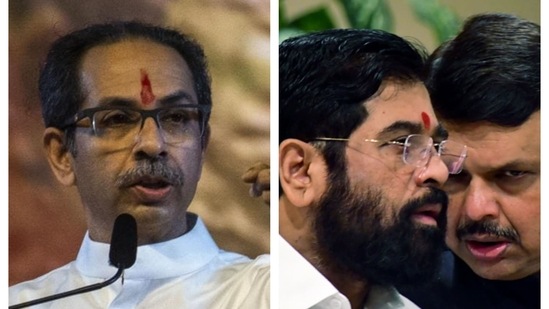
According to legal experts, the key for both sides is material evidence on the number of supporters they enjoy both on the organisational side and the legislative wing. SK Mendiratta, former legal adviser to the EC, said, “All material evidence will be scrutinised in an objective manner. Apart from the strength in the organisation and legislative wing, political activities too might be considered.”
The central poll watchdog, which until now was waiting for the Supreme Court to rule on the case of the “real Shiv Sena”, now has the official go-ahead from the apex court . A Constitution bench led by justice DY Chandrachud and comprising justices MR Shah, Krishna Murari, Hima Kohli and PS Narasimha declined to stay the EC proceedings and rejected Uddhav Thackeray’s argument that the body should wait for the top court to decide on the disqualification of Sena MLAs.
The procedure
{{/usCountry}}The procedure
{{/usCountry}}The exercise to determine who gets the party symbol, flag and name has its basis in the Election Symbols (Reservation and Allotment) Order, 1968.
Section 15 of the law says, “When the Commission is satisfied on information in its possession that there are rival sections or groups of a recognised political party each of whom claims to be that party, the Commission may, after taking into account all the available facts and circumstances of the case and hearing such representatives of the sections or groups and other persons as desire to be heard, decide that one such rival section or group or none of such rival sections or groups is that recognized political party and the decision of the Commission shall be binding on all such rival sections or groups.”
The first step of EC, according to functionaries aware of the process, would be to call both sides, through their lawyers, separately, to produce whatever documents they have to support their claims.
“EC will focus on how many members the two factions have in the organisation and in the legislative wing. This also includes the number of members in both the assembly as well as in Parliament. Both sides have to furnish these materials in a form of affidavit,” said a senior functionary.
Abhishek Singhvi , the lawyer for the Uddhav Thackeray led faction, said. “All efforts would be made with the support of materials. We hope to prove that both the organisation and the electoral wing belong to the Uddhav-led Sena. That will be a verification exercise carried on the basis of material.”
To be sure, the faction-led by current Maharashtra chief minister Eknath Shinde has more legislators with it.
According to former chief election commissioner SY Quraishi, EC determines the case on the basis of the “rule of majority”. The poll body examines which faction has the majority in the legislative and organisational departments, he sid.
In case of legislative majority, EC will take into account which faction has the support of more legislators (MLAs) and parliamentarians (MPs). As far the organisational majority is concerned, all party office bearers and those who are eligible to appoint the president of the political party are taken into account, the former CEC added.
The party has to submit a signed affidavit declaring the support it has. “ EC then goes through the strenuous process of comparing the signatures in case there are bogus ones, that is, if an eligible member has signed for both parties,” Quraishi said. “After this is done, EC takes a call on which party gets the symbol.”
Quraishi added that this principle was ratified by the Supreme Court after the Congress split in the 1969. The Supreme Court upheld the said contention in the year 1971. “The majoritarian principle has met the test of judicial scrutiny,” Quraishi said.
In case there is no certainty whether the party is either vertically divided or it is not possible to say which group has a majority, EC may freeze the party’s symbol and allow the groups to register themselves with new names or add prefixes or suffixes to the party’s existing names. “But this rarely happens; EC usually rules in favour of one or the other party,” the former CEC added.
Previous cases
Fights over the symbol have been bitter in the past, with EC being flooded with responses from each faction of the party.
After the Samajwadi Party split in Uttar Pradesh in 2017, both factions approached the Commission for the coveted bicycle symbol.
The EC went by the numbers and observed that the Akhilesh Yadav faction enjoyed the support of 205 of the 228 party MLAs. The chief minister also had the backing of 56 of 68 members of the legislative council and 15 of the 24 MPs.
The Akhilesh Yadav faction is the Samajwadi Party and entitled to the party symbol, a bicycle, the election commission ruled in January 2017, dealing a huge blow to SP founder and patriarch Mulayam Singh Yadav ahead of the UP election. The faction led by Mulayam Singh was asked to go to the polls under a new name and symbol.
Akhilesh Yadav also submitted proof of a majority of national executive members and national convention delegates backing him.
“As a logical consequence of the above finding and applying the test of majority support approved by the Supreme Court”, the poll panel found the Akhilesh Yadav camp eligible for the party name and symbol.
Later in 2017, when the AIADMK split, EC found that “The petitioners group led by Shri E Madhusudhanan, O Panneerselvam and S Semmalai, and also supported presently by the impleading applicant Shri EK Palaniswami... enjoys support of majority of members, both in the organizational and legislature wings of the All-India Anna Dravida Munnetra Kazhagam.”
In 2021, when the Lok Janshakti Party split, EC froze its Bungalow symbol and name. The commission gave the name Lok Janshakti Party (Ram Vilas) and the election symbol of a helicopter to the Lok Janshakti Party (LJP) faction-led by Chirag Paswan. EC also allotted the name Rashtriya Lok Janshakti Party and the election symbol of a sewing machine to the faction of LJP led by Union minister Pashupati Nath Paras.