India has successfully tested the Agni-Prime nuclear capable missile from a rail-based launcher for the first time, entering an exclusive club of countries that possess such capability, the defence ministry said on Thursday. The next generation missile is equipped with a raft of advanced features and can hit targets at a range of up to 2,000 km.
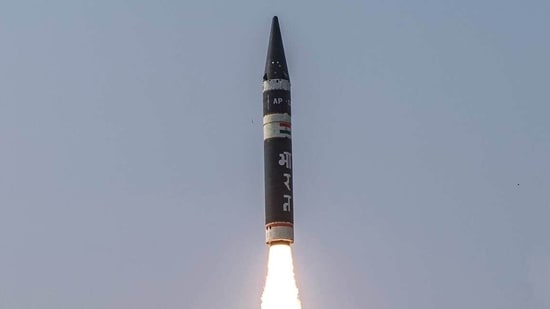
“The Defence Research and Development Organisation (DRDO), in collaboration with the Strategic Forces Command (SFC), has carried out the successful launch of intermediate range Agni-Prime missile from a rail-based mobile launcher system, under a full operational scenario on 24th Sep 2025,” the defence ministry said in a statement.
The successful flight test has propelled India into a group of select nations that have developed a canisterised launch system from the rail network, defence minister Rajnath Singh said. The US, Russia and China possess this capability.
The road mobile variant of the missile has already been inducted by the military, and the latest launch will enable the induction of futuristic rail-based systems into the services. The first-of-its-kind launch was carried out from a specially designed rail-based mobile launcher with the capability to move on the rail network without any pre-conditions, the ministry said.
“It provides for cross-country mobility and has the capability to launch within a short reaction time with reduced visibility. It is self-sustained and is equipped with all independent launch capability features including the state-of-the-art communication systems and protection mechanisms.”
{{/usCountry}}“It provides for cross-country mobility and has the capability to launch within a short reaction time with reduced visibility. It is self-sustained and is equipped with all independent launch capability features including the state-of-the-art communication systems and protection mechanisms.”
{{/usCountry}}The missile trajectory was tracked by various ground stations.
The other variants of the Agni missiles developed by DRDO include the 700-km Pakistan-specific Agni-I, the 2,000-km range Agni-II, the 3,000-km range Agni-III, 4,000-km range Agni-IV and the 5,000-km range Agni-V missile.
The latest test comes a month after India has successfully tested a new integrated air defence system consisting of a variety of weapons that shot down three targets at different altitudes and ranges. The maiden test of the integrated air defence weapon system (IADWS), which is expected to be a part of the bigger national defence shield under Mission Sudarshan Chakra, was conducted by the DRDO. The IADWS is a multi-layered air defence system consisting of quick reaction surface-to-air missiles (QRSAM), very short range air defence system (VSHORADS) and a laser-based directed energy weapon.
India unveiled a locally produced laser weapon that can knock out drones in April, putting the spotlight on defence technologies that the country has demonstrated during the last two to three years. The successful trial of the directed energy weapon (DEW) system with a 30-kilowatt laser came three months after India for the first time carried out a ground test of a scramjet engine, an air breathing engine capable of sustaining combustion during supersonic flights. The development was seen as a crucial milestone in developing next-generation hypersonic missiles that can travel at speeds of more than Mach 5 or five times the speed of sound.
The few countries that have mastered the technology to disable missiles, drones and smaller projectiles using a laser weapon include the US, Russia, China, the UK, Germany and Israel. Similarly, only the US, Russia and China have developed technologies to field fast-manoeuvring hypersonic missiles that fly at lower altitudes and are extremely hard to track and intercept.
Notable achievements last year included the trial of the 3,500-km range K-4 nuclear capable ballistic missile from a submarine and developing the Agni-5 missile with multiple independently targetable reentry vehicle (MIRV) technology.