
 E-Paper



Amit Shah asks MHA officials to make field visits to monitor development activities
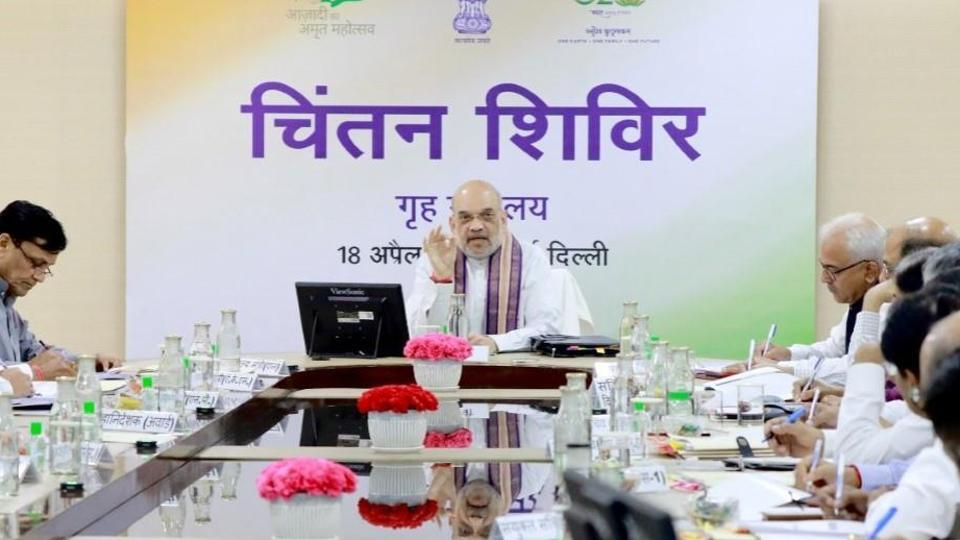
Shah was presiding over first-of-its kind Chintan Shivir (brainstorming session) of senior officials of the ministry of home affairs (MHA)


Union home minister Amit Shah on Tuesday asked officers in his ministry to make field visits to monitor development schemes and fast-track the construction of fencing and roads in border areas.
“The home minister also advocated enhanced use of artificial intelligence to utilise the CCTNS (crime and criminals tracking network system) database for critical analysis of crimes, thereby making cities safer for women, children and vulnerable sections,” said an official familiar with the development.
Shah was presiding over first-of-its kind Chintan Shivir (brainstorming session) of senior officials of the ministry of home affairs (MHA).
Also Read: BJP starts widespread surveys to prepare plans for ’24 Lok Sabha poll battle
The discussions, attended by all senior officers of the home ministry, took place in two sessions at the North Block.
People familiar with the developments said the reason for conducting such a brainstorming session was to finetune the work of secretaries, joint secretaries, directors and other officers of the home ministry by focusing on more pro-active approach by various divisions and departments under it, instead of reacting to the internal security issues.
A statement issued by the MHA said the objective of Chintan Shivir was to review the work of the ministry and “to evolve action plan to implement Prime Minister Narendra Modi’s Vision 2047”.
Chintan Shivir commenced with an in-depth review of the status of compliance of the instructions given by the home minister during an earlier discussion with the officers of the MHA.
Shah, said an officer cited above, directed that “MHA officials should make field visits to monitor development schemes, and directed fast-tracking of construction of fencing and roads in border areas”.
He also stressed on the need to fast-track the recruitment process, saying that recruitment should be initiated well in advance, anticipating future vacancies.
“Departmental promotion committee (DPC) should be held regularly so that employees get timely promotions,” the officer, citing Shah’s directions.
Besides, Shah also reviewed the functioning of MHA dashboard, government land information system (GLIS), budget utilization, E-Office and Special Recruitment Drive.
“The home minister advocated enhanced use of artificial intelligence to utilise the CCTNS database for critical analysis of crimes, thus, making cities safer for women, children and vulnerable sections,” said another officer cited above.
The MHA is responsible for internal security, border management, Centre-State relations, administration of union territories, management of Central Armed Police Forces (CAPFs), disaster management, among others.
It continuously monitors the internal security situation, issues appropriate advisories, shares intelligence inputs, extends manpower and financial support, guidance and expertise to the state governments for maintenance of security, peace and harmony without encroaching upon the constitutional rights of the states.
It operates through 22 divisions such as border management-I and 2 divisions, coordination and international co-operation (CIC), Centre-State (CS) division, cyber and information security (CIS), counter terrorism and counter radicalization (CTCR), disaster management, foreigners, freedom fighters, internal security, Jammu and Kashmir and Ladakh affairs, left wing extremism, north-east, police and women safety among others.
It also administers and controls the functioning of the following central armed police forces.
Besides, several other important institutions and organisations are under its administrative control.
Earlier, in 2018, former home minister Rajnath Singh had formed a committee to review the organisation, structure and process of the MHA. The report of the committee was not made public.


