E-Paper



As high court rejects Assam woman’s plea, a look at what exactly is needed to prove citizenship in the state
In August last year, after a five-year process supervised by the Supreme Court, the updated NRC of Assam, which excluded names of 19 lakh applicants was published.

 Prefer HTon Google


In a recent order, the Gauhati High Court rejected petition of a woman declared foreigner by a tribunal in Assam by stating that land revenue paying receipts, Permanent Account Number (PAN) card and bank documents don’t prove citizenship.
The court of Justice Manojit Bhuyan and Justice Parthivjyoti Saikia also dismissed the petition of Jabeda Begum as she “failed to prove her linkage with her projected parents and her projected brother”.
The order highlights how determination of citizenship is different in Assam - the only state where National Register of Citizens (NRC) containing names of citizens was prepared in 1951 and updated last year.
In August last year, after a five-year process supervised by the Supreme Court, the updated NRC of Assam, which excluded names of 19 lakh applicants (of the 3.3 crore who applied) was published.
The updated NRC has its genesis in the Assam Accord of 1985 signed after a six-year-long agitation against illegal immigrants from Bangladesh, which set March 24, 1971 as the date for determining citizenship in the state.
The accord also resulted in insertion of Section 6A in the Citizenship Act, 1955, which stipulated that Indians and illegal migrants from Bangladesh who came to Assam prior to March 25, 1971 were deemed as citizens. The same date was used for the NRC updation process.
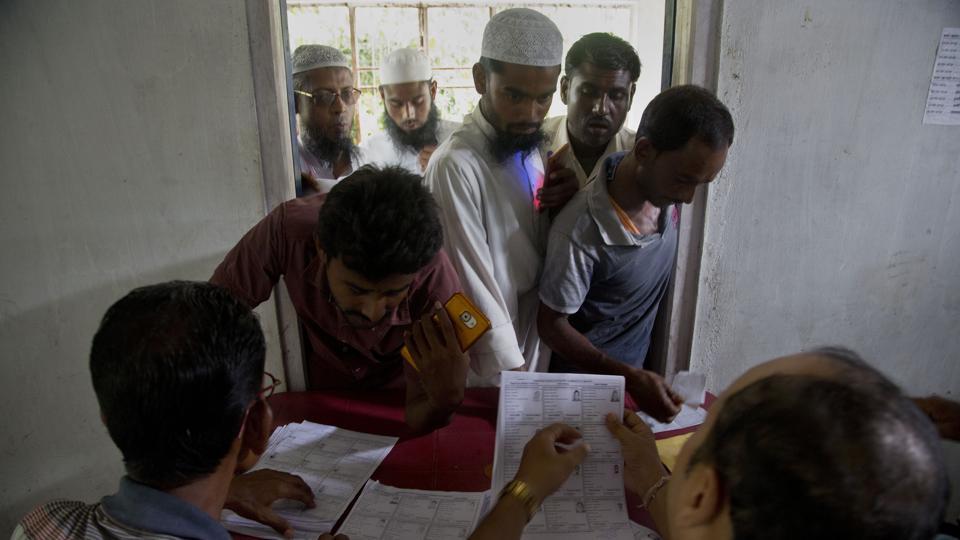
To prove citizenship for inclusion in NRC applicants had to submit any one of the 14 documents issued before March 24, 1971 which had either their names or names of their ancestor to prove residence in Assam up to that date.
These documents were 1951 NRC, electoral rolls till March 24, 1971, land and tenancy records, citizenship certificate, permanent resident certificate, refugee registration certificate, passport, insurance policy, government issued license or certificate, proof of employment, bank or post office accounts, birth certificate, education certificates or documents of court records or processes.
Further, two more supplementary documents - certificates issued by circle officer or gram panchayat secretary to married women migrating after marriage (before or after March 24, 1971) and ration card issued prior to March 24, 1971 - could be added by applicants. But these two documents were to be accepted only if applicants had one of the 14 documents listed above.
For those applicants who names were not in the 14 documents, they have to submit eight different documents to establish relationship with an ancestor (father, mother, grandfather, grandmother etc.) whose names were included in any one of the 14 documents prior to March 24, 1971.
These documents were birth certificate, land records, examination certificates, bank, insurance police or post office records, certificate issued by circle officer or gram panchayat secretary (in case of married woman), name in electoral roll, ration card or any other legally acceptable document.
Those applicants who failed to furnish these documents were excluded from the NRC list. But non-inclusion doesn’t make them non-citizens. These applicants have the provision of appealing their cases in foreigners’ tribunals, High Court and Supreme Court to prove citizenship.