E-Paper



Assam gas well fire continues to rage on; extent contained to the well
The fire billowed to nearly 100 feet above the well, located barely a kilometre away from the Dibru-Saikhowa National Park and the eco-sensitive Maguri Motapung wetland, situated a few hundred metres from the site.

 Prefer HTon Google


The fire at the natural gas well of Oil India Limited (OIL) at Upper Assam’s Baghjan in Tinsukia district is still raging on Thursday amid fears of widespread damage to the eco-sensitive area, two days after a blaze broke out and claimed two firefighters’ lives while attempts were underway to plug uncontrolled gas and condensate release.
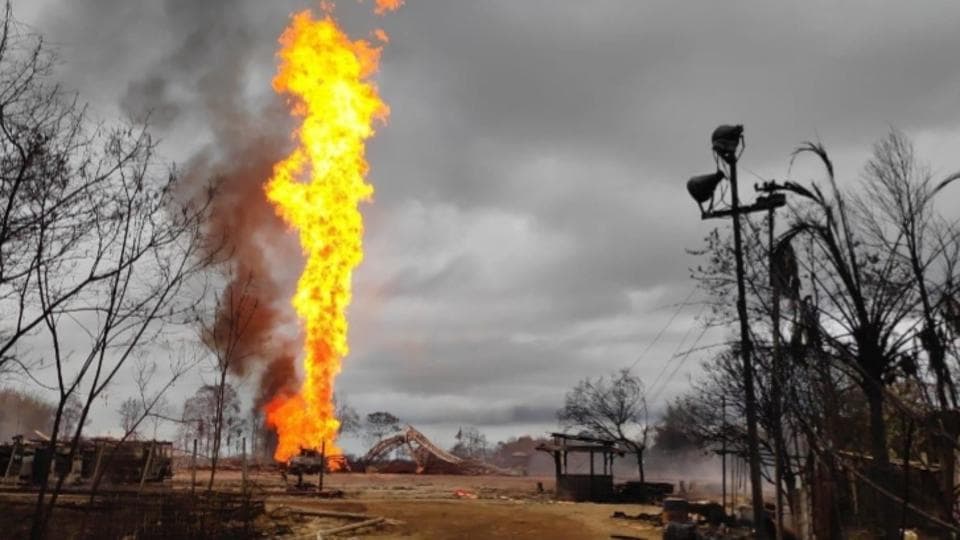
The fire billowed to nearly 100 feet above the well, located barely a kilometre away from the Dibru-Saikhowa National Park and the eco-sensitive Maguri Motapung wetland, situated a few hundred metres from the site.
While the fire had spread to a nearby village and destroyed over 50 houses and many trees on Tuesday and Wednesday, the blaze was largely contained on the third day, according to OIL authorities.
“The extent of the fire has been contained to the well. No flash fire is reported from nearby areas on Thursday,” OIL said in a statement on Thursday.
The well, which had a blowout – an uncontrolled release of gas or oil when pressure systems fail – on May 27, caught fire on June 9 and two firefighters, who were engaged in spraying water to the well to prevent the “uncontrolled” release of gas and condensate from catching fire, lost their lives.
The OIL statement said that the team of experts from the Singapore-based firm, Alert Disaster Control, which specialises in controlling blowouts, is preparing a road map to control the fire and plug the uncontrolled release of gas.
The experts had arrived on Monday, a day before the fire broke out.
“The area near the well has to be first cleared. One option is to drill another well close to the site and connect it with the blowout well to divert the gas. Then, a blowout preventer (BOP), a large valve weighing up to three tonnes, can be used to cap the old well,” said a retired drilling expert, requesting anonymity. The process could take several weeks, he added.
Earlier in 2005, when an abandoned oil well of OIL caught fire in Assam’s Dikom, it took around six weeks to control it.
OIL officials said that it would take about four weeks for the blowout to be plugged.
The process required a large amount of water, which needs to be poured on the wellhead to control the spread of fire.
The officials said that a high discharge water pump would be placed to contain the spread of the fire.
On Thursday, the Assam government ordered an inquiry into the blowout and subsequent fire.
Maninder Singh, additional chief secretary (ACS), Assam, has been asked to submit a report within 15 days.
“We want the inquiry to ascertain how did the blowout happen and if there was a human error, which led to it, and the subsequent fire that broke out,” Assam Chief Minister Sarbananda Sonowal said on Thursday.
The industrial disaster has led to protests by local student organisations, who have alleged that OIL’s mismanagement triggered the blowout, forcing the state-run oil firm to suspend their drilling operations at three locations and no work could be carried out in eight sites across Assam on Wednesday.
“OIL lost 467 metric tonnes of crude oil production from 59 producing wells on June 10 due to blockade by local people and various student organisations,” an OIL statement said.
The incident has raised questions about the role of John Energy, a Gujarat-based company that was conducting a workover operation at the well under the supervision of OIL when the blowout occurred.
Workover is an intervention in an existing oil or natural gas well that requires invasive techniques such as wireline, coil tubing, or snubbing.
The Baghjan well was producing one lakh standard cubic metre per day (SCMD) of gas at a depth of 3,870 metres. The blowout occurred when the workover operation was underway to produce gas from new sand (oil and gas-bearing reservoir) at a depth of 3,729 metres.
An OIL employee alleged on condition of anonymity that when the blowout occurred several senior and mid-level officials and senior employees of John Energy were not present at the site.
On Wednesday, OIL authorities had suspended two officials on charges of dereliction of their duties during the blowout.
“The company is carrying out an internal inquiry and two officials responsible for the well have been placed under suspension. The probe will reveal if they were responsible or not,” said Tridiv Hazarika, spokesperson, OIL.