The significance of the Aam Aadmi Party (AAP)’s overwhelming win in Punjab for the future of Indian politics can be understood by returning to the past.
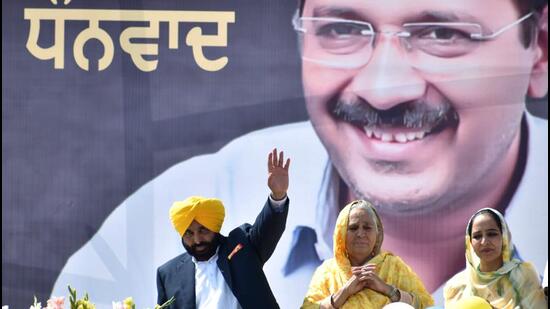
Eight years ago, in the 2014 elections, carried away by its electoral success in the Delhi assembly elections, Arvind Kejriwal – prodded by his party colleagues at that time – thought that AAP could emerge as a national challenger to the Bharatiya Janata Party (BJP). Kejriwal stood from Varanasi against the BJP’s prime ministerial contender Narendra Modi, the party put up hundreds of candidates across the country, and AAP hoped it would replicate nationally what it had done in Delhi. The dream was shattered. AAP candidates lost their deposits across the country. Kejriwal lost to Modi. And the party was forced to go back to the drawing board and narrow its focus to Delhi. AAP’s national ambitions were halted, but even in 2014, the only state where it achieved some success was Punjab.
Five years ago, in 2017, AAP fought the Punjab assembly elections, confident in its ability to win a full state, with Kejriwal now projecting himself as the de-facto CM candidate in a Sikh-majority state. It lost. The defeat shattered AAP’s morale, but it also led to a period of introspection, saw the party invest all its energy in creating a “Delhi model” of government with a focus on health an education, mute its criticism of Narendra Modi, and recognise that unless it could hold on to Delhi, its expansion plans would never proceed.
Two years ago, in 2020, AAP managed to win the Delhi assembly elections, returning to power in the national capital on the basis of its governance achievements, Kejriwal’s image, the absence of a viable opposition leader in the BJP at the state level who could match the CM’s stature, and the continued erosion of the post-Sheila Dixit Congress. AAP won, but knew it shared its vote base with the BJP – the same voters who in 2019 had voted for Narendra Modi voted for Kejriwal in the state assembly, which explains AAP’s strategy of calibrated criticism against the BJP.
But 2017, 2019 and finally 2020, also led to a reboot in AAP’s calculus. There was, by now, a consensus across the rest of India’s opposition that the Congress was in no position to challenge the BJP on its own. And AAP was now convinced that its future lay not in challenging the BJP, but in challenging the Congress.
{{/usCountry}}But 2017, 2019 and finally 2020, also led to a reboot in AAP’s calculus. There was, by now, a consensus across the rest of India’s opposition that the Congress was in no position to challenge the BJP on its own. And AAP was now convinced that its future lay not in challenging the BJP, but in challenging the Congress.
{{/usCountry}}Punjab was the first test of this strategy. Thanks to the Congress’s entirely self-inflicted wounds, the Akali Dal’s patchy record of governance and association with the BJP till not so long ago, and the BJP’s posture during the farm agitation, the AAP found a more receptive political field.
The fact that as the ruling party in Delhi, it had come across as sensitive and sympathetic to farmer protests put it on the right side of public opinion; the fact that the party picked a Sikh CM candidate in Bhagwant Singh Mann put it on the right side of the state’s identity politics; and the fact that there was a freshness of appeal, based on the Delhi model of governance, in a state where consecutive governments have failed to meet public expectations, put it on the right side of the politics of hope.
But beyond Punjab, AAP’s win will inaugurate a churn in the politics of India’s opposition. If 2021 saw Mamata Banerjee defeat the BJP in Bengal and thus emerge as the primary axis around which opposition politics revolved, 2022 will see Kejriwal as the key axis around which opposition politics will further evolve. AAP will next seek to eat in to the Congress’s base in Gujarat and emerge as the primary opposition in state elections scheduled for later this year.
Indeed, the Congress’s decimation in Punjab, but also the defeat in Manipur, Goa and Uttarakhand, will only embolden others in the opposition firmament, but also in the electorate who want alternatives to BJP. Kejriwal’s right-of-centre political positioning – AAP leaders are fond of saying that the only way to defeat the “far right” is from the “centre right” – and his roots in north India arguably gives him an edge over Banerjee in expanding the party’s footprint in states where the BJP and the Congress are in direct competition in north and west India.
AAP’s Punjab win is significant not because it intensifies the battle of who will lead India. It is significant because it intensifies the battle of who will lead the Indian Opposition.