
 E-Paper



Attempts were made to vilify RSS even after Independence: PM
The PM is a former swayamsevak of the Sangh, the ideological fount of the ruling Bharatiya Janata Party. He also released a commemorative stamp and a coin to mark the centenary of the organisation that was set up in 1925

 Prefer HTon Google


Prime Minister Narendra Modi on Wednesday paid tribute to the founders and swayamsevaks (volunteers) of the Rashtriya Swayamsevak Sangh (RSS) who “dedicated themselves to nation building” and said they stayed the course on putting the nation first despite attempts to vilify the organisation and target its members after India gained Independence.
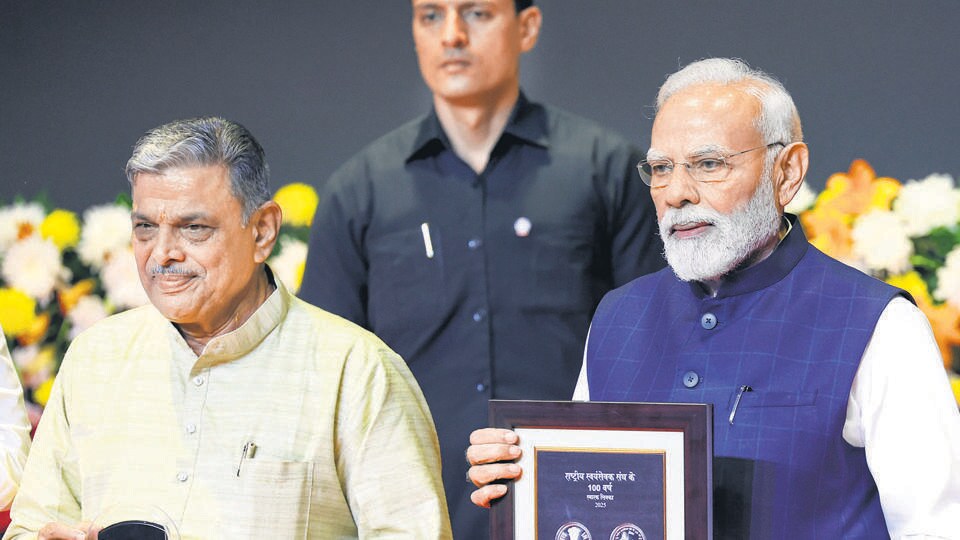
Pointing out that it is often said about the Sangh that “ordinary people come together to accomplish extraordinary and unprecedented work”, the PM said as a swayamsevak, he was happy that the RSS has drawn up a “road map” to fight the current challenges that India faces such as “attempts to break the unity of the country and changes to the demography…”
The PM is a former swayamsevak of the Sangh, the ideological fount of the ruling Bharatiya Janata Party. He also released a commemorative stamp and a coin to mark the centenary of the organisation that was set up in 1925.
“In its journey of dedication to the nation, it’s not as if the RSS has not been targeted…Even after Independence, efforts were made to vilify the RSS. There were innumerable conspiracies hatched to prevent the RSS from joining the mainstream… Guruji (second RSS chief MS Golwalkar) was trapped in false cases and sent to prison. But when he came out, he did not show any resentment,” the PM said.
Quoting Golwalkar, Modi said when we accidentally bite the tongue, we don’t break the teeth. This simplicity and the virtue of not allowing negativity to take over, has empowered the volunteers to continue to work in the face of opposition, he said.
Reflecting on the journey of the RSS that was founded by KB Hedgewar on Vijayadashami Day in Nagpur, the PM said, “Vijayadashami is a timeless proclamation of Indian culture’s faith and conviction. It is no coincidence that the Sangh was founded on this festival…it was the revival of an ancient tradition that has continued for thousands of years, a tradition where national consciousness awakens to meet the challenges of every era. In the current time too, the Sangh stands as the embodiment of that eternal national spirit.”
While opponents of the Sangh, including some opposition parties, accused it of not being part of the struggle for Independence, the PM underlined the Sangh’s role in liberating India from occupation.
He referred to the picture of the RSS contingent marching in the Republic Day Parade in 1963 that has been incorporated on the commemorative stamp that was released by him. The Sangh says it was included in the parade in recognition of its services during the 1962 India-China war. “In 1963, RSS volunteers also participated in the 26 January parade. They had marched with great pride and honour to the tune of patriotism,” he said.
The PM also spoke about the ₹100 denomination coin with a picture of Bharat Mata on one side.
“The ₹100 coin features the national emblem on one side and on the other side it depicts a majestic image of Bharat Mata in Varada Mudra with a lion, with swayamsevaks bowing before her in devotion and dedication. For the first time in the history of Independent India, the image of Bharat Mata has been featured on Indian currency which marks a moment of great pride and historical significance,” he said.
Praising the organisation for its commitment to social service and contribution to society, the PM compared the outfit to a river, which nurtured civilisations. “Just as human civilisations flourished along the banks of vast rivers, hundreds of lives have flourished along the banks of the Sangh…and just as the tributaries of a river spread and sustain life, the Sangh through its offshoots has touched every section of society,” the PM said.
The PM also addressed two major accusations levelled against the Sangh and the BJP - one of wanting to alter the Constitution and second of propagating sectarianism.
He said it was the faith in the democratic system and the Constitution that gave strength to the Sangh to take on the task of fighting the Emergency that was imposed in 1975. “Every swayamsevak has unflinching trust in democracy and constitutional institutions. When Emergency was imposed on the country then this faith gave strength to every Swayamsevak to struggle,” he said.
On the Sangh’s egalitarianism and commitment to weed out caste differences, he said the Sangh was “synonymous with patriotism and service”. He listed the contribution of the volunteers during and after Partition, the 1984 anti- Sikh riots and some recent natural disasters in Punjab, Kerala and Uttarakhand.
He also spoke about other challenges that India faces.
“The challenges and struggles of today’s times are different…economic dependency on other countries, conspiracies to break our unity, conspiracy to change demography... As a prime minister, I am satisfied that our government is dealing with all these issues effectively and at the same time as a swayamsevak, I am very happy that RSS has recognised these challenges and has also designed a road map to fight these.”
These challenges, he said, were related to internal security and the future. “That is why in my Independence Day speech, I announced that a demographic mission will be set up. We have to remain alert about this challenge…” he said.
RSS general secretary Dattatreya Hosabale, who shared the stage with the PM, said the organisation was set up with the objective of the nation’s all-round progress and organising society. “At that time, Hedgewar had said — ‘I am not doing any new work. The method is new, the system is new, but the work is the same, which for centuries in this country many people have done for social awakening, protection of religion, and material and spiritual progress in an individual’s life. I too have started the same work’...” Hosabale said.
This is the first time a stamp has been issued to commemorate the Sangh. In 1999, a stamp was issued to honour Hedgewar, and in 1978, a stamp to commemorate Deendayal Upadhyaya was issued.


