Azam Khan out of jail; Supreme Court refuses to stay in interim bail in ED case
The ED had challenged the Allahabad High Court's interim bail order, questioning its findings on the circumstances surrounding Khan's arrest on October 31.
Senior Samajwadi Party (SP) leader Azam Khan walked out of Ghaziabad’s Dasna jail in Uttar Pradesh on Wednesday, hours after the Supreme Court refused to stay his release on interim bail in a money laundering case. However, the court agreed to hear the Enforcement Directorate’s (ED’s) challenge to the Allahabad High Court order granting him relief.
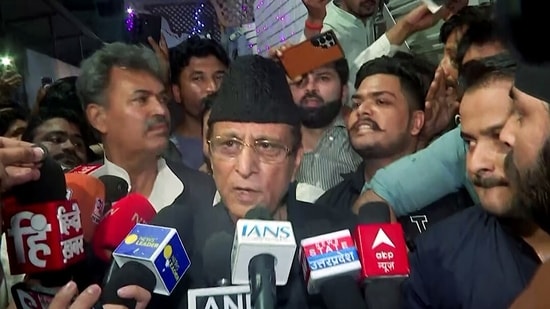
Senior Samajwadi Party (SP) leader Azam Khan speaks to the media after being released from Dasna Jail, in Rampur on Wednesday. (ANI Video Grab)
{{^htLoading}} {{/htLoading}}
The release warrant reached Dasna jail at around 4.30 pm, following which formalities were completed and Khan was allowed to walk out. He left for his hometown Rampur.
Why was Azam Khan granted interim bail in the ED money laundering case?
The Allahabad High Court said, prima facie, that the ED had not strictly followed safeguards for arrest under Article 22(1) of the Constitution and Section 19 of the PMLA. It also questioned the circumstances and timing of his arrest.
Did the Supreme Court stop Azam Khan's release on interim bail?
No. The Supreme Court refused to stay the interim bail, allowing Khan to leave Dasna jail. It agreed to hear the ED's challenge to the Allahabad High Court order.
What is the money laundering case against Azam Khan about?
The case concerns alleged financial irregularities involving the Maulana Mohammad Ali Jauhar Trust, which Khan founded and controls, and the Jauhar University project in Rampur. Khan has denied the allegations.
Powered ByAsk HT
SP chief Akhilesh Yadav described his release as a victory of truth and expressed confidence that Khan would continue to get justice. “Truth has triumphed. We have complete faith in the judiciary. He will get justice even in the future,” Akhilesh Yadav said in Gorakhpur.
{{^htLoading}} {{/htLoading}}
{{^usCountry}}
Earlier in the day, Chief Justice of India (CJI) Surya Kant declined an urgent hearing sought by additional solicitor general SV Raju, appearing for ED, on Wednesday itself and asked the agency to argue its objections before the court on Thursday.
{{/usCountry}}
{{#usCountry}}
Earlier in the day, Chief Justice of India (CJI) Surya Kant declined an urgent hearing sought by additional solicitor general SV Raju, appearing for ED, on Wednesday itself and asked the agency to argue its objections before the court on Thursday.
{{/usCountry}}
Seeking an immediate hearing, Raju questioned the high court’s findings, contending that it had granted bail as though it had already concluded the trial and had characterised the investigation as “malafide”. He also objected to the high court’s observation that Khan’s arrest was motivated, pointing out that ED had arrested him soon after he walked out of jail in another case. “No. Not today. You argue all these points before the court concerned tomorrow,” CJI Kant told the law officer, making clear that the matter would be listed on Thursday.
{{^htLoading}} {{/htLoading}}
When Raju sought a direction to maintain status quo until then, expressing apprehension that Khan could be released in the meantime, justice Joymalya Bagchi, sitting on the bench led by the CJI, declined to intervene.
“Let him be on interim bail. Heavens will not fall,” the judge remarked.
Allahabad HC cited alleged lapses in arrest procedure
The Allahabad High Court granted Khan interim bail on Tuesday, prima facie finding that ED had not strictly followed the mandatory safeguards governing arrest under Article 22(1) of the Constitution and Section 19 of the Prevention of Money Laundering Act (PMLA).
{{^htLoading}} {{/htLoading}}
The high court, comprising justices Rajiv Gupta and Devendra Singh, had questioned the circumstances in which the 78-year-old leader was arrested on October 31, minutes after he was released from Rampur district jail following bail in a separate forgery case. It described the timing of the arrest as indicative of a “motivated and mala fide” exercise.
The case relates to alleged financial irregularities involving the Maulana Mohammad Ali Jauhar Trust, founded and controlled by Khan.
Utkarsh Anand is the National Legal Editor at Hindustan Times, where he leads the newspaper's coverage of the Supreme Court, constitutional law, the judiciary and the Union law ministry. He joined Hindustan Times in 2020 after stints at Press Trust of India (PTI), The Indian Express and CNN-News18, and has over two decades of experience reporting on law, governance and public policy. His work has focussed on some of India's most consequential constitutional and legal developments, including the Supreme Court's judgments on Article 370, marriage equality, decriminalisation of homosexuality, the Babri Masjid dispute, electoral reforms and judicial appointments. He specialises in making complex legal proceedings and judgments accessible to readers while examining their wider social and political impact. Beyond daily reportage, Utkarsh has led investigative projects and enterprise reporting that have shaped public debate and prompted institutional responses. His work has received several journalism awards, including the Ramnath Goenka Excellence in Journalism Award. As National Legal Editor, he has also played a key role in expanding Hindustan Times' legal journalism footprint, mentoring reporters and strengthening coverage across platforms. A Chevening South Asia Journalism Programme Fellow, Utkarsh regularly writes analyses on the judiciary and constitutional issues, and his reporting is widely followed by lawyers, judges, policymakers, academics and readers seeking clarity on India's evolving legal landscape.
Rohit Kumar Singh is a senior journalist based in Lucknow and currently serves as Special Correspondent and City Chief with Hindustan Times. With over 25 years of experience in journalism, he specialises in investigative reporting, with a strong focus on crime, policing, internal security, terrorism, governance and public policy in Uttar Pradesh. He began his journalism career in 2000 and joined Hindustan Times in June 2008 after working with The Daily Pioneer and Sahara Samay. Over the years, he has produced numerous high-impact investigative and exclusive reports on organised crime, terrorism, law enforcement, politics, governance and public administration. Rohit has extensively covered major criminal investigations, terror incidents, elections, police reforms, anti-terror operations, corruption, communal violence and other sensitive security issues. His reporting is recognised for its accuracy, depth, strong sourcing and analytical approach, making him one of the most respected journalists covering the police and internal security beat in Uttar Pradesh. Throughout his career, he has consistently delivered stories that have shaped public discourse, exposed systemic lapses and promoted accountability in governance and law enforcement. He continues to focus on public- interest journalism, combining investigative reporting with in-depth analysis of issues that impact governance and public safety.
Get Latest News, breaking headlines, and top India News, and today real-time updates from across the nation. Stay informed on politics, government policies, crime, Today Weather, and major developments on Hindustan Times
Get Latest News, breaking headlines, and top India News, and today real-time updates from across the nation. Stay informed on politics, government policies, crime, Today Weather, and major developments on Hindustan Times
Home/India News/Azam Khan out of jail; Supreme Court refuses to stay in interim bail in ED case
{{^htLoading}}
Advertisement
{{/htLoading}}
SHARE THIS ARTICLE ON
{{#usCountry}}{{/usCountry}}
Notifications
Get breaking alerts directly from the newsroom
Notifications are on!You'll be notified when news breaks