Roughly 15.2 million voters will step into 13,641 polling booths set up across the national capital on Saturday to seal the fate of 162 candidates on seven seats in a prestige fight that will close out the penultimate phase of the general elections.
The battle for Delhi, the seat of national power, is a microcosm of the electoral contest across the nation with the Bharatiya Janata Party (BJP), which holds all seven seats, taking on an alliance of the Aam Aadmi Party (AAP) and the Congress, both constituents of the Opposition’s umbrella national coalition.
At stake are not only the seven seats after a fierce campaign – headlined by Prime Minister Narendra Modi and Union home minister Amit Shah on one side, and Congress leader Rahul Gandhi and Delhi chief minister Arvind Kejriwal on the other – but also bragging rights about control of the national capital that houses Parliament, the PM’s residence, Rashtrapati Bhavan, and a bevy of dignitaries national and international.
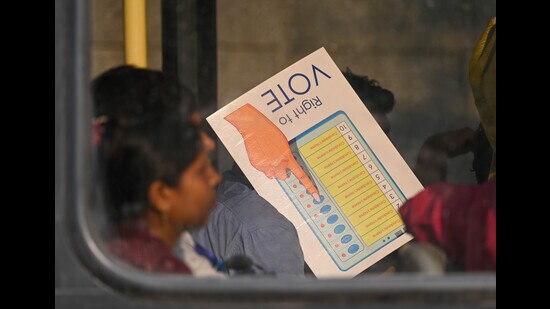
P Krishnamurthy, the Delhi’s chief electoral officer (CEO), said at least 28,000 balloting units and 14,000 control units of the EVMs (electronic voting machines) as well as around 14,000 VVPATs (voter verifiable paper audit trails) were likely to be used for polling and had been distributed to the various polling stations in the national capital.
{{/usCountry}}P Krishnamurthy, the Delhi’s chief electoral officer (CEO), said at least 28,000 balloting units and 14,000 control units of the EVMs (electronic voting machines) as well as around 14,000 VVPATs (voter verifiable paper audit trails) were likely to be used for polling and had been distributed to the various polling stations in the national capital.
{{/usCountry}}“Extensive arrangements have been made to ensure a smooth and efficient electoral process. 100,000 polling personnel and around 100,000 security personnel have also been deployed to ensure smooth, free, and fair polls,” said Krishnamurthy.
Other than the seven seats in Delhi, all 10 seats in Haryana including Gurugram, eight in Bihar, four in Jharkhand, six in Odisha, 14 in Uttar Pradesh, eight in West Bengal, and one in Jammu & Kashmir will also go to the polls. The BJP won 40 of these seats in 2019, its allies five, and the Indian National Developmental Inclusive Alliance (INDIA) parties four. To be sure, the one of 14 seats in Uttar Pradesh that INDIA member Samajwadi Party won in UP in 2019 was in alliance with the Bahujan Samaj Party (BSP). The BSP is not part of the INDIA group in 2024.
Focus will be on the turnout amid searing temperatures and an orange alert sounded across the Capital. In 2019, Delhi had recorded 60.60%, 6.7 percentage points lower than the overall national figure of 67.3%.
Krishnamurthy said arrangements had also been made keeping mind the heatwave forecast.
“Shaded areas have been made at all polling stations, with fully covered waiting zones equipped with coolers and fans to ensure voter comfort. We have ensured the availability of drinking water, toilets, ramps, and wheelchairs at every polling station under the Assured Minimum Facility Policy so that no voter faces any inconvenience. Additionally, paramedical staff equipped with basic medical kits will be stationed at all polling locations,” Krishnamurthy said.
Since 1996, the party that has won Delhi has also triumphed nationally. The last three general elections in the Capital have seen clean sweeps – 2009 by the Congress and 2014 and 2019 by the BJP. Except in 1967, 1989 and 1991, the party which has won a majority of constituencies from Delhi has always finished first in the Lok Sabha.
The battle for Delhi holds echoes of the national contest because people from all over the country have always migrated to the Capital for employment or the aspiration of a better life, making the city a cultural melting pot. The issues at play are also largely national – Modi’s popularity vs Kejriwal’s rooted connect, nationalism vs federalism, BJP’s welfare outreach vs AAP’s focus on health care and education, and questions of Constitution, reservation and communalism.
This time, the contest is bipolar for the first time in 15 years. The AAP is fighting four seats – New Delhi (Somnath Bharti), South (Sahiram Pahalwan), East (Kuldeep Kumar) and West (Mahabal Mishra) – and the Congress three – Chandni Chowk (JP Aggarwal), North East (Kanhaiya Kumar) and North West (Udit Raj). They face an uphill battle against the BJP, which won 57% of the vote in 2019 and held a 16 percentage point advantage over the combined vote shares of the AAP and the Congress.
This time, the BJP has dropped six of its seven incumbent MPs to ward off anti-incumbency, repeating only the North-East Delhi parliamentarian Manoj Tiwari, who is taking on Kanhaiya Kumar of the Congress.
The BJP – which has fielded Ramvir Singh Bidhuri (South Delhi), Bansuri Swaraj (New Delhi), Praveen Khandelwal (Chandni Chowk), Kamaljeet Sehrawat (West Delhi), Harsh Malhotra (East Delhi), Yogendra Chandolia (North West Delhi) and Manoj Tiwari (North East Delhi) – modelled its campaign on the contours of its national pitch around Modi’s governance record and his popularity. The PM held two rallies in the Capital, accusing the INDIA bloc of dynasty politics, appeasement and communalism and alleging that the Opposition wanted to fritter away reservations for scheduled castes, scheduled tribes and other backward classes to help minority communities.
Delhi BJP chief Virendra Sachdeva said the people of Delhi want Narendra Modi to return as Prime Minister for the third time and will be voting for him.
“During the election campaign, we received the love and blessings of the people. It has rattled the opposition AAP and it may try to cause power cuts in the city to disrupt the polling hours to disrupt voting. We have also requested the election commission for proper verification and cross-checking of the identity of burqa-clad voters at every polling station as per the ECI rules because there is a change of impersonation during polls. We have requested the poll panel to deploy an adequate number of women polling personnel for the purpose,” said Sachdeva.
The Opposition, in contrast, focussed on local issues of governance and anti-incumbency against BJP’s parliamentarians. The campaign was enthused by the release of Kejriwal, who was freed by the Supreme Court on May 10 after spending 50 days in jail over corruption charges in connection with the now-scrapped excise policy case. Since his release, Kejriwal held 17 public meetings and roadshows, alleging that his imprisonment was part of a BJP conspiracy to topple his government, underlining his record of bolstering health care and education in the city, and saying that democracy and federalism were in danger.
The AAP said Delhiites will respond to Kejriwal’s arrest by voting BJP out.
“For the first time, the people of Delhi witnessed that a sitting chief minister who has transformed so many aspects of their lives such as education, health, electricity, water, free bus rides for women etc, was arrested in a fake case; that too after the Lok Sabha elections were announced. This has enraged Delhiites and they felt that this is an attack on democracy itself. The people of Delhi will respond to the jail sentence of their CM by voting BJP out,” said an AAP leader.
The Congress campaign was led by senior leader Rahul Gandhi, who addressed two rallies and one townhall meeting. The Congress, too, criticised Modi and the BJP’s policies, spoke about unemployment, rising prices and the dangers to the Constitution.
Delhi Congress chief Devender Yadav said its candidates put up a very effective election campaign for the Lok Sabha polls. “Congress leader Rahul Gandhi’s public meetings and interactions with the voters and party workers boosted their enthusiasm. Not only in the three seats where Congress is contesting, but in the four seats where our alliance partner AAP is contesting the election campaigns were very effective. The people of Delhi will be voting to save the democracy and the constitution. INDIA bloc candidates are set to win the Lok Sabha election,” said Yadav.
In the final days of the campaign, allegations of assault by AAP Rajya Sabha MP Swati Maliwal, who said Kejriwal’s aide Bibhav Kumar attacked her at the CM’s residence, sparked a row with the BJP saying that women’s safety had been compromised, and the AAP dismissing the charges as a conspiracy.
Over the last decade, Delhi has developed a distinctive voting pattern, where the citizens have overwhelmingly voted for the AAP in assembly elections (67 out of 70 seats in 2015 and 62 in 2020), only to strongly back the BJP in the national polls (all seven seats in 2014 and 2019.). June 4 will decide if this pattern holds or if a new political paradigm emerges.