E-Paper



Baudhayana framed right-angled triangle theorem: NCERT Class 8 textbook
The textbook uses examples from Indian monuments and cultural contexts to explain key concepts of the subject, including Baudhayana’s theorem on right-angled triangles


Ancient Indian mathematician Baudhayana was the first person to formulate a theorem on right-angled triangles that in its modern form came to be associated with Greek mathematician Pythagoras, a newly released Class 8 mathematics textbook by the National Council of Educational Research and Training says.
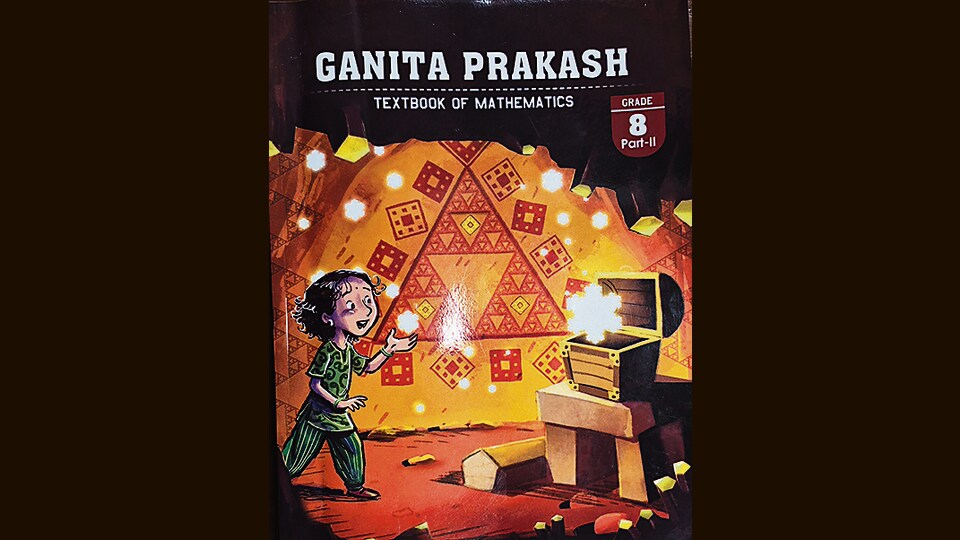
The textbook uses examples from Indian monuments and cultural contexts to explain key concepts of the subject, including Baudhayana’s theorem on right-angled triangles. The modern form of this theorem states that if a triangle has side lengths a, b, and c, with c as the hypotenuse, then the relationship a² + b² = c² holds true.
“Baudhayana was the first person in history to state this theorem in the general Pythagorean and essentially modern form. The theorem is also known as Pythagorean Theorem, after the Greek philosopher-mathematician Pythagoras (c. 500 BCE) who also admired and studied this theorem, and lived a couple hundred years after Baudhayana. It is also often called the transitional name ‘Baudhayana-Pythagoras Theorem’ so that everyone knows what theorem is being referred to,” the book says.
The book quotes multiple verses from Baudhāyana’s Sulba Sutra (800 BCE), including his statement that “the diagonal of a square produces a square of double the area,” and further explanations showing how the areas of squares on two sides combine to equal the area of the square on the diagonal, offering a clear geometric justification of the theorem.
The textbook says in Sulba Sutra (800 BCE),Baudhayana listed several integer sets such as (3, 4, 5) and (5, 12, 13) that satisfy a² + b² = c², explaining that these right-triangle side lengths are known as Baudhayana triples or Baudhayana-Pythagoras (Pythagorean) triples or right-angled triangle triples, and can be generated in infinitely many ways.
“The study of Baudhayana triples inspired the great French mathematician Fermat—who lived during the 17th century—to make a general statement about the sum of powers of positive integers,” the textbook says.
According to the textbook, Fermat famously noted in the margin of a book that “...one cannot find a single perfect cube that is a sum of two perfect cubes, a fourth power that is a sum of two fourth powers, and so on,” meaning the equation involving sums of powers greater than two have no solutions. He added, “I have found a truly marvellous proof of this statement, but the margin is too small to contain it.”
Known as Fermat’s Last Theorem, the claim remained unproven for more than 300 years until mathematician Andrew Wiles, inspired by the problem as a child, finally proved it in 1994, the book states.
“…Indian rootedness has also been kept in mind while giving contexts for different concepts. The contributions of Indian mathematicians have also been given as part of a problem-solving approach to make students aware of India’s rich mathematical heritage and its global contributions to mathematics,” said the textbook’s ‘About The Book’ section.
According to the Indian Science Heritage website, maintained by the National Council of Science Museums (NCSM), Baudhayana was an ancient Indian mathematician who lived around 800 BCE and was most likely also a Vedic priest. He predates the mathematician Apastamba and belonged to the Yajurveda tradition, it says.
This is the second part of NCERT’s (National Council of Educational Research and Training) Ganita Prakash textbook for Class 8. Part 1, which also contained references of ancient Indian contributions to the subject, was released earlier this year.
The textbook, which has seven chapters, contains examples of mathematical concepts from Indian monuments and culture. For instance, the book states that “perhaps oldest” fractals in human-made art appear in the temples of India including Kandariya Mahadev Temple in Khajuraho, Madhya Pradesh, and in temples located at in Madurai, Hampi, Rameswaram and Varanasi, among many others.
“In all the chapters, an attempt has been made to emphasise connections with other subjects including arts, social science and science.The concepts and problems in this textbook are related to daily life situations.,” said the ‘About the Book’ section.
Eknath Ghate, senior professor at the School of Mathematics, Tata Institute of Fundamental Research (TIFR), Mumbai, said the claims in the book appear to be reasonable. “We should be proud of India’s contributions to mathematics, and it is encouraging to see the work of Indian mathematicians finally being recognised in textbooks,” he said.