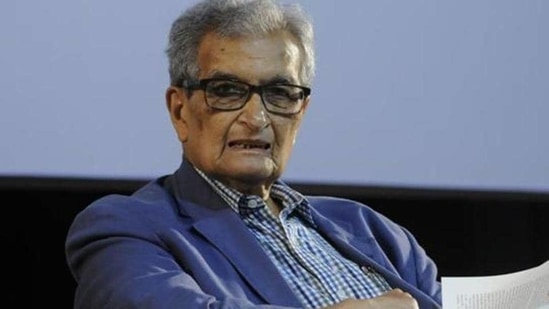
Ahead of the fifth of eight phase assembly elections in West Bengal on Saturday, Nobel laureate Amartya Sen spoke to Sunetra Choudhury about the elections and the issues involved. Edited excerpts:
Why are Bengal elections associated with violence? The fear of violence was also cited by the Election Commission (EC) for eight phase polls.
I don’t think it is because Bengal is more violent. I think the EC wanted it divided and if you see how the election is going, where the Prime Minister goes away and does a little bit of work for his Prime Ministerial role and then comes back in time for another part of the elections. This is something in which the central government clearly has some ability to participate in every activity in a way that would not have been possible if it were a one-day election or a two-day election. Now, I don’t know whether that was the reason for EC doing it in this form. A lot of people in Bengal are rather critical of the Election Commission, the way the law and order situation has gone...
Bengal is divided between Hindus and Muslims that has not been traditionally a big divider. On the contrary, if you go back to the beginning of Bengali culture and literature, in the 10th century, you will see an intermingling of Hindus and Muslims... The main epics, the Ramayana and Mahabharata, the main translating initiative came from the Muslim King in Bengal who was very fond of the epics. There has been a tradition of Hindu-Muslim unity from time to time...
{{/usCountry}}Bengal is divided between Hindus and Muslims that has not been traditionally a big divider. On the contrary, if you go back to the beginning of Bengali culture and literature, in the 10th century, you will see an intermingling of Hindus and Muslims... The main epics, the Ramayana and Mahabharata, the main translating initiative came from the Muslim King in Bengal who was very fond of the epics. There has been a tradition of Hindu-Muslim unity from time to time...
{{/usCountry}}BJP no doubt uses polarisation, but election strategist Prashant Kishor has acknowledged that TMC and Congress only tried to appease Muslims and now Hindus wanted to vote for a party that was looking at their interests. Do you agree with this?
It seems like an approximate history. Bengal has been a divided ground for a long time. When the British partitioned it early in the 20th century and wanted a Muslim part separated out, they hoped that there would be support from the Muslims in Bengal... Bengalis, both Hindus, and Muslims, were totally against it... Given that Muslims have been traditionally a lot poorer than Hindus in Bengal... there is a need for justice in dealing with it, in looking after the poor, in looking after those at the rougher end of the pyramid of justice... It is important to see who the poor in a region are and what can be done to help them. Now some of the concerns with Muslims came for the same reason as the concern for Matuas, Namasudra, and the Hindu lower caste or the Hindu-related tribal population of Bengal.
So, I think the whole idea of Muslims having done it, and now it was the time for Hindus to teach them a lesson, is just a part of the propaganda of a party inspired by Hindutva thoughts...
You spoke about the lower caste communities and the underprivileged, the BJP counts them as their voters. They also voted for them in Uttar Pradesh and in the 2019 general elections. What would explain that?
That’s a very interesting question because what happens electorally is not just a matter of what preceding justice was in a particular area. It depends so much on the organisational facility.
One of the interesting things to look at far away from Bengal or UP would be say Kerala. Kerala had more untouchability, more caste division than almost anywhere else in India. And yet, because of ultimate organisation, in this case by the Left, the caste situation changed radically over time. And it was possible for the Communist Party, which ignored these caste divisions, to get support from all the castes. We must not ignore the enormous role that political organisation plays. Hindutva has been a very dynamic political movement. I may not agree with them, but I certainly admire many of their organisational feats and they were successful not in all the elections...
Do you think certain crucial mistakes were made by the state government?
There may well have been, I haven’t studied it in particular. There are also achievements. The Bengali peasants still have a better health condition than the Gujarati peasants, despite being poorer. There are some delivery issues, but distribution has worked quite well and so on...