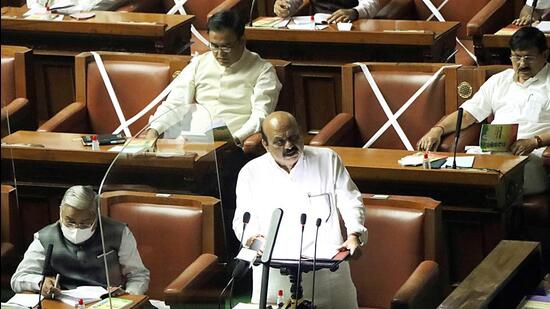
Apart from two new schemes, Bengaluru city has been given old wine in a new bottle in the budget presented by Karnataka chief minister (CM) Basavaraj Bommai on Friday. Compared to the previous fiscal year’s ₹7,795 crore, the new budget allocated ₹8,409 for the city.
To salvage the crumbling infrastructure in the city, 71.3% of the budget allocation, which accounts for ₹6,000 crores of the total allocation for Bengaluru, has been set aside. Under the state scheme ‘Amruth Nagaroththana’, this ₹6,000 crores will be diverted to the infrastructure sector over the course of three years. Experts, however, said that with inadequacies and slow speed of infrastructure development in the city, the allocation will fail to improve the scenario. As per the Budget, road development, grade separator, lake development, major stormwater drain development, development of parks, buildings, solid waste management, streetlights, slum area development etc., will be taken up under this scheme.
While most of the schemes announced were continuations of the old promises, the two new schemes involve setting up of ‘Atal Bihari Vajpayee Park’ and ‘namma clinics’.
The ‘Atal Bihari Vajpayee Park’, spread across 350 acres of government land, in Jarakabande area of Yelahanka promises to create large urban lunge spaces like Cubbon Park and Lalbagh. The project has faced protests in the past. Drawing inspiration from the Delhi government’s ‘mohalla clinics’, the government has announced setting up ‘namma clinics’ in Bengaluru and other major cities in the state. “They will be established in all the wards of Bengaluru. In these clinics, the services of detection of non-communicable diseases and referral for higher treatment to specialists will be provided,” the CM said.
{{/usCountry}}The ‘Atal Bihari Vajpayee Park’, spread across 350 acres of government land, in Jarakabande area of Yelahanka promises to create large urban lunge spaces like Cubbon Park and Lalbagh. The project has faced protests in the past. Drawing inspiration from the Delhi government’s ‘mohalla clinics’, the government has announced setting up ‘namma clinics’ in Bengaluru and other major cities in the state. “They will be established in all the wards of Bengaluru. In these clinics, the services of detection of non-communicable diseases and referral for higher treatment to specialists will be provided,” the CM said.
{{/usCountry}}A 37km-long new Metro line connecting Sarjapura to Hebbala through Agara, Koramangala and Dairy circle was also announced by the state. While no funds have been allocated for the project, the government agreeing to prepare a detailed project report has raised hopes of the project taking off in the coming years.
The Budget added that in 2022-23, 33 km of Metro line will be operationalised. With this, Namma Metro will have a total 89 km line. Metro works have been taken up to construct a 58.19 km long metro line connecting Central Silk Board with Kempegowda International Airport, which will be completed by March 2025.
Work on connecting Metro stations with Indian Railways stations will be taken up at a cost of ₹55 crore in Whitefield, KR Puram, Byappanahalli, Yeshwantpur, Jnanabharathi and Yelahanka.
Other allocations involved the construction of a skywalk worth ₹45 crore at Banashankari junction, to connect the Metro station with the bus stand; the Bengaluru suburban railway project, proposed to be completed by 2026 at an estimated expenditure of ₹15,267 crore; ‘Green Expo’ on lines of the Singapore model to be constructed in the heart of Bengaluru and grade separator/flyover work to be taken up to decongest Goraguntepalya junction.
Also, a grant of ₹1,500 crore has been earmarked to develop mega stormwater drains to cater to heavy rains and prevent floods by developing Rajakaluve in Bengaluru city.
Bengaluru-based urban expert, Ashwin Mahesh, said, “Even though the government has allocated ₹6,000 crores, but the problem is with execution.Giving the civic agencies more money is not enough because they can’t absorb money. They are already struggling to undertake the work they have been given.”
“To put things in perspective, Bengaluru is struggling with poor administration first and then comes the money problem. Whatever major was announced in the budget has going for the past 15 years and we know what it has produced,” he said. The government should have focussed on improving the intersection of Bengaluru’s ring roads, he said.
Bengaluru Bus Prayanikara Vedike, an advocacy group for bus users, expressed disappointment over the lack of allocation for bus services. “The Budget evokes a deep sense of betrayal for common people of Bengaluru. Ordinary people and their daily concerns linked to mobility have not been given rightful attention by the government. There was absolutely no mention of bus transport and no reduction of fares for common people, nor free travel for women and other vulnerable communities.”
“The misplaced focus on roads and Metros continue to drive the Budget. These infrastructure and investments don’t serve the common people. They don’t address the problem of congestion either,” the statement added.