
 E-Paper



Biden makes Kyiv visit in strong signal to Putin
In a historic visit, just ahead of the first anniversary of Russia’s war in Ukraine, President Joe Biden travelled to Kyiv on Monday to express his solidarity with the Ukraine and convey American and western support to President Volodymyr Zelensky

 Prefer HTon Google


In a historic visit, just ahead of the first anniversary of Russia’s war in Ukraine, President Joe Biden travelled to Kyiv on Monday to express his solidarity with the Ukraine and convey American and western support to President Volodymyr Zelensky. He also announced $500 million of additional military assistance to support Ukraine’s war efforts as it prepares for a renewed Russian offensive.
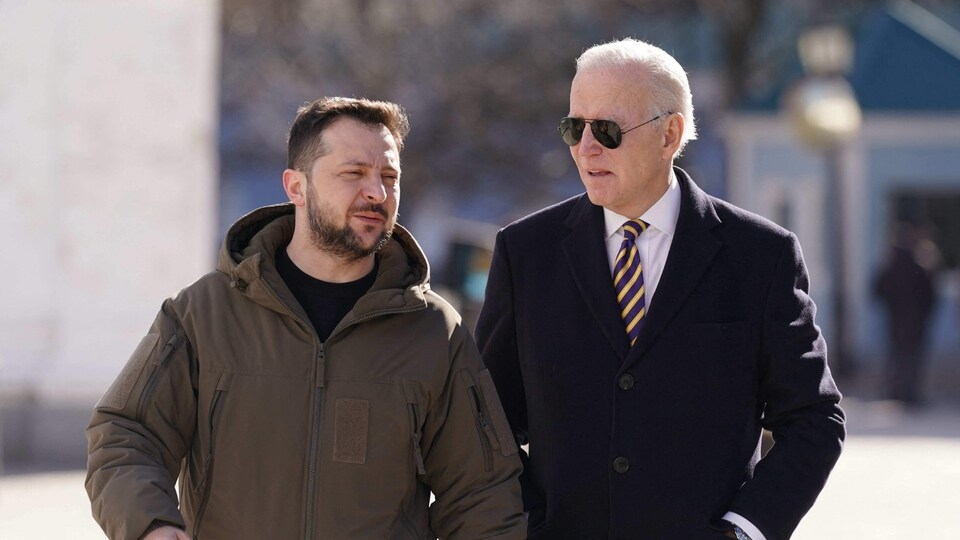
Appearing together, Zelensky said that when the war began last year, his first call was to the US. Recalling the conversation, Biden responded: “You said that you didn’t know when we would be able to speak again. That dark night one year ago, the world was literally at the time bracing for the fall of Kyiv, perhaps even the end of Ukraine. One year later, Kyiv stands. And Ukraine stands. Democracy stands.”
Biden’s five-hour visit, not announced in advance, came at a time when both sides are preparing for an intensified conflict in the spring. The war has already cost hundreds of thousands of lives, displaced millions of Ukrainians, sparked what many see as a proxy war between the US-led North Atlantic Treaty Organisation (Nato) and Russia, led to global food, fuel and fertiliser crises, and triggered at least a round of Russian nuclear brinksmanship last year. But Ukraine has surprised the international community with its fierce resistance, and the US has stayed the course in supporting Ukraine, a fact that Biden’s visit was meant to highlight.
“It’s presumptuous of me to say this but I thought it was important that the President of the United States be here the day that the attack began... I thought it was critical there not be any doubt, none whatsoever, about US support for Ukraine in the war,” Biden said. He pointed out that this was one issue on which there was a broad bipartisan consensus in the US Congress, even as Zelensky thanked the administration, the Congress and the American people for their support.
Biden said that in that first call after the war, Zelensky had asked him to gather world leaders in support of Ukraine and claimed that the US had since succeeded in building a coalition, from the Atlantic to the Pacific, in Ukraine’s support.
The US President also claimed that Russian President Vladimir Putin had miscalculated. “Russia’s aim was to wipe Ukraine off the map. Putin’s war of conquest is failing… Putin thought Ukraine was weak and the West was divided. He thought he could outlast us. I don’t think he’s thinking that right now.”
On the next steps in US assistance to Ukraine, Biden said that the new aid of half a billion dollars will cover artillery ammunition for long-range weapons like Howitzers and HIMARS, more anti-tank javelins, more anti-armor systems and air surveillance radars to protect against aerial attacks. This is on top of the western support of 700 tanks and thousands of armored vehicles, 1,000 artillery systems, more than two million rounds of artillery ammunition, more than 50 advanced launch rocket systems, anti-ship and air defence systems that has been provided to Ukraine already. The US is also set to announce new sanctions on Russian elites later in the week.
Zelensky said that the two leaders had also spoken about “long range weapons and the weapons that may still be supplied to Ukraine even though it wasn’t supplied before”, even though newer capabilities haven’t been announced yet.
The unprecedented visit was marked by suspense. This is the first time an American president has travelled to a country at war where the US does not control critical infrastructure, the President’s national security adviser, Jake Sullivan, who accompanied Biden, told reporters over a call — HT was at the briefing — soon after the American delegation left Ukraine.
The US does not have a military presence in Ukraine, unlike Iraq and Afghanistan, the other wartime theatres that past presidents have visited in recent decades. It does not control Ukrainian air space. The American embassy in Kyiv has a light footprint. And the President travelled with an extremely small delegation.
But Biden, according to Sullivan, was clear he wanted to make the visit to send a “clear unmistakable message” of enduring American support and of the unity of the West in standing behind Ukraine against Russian aggression “for as long as it takes”.
Multiple teams in the White House and officials from the intelligence community, Secret Service and Pentagon worked together over months to come up with a security and operational plan to ensure that the risk was “manageable”. Biden gave his final approval for the visit on Friday. To prevent any accident and mitigate risks, Russia was notified of the visit. “We did notify Russia that President Biden will be travelling to Kyiv some hours before departure for deconfliction purposes,” said Sullivan.
Biden departed from the Andrews Air Base near DC on Sunday at 4.15 am, eastern time, and arrived in Kyiv almost 23 hours later, at 8 am on Monday, local time. There is speculation that the President travelled by air to Poland, and then took a train, though officials have not revealed the modes of transport yet due to security reasons.
At 8.30 am local time, Biden went to Mariinsky Palace, where he was received by Zelensky, who thanked him for coming. On his eighth visit to the city, Biden then told a reporter that the visit’s purpose was to show US is here to stay. “We are not leaving”. The two leaders then went inside, introduced their respective teams to each other, had structured bilateral discussions, after which Biden and Zelensky met separately.
A little after 11am, the two leaders then visited the St. Michael’s Gold-Domed Cathedral in central Kyiv, where they did an outdoor walkabout. The two also laid a wreath at the Wall of Remembrance for the fallen heroes war as a military salute played in the background.
Sullivan said that the two presidents had a “detailed discussion on battlefield situation”, the support that the US had already provided and the capabilities that were needed. While the US did not announce any new equipment assistance, the NSA said they had a “good discussion on the subject”, with both sides laying out their perspective.
Biden and Zelensky also spoke about the political elements of the crisis, including an upcoming session on Ukraine at the United Nations General Assembly, Ukraine’s peace formula and the US determination to hold the “large and diverse international coalition” together to support Ukraine for as long as it took. Acknowledging difficult times lay ahead, Sullivan said. “This was not a celebration but an affirmation of the courage of the Ukrainian people.” Biden travelled to Poland from Ukraine, where he will give a major speech on Tuesday to mark the war anniversary.


