Global tech giants and homegrown start-ups have set their sights deep into India’s impoverished farm economy. They believe the sector can offer opportunities worth billions at a time when the Modi government is wagering big on private investment to transform the country’s agriculture sector.
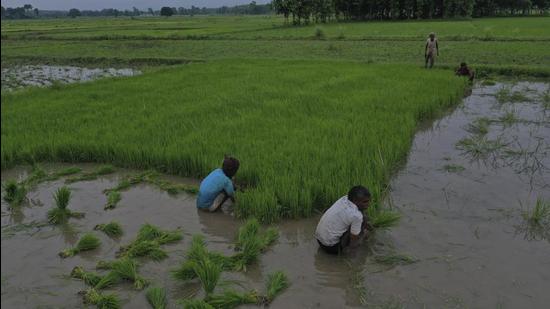
This technology thrust however runs parallel to year-long protests by farmers’ groups against a move to liberalise the agriculture sector through three federal laws. The farmers allege the laws will expose them to exploitation by big
Global tech giants and homegrown start-ups have set their sights deep into India’s impoverished farm economy. They believe the sector can offer opportunities worth billions at a time when the Modi government is wagering big on private investment to transform the country’s agriculture sector.
This technology thrust however runs parallel to year-long protests by farmers’ groups against a move to liberalise the agriculture sector through three federal laws. The farmers allege the laws will expose them to exploitation by big corporations and gradually wean them off long-standing state support. Nearly half the population depends on farm incomes.
The agriculture ministry last week signed a slew of agreements with tech firms, including with three American giants, to push a big-data project called Agristack, first reported by HT in 2018, when preliminary plans were afoot. Firms can now access the data of millions of farmers to develop high-tech solutions.
Some of the changes are historic. Amazon India has launched farm-input products on its platform. An algorithm-based hand device by Trimble Inc, an American firm, can instantly read soil nutrient levels.
Also Read | ‘Survey shows farm incomes have risen’
Bengaluru-based Crop-in Ltd offers an AI-based cloud-computing solution, which can remotely detect crop damage. Leveraging artificial intelligence, Agrograde, an Indian startup, is working on standardising quality in fresh produce by automating grading that can literally sort bad apples out.
On the ground, farming remains an occupation of drudgery and risks. A latest government survey says the share of farmers’ income from cultivation has been declining. Farmers receive less prices than they pay for their daily needs, known as terms of trade. Often, they sell below cost of cultivation.
“We are excited to partner with government of India’s vision of empowering farmers with technology. The rapid penetration of smartphones and internet can help Indian agriculture experience a paradigm shift,” said Amit Agarwal, the country head of Amazon India.
A recent research note from consultancy Bain and Company said agritech would create a “value pool” of $30-35 billion by 2025. Already, India stands third globally in terms of agritech startup funding, after Germany and the US.
Technology is critical in a country where farm incomes are low, about one-third of those of non-agricultural households.
Data show that in manufacturing, high-tech has spread fast, a process called technology diffusion. The-then World Bank president Jim Kim, in a 2016 speech, predicted so much that automation in non-farm sectors would threaten 69% of today’s jobs in India.
“The challenge in technology is that land holdings are so small that even using a tractor makes no sense in some farms,” said former economist with Tamil Nadu Agricultural University, K Mani. Secondly, all Indian technologies are meant for irrigated lands only, he said.
Trimble Inc is tapping into a rental model for farmers to hire their farm equipment to make products affordable.
Last month, wholesale prices of tomato fell sharply to a nearly three-year low, as loss-making farmers in Maharashtra and Haryana dumped the produce or fed them to cattle.
Homegrown startups such as Arya.ag, a value-chain integrator, promises to solve these problems with artificial-intelligence-driven products such as “Hermetic solution”. This an on-demand warehousing option for locations where traditional warehousing is not available, CEO Prasanna Rao said.
Recent research by economist Ashok Gulati and his colleagues shows that governments have raised input subsidies over the years, which, in turn, have virtually turned the tap off for new public investment. This has had the effect of choking off agricultural growth, it said.
Over a 33-year period, public capital formation in agriculture, a measure of investments, including in technology, has declined from 3.9% of agricultural GDP in 1980-81 to 2.2% in 2014-15. However, input subsidies on fertilisers, power, water and crop insurance have shot up from 2.8% to 8% during this period.
“For a true revolution, these technologies must affordable and be suitable for small-scale farmers, who make up 85% of our total farming community,” said Kapil Regen, an economist with Comtrade.
Trimble Inc’s says it targets the top and middle of Indian farms. “About 20-30% of large and medium farmers control 70-80% land and our initial target are those farmers,” the firm’s managing director Rajan Aiyer had told HT on an earlier occasion.
One Subscription.
Get 360° coverage—from daily headlines
to 100 year archives.
Archives
HT App & Website