
 E-Paper



Bill to grant India freedom greenlit by House of Lords
HT carried a report on the House of Lords approving the Indian Independence Bill on its front page on July 17, 1947

 Prefer HTon Google


The House of Lords on July 17 approved the India Independence Bill, which will grant full independence on August 15 to the two new dominions of India and Pakistan. The Bill now only awaits the formal Royal Assent on Friday to become law, in what is expected to be a formality.
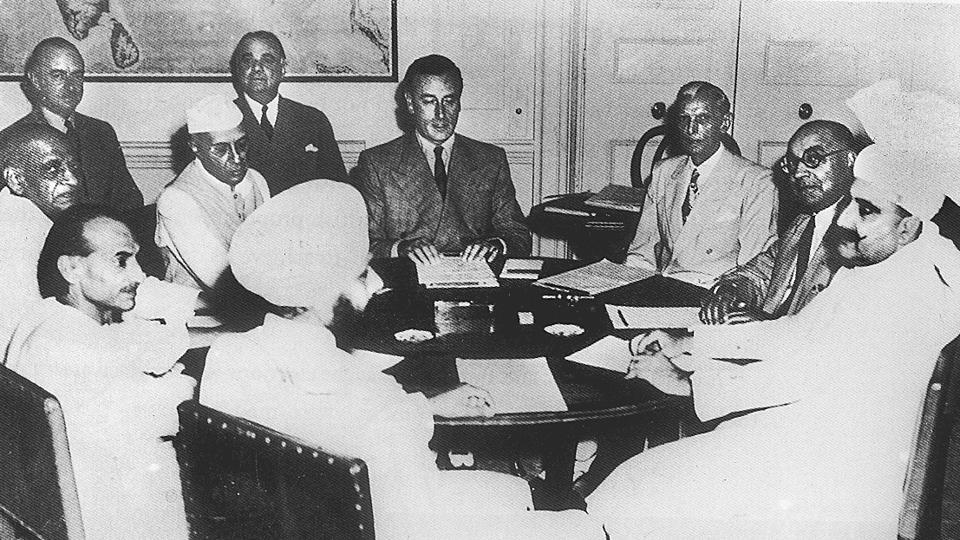
The Bill proposes the formation of the two independent dominions, the partition of the Bengal and Punjab provinces between the new nations, the transfer of legislative powers to the respective constituent assemblies of the countries as well as surrender of British control over the princely states. The proposed legislation is a modification of the plan laid down by Lord Mountbatten, the Viceroy of India, in June
The measure, rushed through all its stages in the Upper House in about five hours, was greeted with the whole-hearted approval of Labour and Conservative peers, many of whom had been closely associated with Indian affairs for the past two decades.
Lord Listowel, the last secretary of state for India, was supported in his messages of goodwill to the two dominions by Lord Halifax, a former Viceroy of India, Lord Pethick-Lawrence, his predecessor in the India Office, and Lord Templewood, former secretary of state for India.
Lord Listowel, emphasising that the move to give self-government to India was an achievement which might well be the opening of a new chapter in the growth of freedom under British rule, declared that Britain’s love of India and her desire to serve India were stronger than ever. “We only ask the opportunity,” he said.
Lord Listowel said the Bill would mark the emergence of two Asian Dominions as equal partners in the Commonwealth.
“Our record during the British connection with India is, on the whole, and despite mistakes and failures — which one must hope our Indian friends will forgive — a record of efficient administration, ungrudging service, and a broadening of freedom. It is something of which our fellow countrymen can feel justly proud.”
During this period, Lord Listowel said, the authorities both at home and in India had displayed an understanding, “not exceeded by the genius of the Romans,” of the political requirements of a society wholly different from their own. After mentioning the milestones on India’s road to full nationhood, Lord Listowel said the new Dominions would remain “in form as well as in spirit, political democracies.”
He mentioned that the Constituent Assembly had recommended that the new Dominion of India should have a bicameral federal legislature, of which the Upper House would be called the Council of States and the Lower Chamber, the House of the People.
Lord Listowel deplored the fact that British India would reach maturity as two nations instead of one, but said it was better that India be divided by mutual consent than remain united against her will and be thrown ultimately into the convulsion of civil strife.
“It was greatly to be hoped that when the disadvantages of separation had come to light, the two Dominions would agree to reunite in a single unit which might achieve a foremost position in world affairs,” he said.
Lord Pethick-Lawrence, who headed the British Cabinet Mission to India in 1946, declared that while he believed their plan had been the better one, he gave the Bill his wholehearted support because it had won the approval of the main political groups concerned.
The 1946 plan proposed a complicated governance structure. It said that a unified Union of India comprising three groups of provinces, one each for Hindu-majority, Muslim-majority and mixed-population provinces, would form their own constitutions. Over and above this, a national constituent assembly would put down a constitution for the Union as whole.
However, the plan was rejected after the Congress and Muslim League separately said it did not meet their demands.
Lord Halifax, Viceroy from 1926 to 1931, paid tribute to the work of the Labour government and emphasized the benefits of India remaining within the Commonwealth.
Lord Templewood, who, as Sir Samuel Hoare, piloted through Parliament the 1935 Government of India Act, sounded a note of warning. He said that India’s defence might be “irrecoverably damaged” if the two defence forces “drifted into watertight compartments”.
One of the few dissentient voices in the House was that of Lord Selbourne, Conservative, who declared that he regarded the future of India under this settlement as a relapse into that internecine warfare from which Britain rescued it. He would be surprised, he said, if other countries did not intervene in that warfare either openly or secretly.


