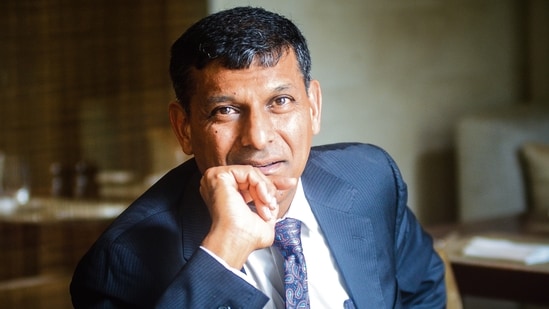
Former Reserve Bank of India governor Raghuram Rajan said Donald Trump's 50 per cent tariff against India is a big “blow” to US-India relations, describing it as a “wake-up call” for the Indian government.
US President Donald Trump's doubling of tariffs on imports from India to as much as 50 per cent took effect as scheduled on Wednesday, delivering a serious blow to ties between two powerful democracies that had in recent decades become strategic partners.
A punitive 25 per cent tariff, imposed due to India's purchases of Russian oil, was added to Trump's prior 25 per cent tariff on many imports from the South Asian nation.
In an interview with India Today TV on Thursday, Raghuram Rajan feared that the US move could particularly hurt small exporters such as shrimp farmers and textile manufacturers, putting livelihoods at risk, saying it's “deeply distressing”.
According to the noted economist, trade, investment, and finance have increasingly been weaponised in today’s global order and India should tread carefully.
{{/usCountry}}According to the noted economist, trade, investment, and finance have increasingly been weaponised in today’s global order and India should tread carefully.
{{/usCountry}}"This is a wake-up call. Let us not become dependent on any single country to a large extent. Let us look east, to Europe, to Africa, and continue with the US, but unleash reforms that will help us achieve the 8–8.5% growth needed to employ our youth," Rajan said in the interview.
Trump's additional 25% tariff takes effect
The additional 25 per cent duties take total tariffs as high as 50 per cent for goods as varied as garments, gems and jewellery, footwear, sporting goods, furniture and chemicals, among the highest imposed by the US and roughly on par with Brazil and China.
The new tariffs threaten thousands of small exporters and jobs in India, including Gujarat, and are expected to hurt growth in the world's fastest-growing major economy.
India should reassess policy on Russian oil imports: Raghuram Rajan
Rajan said India should reassess its policy on Russian oil imports. “We need to ask who benefits and who is hurt. Refiners are making excess profits, but exporters are paying the price through tariffs. If the benefit is not large, perhaps it is worth considering whether we should continue these purchases,” the former RBI governor was quoted as saying.
On India's improving trade ties with China, the former chief economist at the International Monetary Fund (IMF) said, "By all means, work with China, Japan, the US, or anyone else. But don’t be dependent on them. Ensure you have alternatives, including self-reliance where possible."
‘Blow to US-India relationship’
Calling it a “blow” to the US-India relationship, Rajan added that the move will particularly hurt small exporters such as shrimp farmers and textile manufacturers, putting livelihoods at risk. “It is also harmful to the US consumer, who will now buy goods at a 50 per cent markup,” he said.
The higher tariff on India came despite months of talks between New Delhi and Washington. While India was one of the first countries to open negotiations with the Trump administration, officials have expressed frustration with high levies and protectionist policies in key areas such as agriculture. Farmers are a vital voting bloc in India, reported Bloomberg.
Donald Trump has criticised India for its purchases of Russian crude. Russian oil is not sanctioned, and indeed purchases were tacitly encouraged by US officials after the Group of Seven nations imposed a $60-per-barrel price cap in 2022, after the invasion of Ukraine, as a way of keeping supply in the market while controlling revenue that headed back to the Kremlin.
Historically, India was not a significant importer of Russian crude, depending more heavily on the Middle East, but it seized the opportunity presented to contain domestic energy costs.
New Delhi has defended its ties with Russia and has called Washington’s actions “unfair, unjustified and unreasonable".
While India is a vital buyer of seaborne Russian crude, China remains the largest client. There, however, the Trump administration has taken a softer stance amid a broader trade dispute.
(With inputs from Bloomberg)