Peace and tranquillity in the border areas are the prerequisite for normal India-China ties, external affairs minister S Jaishankar told his Chinese counterpart, Wang Yi, on Wednesday, even as he raised New Delhi’s concerns about fair access to Chinese markets, balanced trade and predictability of supply chains.
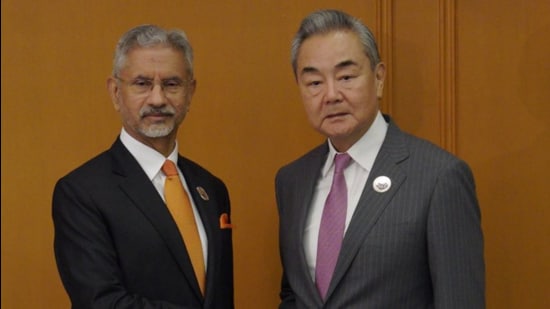
The two leaders met on the margins of Asean-related meetings in the Philippines capital of Manila at a time when India and China are slowly rebuilding their ties after a military stand-off on the Line of Actual Control (LAC) that began in 2020 and lasted more than four years. Wang visited India in June and met National Security Adviser Ajit Doval to review progress in the efforts to normalise ties.
Jaishankar said on social media he had a wide-ranging discussion with Wang, in which he emphasised the Indian position that a stable and cooperative relationship “can best be developed on the basis of mutual respect, mutual interest and mutual sensitivity” to contribute to a multipolar Asia and a multipolar world.
“Peace and tranquillity in the border areas is obviously the prerequisite for normal ties. Since October 2024, both sides have engaged to ensure that important objective. This will continue to need our constant attention,” he said, referring to the understanding reached by the two sides in 2024 to end the face-off on the LAC that took bilateral relations to a six-decade low.
Jaishankar acknowledged the steps taken by both countries to normalise relations over the past few months, including the resumption of direct flights, updating the visa regime, restarting the Kailash Manasarovar Yatra and re-commencing border trade, but pointed out there were other “important dimensions of our ties that need to be addressed”, such as the trade imbalance.
“Fair market access and a trade balance rank high in that regard. There are also concerns about predictability of supply chains,” Jaishankar said while highlighting India’s trade-related concerns. “Facilitating both official and people-to-people exchanges merit our attention. We also need to agree on the meetings of various mechanisms and platforms as per our mutual priorities,” he said.
China’s curbs on exports of critical commodities such as rare earth metals, fertilisers and heavy machinery such as tunnel boring machines have impacted India over the past two years. Chinese officials have contended that this was “collateral damage” from actions aimed at the US, but the Indian side perceives these steps as restrictive trade measures.
Also Read | Changing power equation in the Indo-Pacific
New Delhi also has serious concerns about the heavily asymmetric trade with Beijing, and has called for easier access to Chinese markets and steps to address the trade deficit, which recently reached an all-time high of $112 billion. Two-way trade in FY26 was worth $151 billion, but India’s exports were valued at only $16.6 billion.
Jaishankar told Wang, whom he last met a year ago, that India-China relations “have been gradually normalising” since a meeting between Prime Minister Narendra Modi and President Xi Jinping in the Russian city of Kazan in October 2024 and this “direction was further affirmed when they met in Tianjin last August”.
Mechanisms to ensure peace and tranquillity in the border areas “must be given full support and strong encouragement”, Jaishankar said while making it clear that the interests of both sides should not come in the way of managing and resolving differences.
“It is natural that as two large and important nations, and that too proximate neighbours, India and China would have their own particular interests. That is why our leaders had agreed that differences should not become disputes. It is the responsibility of diplomacy to properly manage them,” he said.
Jaishankar appreciated China’s support during India’s presidency of the Brics grouping this year.
The Indian side has maintained that proper handling of the border issue is central to developing bilateral relations. Beijing has repeatedly called for differences over the boundary to be put in its “appropriate place” as the two countries take forward their ties in other fields such as trade.