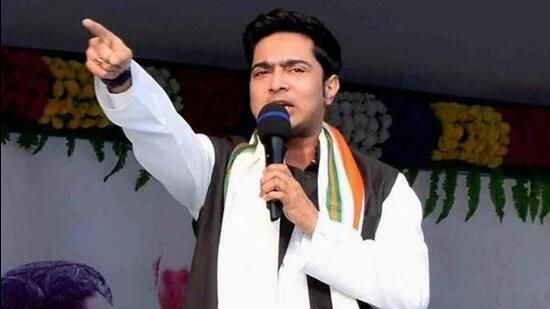
NEW DELHI: The Supreme Court on Thursday asked the Enforcement Directorate (ED) if it was willing to interrogate Trinamool Congress leader and Member of Parliament Abhishek Banerjee in Kolkata if by an order the state police were made to cooperate and the state government held accountable for the safety of ED officials.
Posting the matter to Tuesday to facilitate ED to produce certain records, the Court got an oral assurance from the investigating agency that nothing will be done in the meanwhile to “precipitate” the case.
The suggestion by the court came while hearing a petition by Abhishek Banerjee, the Trinamool Congress general secretary and nephew of West Bengal chief minister Mamata Banerjee. He along with his wife Rujira had challenged the summons issued to them by ED on September 10, 2021 to appear in Delhi in connection with a money laundering probe. The duo had lost before the Delhi high court which refused to quash the summons by an order passed on March 11.
The Trinamool MP had urged the top court to consider that being an important opposition leader, he should not be required to appear in Delhi as the Centre could try to “fix” him using central investigation agencies and that he would cooperate if he was allowed to appear in Kolkata where ED has an office.
The bench of justices UU Lalit, S Ravindra Bhat and Sudhanshu Dhulia said, “What if we say that the moment you make a requisition three days in advance, the Kolkata police shall extend all cooperation. We will also hold the state government accountable for any action.”
{{/usCountry}}The bench of justices UU Lalit, S Ravindra Bhat and Sudhanshu Dhulia said, “What if we say that the moment you make a requisition three days in advance, the Kolkata police shall extend all cooperation. We will also hold the state government accountable for any action.”
{{/usCountry}}Additional solicitor general (ASG) SV Raju appearing for ED said, “My lords know how the central agencies were treated in Kolkata.”
He was referring to the incidents that took place in the state in May last year when upon the arrest of four senior Trinamool leaders - two state ministers Firhad Hakim and Subrata Mukherjee and two former state ministers Madan Mitra and Sovan Chatterjee- by the central bureau of investigation (CBI) in connection with the Narada sting tape case, chief minister Mamata Banerjee staged a dharna at the CBI office and the state law minister Moloy Ghatak led a mob outside the trial court which granted bail to the four persons.
“The CBI officers were gheraoed and there were apprehensions on their safety. The petitioner is an influential politician in the state,” the law officer said. He told the court that Banerjee has appeared on past occasions and being an MP, he has a residence in Delhi as well. “I can file the documents to show his reply where his address in Delhi is shown,” the law officer said, seeking an adjournment. The court posted the matter for Tuesday and told ED, “We are not passing any order but things may continue as they are. ASG assured the Court, “There won’t be any precipitative action till the next date.”
For Banerjee and his wife, senior advocates Kapil Sibal and Abhishek Manu Singhvi appeared. Sibal told the court that Section 160 of the Code of Criminal Procedure Code (CrPC) clearly provides that the police can require attendance of witnesses at the place where they reside. “I am not saying no to investigation. All that I am saying is you (ED) come to Kolkata and interrogate me. Why do they wait for me to come to Delhi?”
Singhvi pitched for Rujira and reminded the court that the predicate offence on which the money laundering charge is being investigated was registered at Kolkata and ED can certainly question the witnesses at their Kolkata office.
Raju told the court that Section 160 applies to police investigation while in money laundering offences, the applicable law is Section 50 which does not require summoning of witnesses at their place of residence. He further pointed out that this question whether Section 160 CrPC will apply to PMLA investigations is an issue pending before another bench of the Supreme Court where judgment has been reserved.
Even under Section 160, the summoning at place of residence is restricted to women and males below 15 years. “Clearly, he (Banerjee) cannot seek benefit under this provision,” ASG Raju said, adding, “The investigation in the case is getting delayed due to non-cooperation by the petitioners.”
Banerjee had said in his petition that the order by the Delhi high court ignored the fact that the petitioner is an “important opposition leader” and his party defeated the political party at power in the Centre thereby giving justifiable cause to “target” and “fix” the petitioner by misusing the central investigation agencies against him. The petition filed by advocate Sunil Fernandes raised a question of law whether ED can assume a “pan-India jurisdiction” to summon any person at any place of their choice in utter derogation of the fundamental rights of the witness/accused persons, principles of fair play and expeditious investigation and the provisions of the CrPC and PMLA.