The charts that matter
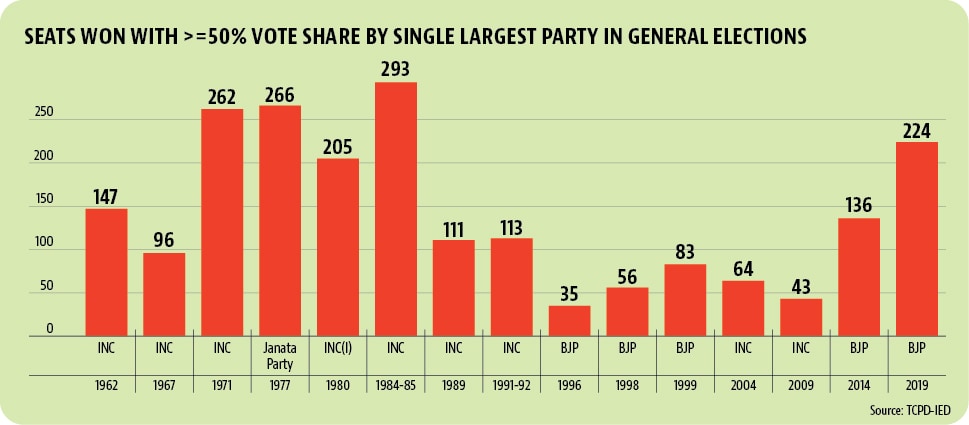 224 of BJP’s 2019 Lok Sabha seats were won with a vote share higher than 50%The central premise of an all-in-unity electoral strategy against the BJP is that it will prevent fragmentation of anti-BJP votes. In India’s first-past-the-post system, it is possible for a party to win a particular constituency without winning a majority vote share. How effective would such a strategy be against the BJP? The BJP won 224 out of its 303 parliamentary constituencies (PCs) with a vote share of 50% or more in 2019. In 2014 this number was just 136. Even if there were a wider opposition alliance, the BJP would not have lost these contests. To be sure, the number of PCs where the BJP’s 2019 vote share is more than 50% is still less than what the Congress or Janata Party had at their own peaks.
- What about the PCs where the BJP had a sub-50% vote share?In the 2019 general elections, BJP won 79 PCs with a vote share below 50 per cent. Out of these 79, the combined vote share of the second and third ranked candidates was more than the BJP in 48 PCs. This suggests that even an understanding between the two biggest anti-BJP candidates would not have inflicted a big loss on the BJP’s tally in 2019.
- 106 of the BJP’s PCs in 2019 are from states where there is no significant third force to ally with the principal opposition partyOf the 303 PCs the BJP won in 2019, 106 are from seven states – Gujarat, Rajasthan, Haryana, Madhya Pradesh, Chhattisgarh, Himachal Pradesh, and Uttarakhand – where it is in a direct contest with the Congress. No other political party apart from the Congress and the BJP had a state-wise vote share of even 5% in these states. This means that even if there was an agreement over a wider alliance, there would not be a party to ally with the Congress in these states.
- Another 124 of the BJP’s 303 PCs come from states where an opposition unity is extremely unlikelyThe BJP won 124 out of 303 PCs in 2019 from Uttar Pradesh, West Bengal, Odisha, Delhi, Karnataka and Telangana. In each of these states the current state of play between opposition parties – SP and BSP in Uttar Pradesh, TMC and Congress/Left in West Bengal, BJD and Congress in Odisha, BRS and Congress in Telangana and AAP and Congress in Delhi and Congress and JD(S) in Karnataka – suggests that a larger opposition alliance is extremely unlikely if not downright impossible. The unlikely did happen in two states in 2019, but the larger alliance of the SP-BSP in Uttar Pradesh and the Congress-JD(S) in Karnataka in 2019 did not inflict much damage to the BJP in 2019.
- But the BJP could face significant damage due to a larger alliance in Bihar and MaharashtraMaharashtra and Bihar have a total of 88 PCs in the Lok Sabha and the National Democratic Alliance (NDA) won 80 of these in the 2019 elections. With the JD(U) walking out of the NDA in Bihar and the Shiv Sena having undergone a split in Maharashtra, political equations in these two states have become uncertain. While a simple realignment of party-wise vote shares can be misleading, there is merit in being circumspect about the claim that the BJP will not suffer any losses because of these realignments.
Get the latest India News, breaking headlines and real-time updates from across the country. Stay informed about politics, government policies, crime, weather and major national developments.
Get the latest India News, breaking headlines and real-time updates from across the country. Stay informed about politics, government policies, crime, weather and major national developments.
Advertisement
{{/htLoading}}{{#usCountry}}