E-Paper



CBI arrests NTA-appointed expert accused of leaking NEET-UG physics questions; 11th arrest so far
The accused, Manisha Sanjay Havaldar, is currently employed at Seth Hiralal Saraf Prashala in Pune, Maharashtra.

 Prefer HTon Google


The The Central Bureau of Investigation (CBI) has arrested a third National Testing Agency (NTA) expert in the NEET-UG 2026 paper leak case — a Pune-based physics teacher who allegedly shared questions from the Physics paper with co-accused Manisha Mandhare — confirming that the entire paper comprising all three subjects was compromised.
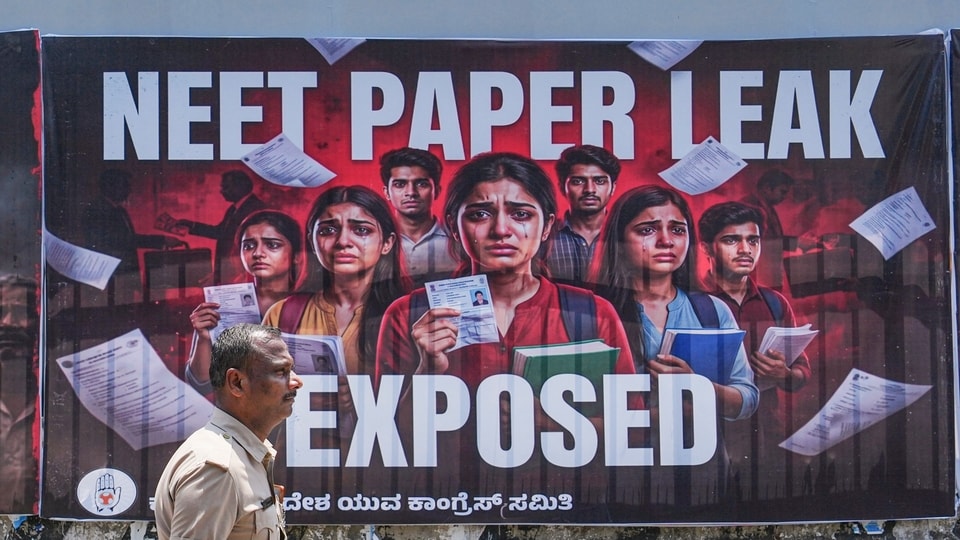
Friday’s arrest was of Manisha Sanjay Havaldar, a Pune-based Physics teacher and principal of Seth Hiralal Saraf Prashala. The federal agency has now identified an NTA contractor behind each of the three subject papers: PV Kulkarni for chemistry, Manisha Mandhare for botany and zoology, and Havaldar for physics for leaking the questions to one of India’s most consequential medical education tests.
“She was the source for leak of NEET-UG 2026 examination physics questions,” the CBI said. All three were appointed by NTA as experts and had complete access to their respective papers.
“During April 2026, she had shared some of the questions of the NEET-UG 2026 examination pertaining to physics with co-accused Manisha Mandhare. The questions she shared have tallied with the physics questions of actual paper sets,” the agency said, offering the first confirmation of the leak of the third main portion of the exam sat by 2.27 million candidates.
HT reported on Thursday that NTA had asked the CBI to determine whether physics questions had also been leaked in addition to chemistry and biology.
The physics breach differed in mechanism from the other two: while Kulkarni and Mandhare had each conducted special coaching classes at their Pune residences where students directly copied questions, Havaldar allegedly shared the questions with Mandhare rather than distributing them to students herself.
Mandhare, according to CBI’s statement last week, had mobilised prospective students through co-accused Manisha Waghmare — a Pune beauty parlour owner arrested on May 14 — and held classes at her Pune residence where she disclosed questions from the papers she had access to. CBI suspects that the Physics questions shared by Havaldar with Mandhare were also disclosed to the students who took those classes, officials said.
“We are yet to ascertain the extent of involvement of Havaldar in the paper-setting process. We have not received any PDF of the leaked physics questions, unlike chemistry and biology,” a senior National Testing Agency official said on condition of anonymity.
The arrests of Kulkarni on May 15, Mandhare on May 16, and now Havaldar complete a picture of systematic insider. Nearly all 90 biology questions and all 45 chemistry questions of the May 3 paper were circulated as guess papers at least a week before the exam; an independent analysis of the leaked PDFs by HT has confirmed the extent of the overlap.
The questions were sold to students for as much as ₹30 lakh.
Immediately after Havaldar’s arrest, she was suspended by the college administration which appointed a five-member committee to investigate the case in detail.
Satish Gavali, secretary at Vidya Prasarini Sabha which runs Seth Hiralal Saraf Prashala, said, “Considering the seriousness of the subject, we have immediately suspended her from her duty and appointed a five-member committee to further detail investigation of the case.”
Also Read | NTA to CBI: Probe possible Physics questions leak too
Eleven persons have now been arrested across Delhi, Jaipur, Gurugram, Nashik, Pune, Latur, and Ahilyanagar. Apart from the three NTA experts, those in custody include Shivraj Raghunath Motegaonkar, founder of a prominent Latur-based medical and engineering entrance test coaching centre; Waghmare, the beauty parlour owner who served as the key link between the NTA insiders and the student network; Dhananjay Lokhanda, Shubham Khairnar, Mangilal Biwal, Vikas Biwal, Dinesh Biwal, and Yash Yadav.
The CBI conducted searches at multiple locations on Friday, seizing incriminating documents, laptops, bank statements, and mobile phones.The agency said its investigation has now “brought out the actual source of the leakage of the question papers.”
“The middlemen, involved in mobilizing the students who paid lakhs of rupees to attend the special coaching classes where the questions which would come in the NEET UG-2026 exam were shared, have also been identified and arrested,” a spokesperson said. NTA cancelled the exam on May 12 after the leak was all but confirmed when the “guess paper” PDFs emerged. More than 2.2 million candidates will now have to retake the test on June 21.
Parent of Latur aspirant may become CBI witness
The parent of an aspirant in Latur, who allegedly provided a house to conduct special classes to train aspirants with the leaked question papers before the May 3 exam, is likely to become a witness for the CBI, officials aware of the matter said. Manoj Shirure, a paediatrician, was questioned by the agency after investigators allegedly found a link between him and the arrested accused, including Motegaonkar and Kulkarni. According to the agency, Shirure had procured the leaked paper for his son.