The Forest (Conservation) Amendment Act, 2023 will benefit real estate companies that own land in what was to be declared “deemed forest” in Haryana’s Aravallis, documents show.
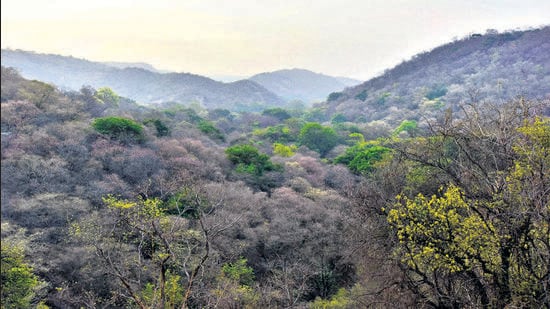
For example, in Mangar village spread over 4262 acres (of which 3810 acres is hill area), a large part of land that should have been identified as forest as per dictionary meaning is in fact owned by three private companies, Ireo Private Limited, M3M India Private Limited, and Patanjali Yogpeeth Trust , and a web of their subsidiaries . A part of the biodiversity rich sacred grove, Mangar Bani, one of the last remaining patches of primary forest in this entire region, is also owned by one of these companies, papers show.
HT has seen latest jamabandi records of 2018-19 available on Haryana government’s website and other documents that show nearly 1,000 acres of Mangar’s forest-like area, also denoted as gair mumkin pahar (uncultivable land)is owned by these three companies. To be sure, other private companies also own smaller patches of land here.
Also Read: Nagaland assembly passes resolution on Forest (Conservation) Amendment Act 2023
Ireo, M3M and Patanjali did not respond to detailed questionnaires. A person who answered the phone at one of Ireo’s offices said management was unavailable to speak.
Speaking on condition of anonymity, a representative of Patanjali Yogpeeth Trust said a senior executive of the firm, handling land-related issues,died on September 24, explaining that this meant the company would not be able to respond. He added: “The amendment to the forest conservation act is a development oriented and not destruction oriented.”
When contacted over phone a director at M3M declined to comment “as it is a legal matter”.
{{/usCountry}}When contacted over phone a director at M3M declined to comment “as it is a legal matter”.
{{/usCountry}}Also Read: Wildlife board’s key panel to take call on how to conserve grasslands
The amendment removes the protection forest land such as this derived from a 1996 Supreme Court judgment that dealt with forests identified as per dictionary meaning of the word or deemed forests. The Supreme Court’s December 12, 1996 verdict in TN Godavarman Thirumulpad vs. Union of India & Others case directed that “forests” will not only include forest as understood in the dictionary sense, but also any area recorded as forest in government records irrespective of the ownership.
The Supreme Court in its Godavarman order directed state governments and UTs to identify forests as per dictionary meaning of the word and treat them as forests for purpose of the Forest (Conservation) Act, 1980 irrespective of ownership and condition. Over 25 years after the top court order, Haryana did not identify any deemed forests. Even Mangar Bani sacred grove, a dense forest with rich biodiversity, was awaiting a deemed forest tag. Haryana presently has a forest area of only 3.63% of the total geographical area of the state.
Speaking on condition of anonymity, a senior official from the Haryana forest department said detailed guidelines on implementation of the Forest (Conservation) Amendment Act, 2023 have not been issued by the Union environment ministry. “We will take a call based on the guidelines (once they are issued),” the official added.
“Total area of gair mumkin pahar in Mangar is around 3810 acres out of which 1132 acres is notified under Punjab Land Preservation Act (PLPA) special section 4, and hence has to be treated as forest as per Supreme Court orders. Another few hundred acres falls in the Aravalli Plantation zone, which is also recorded as forest. The rest of the Aravalli area – around 2,500-odd acres -- should have been declared as deemed forests as per Supreme Court’s 1996 Godavarman judgment but now the FC Act amendment seems to have removed that category,” said Chetan Agarwal, Gurugram based forest analyst.
HTs analysis of land records in Mangar shows the ownership of what would have been called “forest” land by Ireo Private Limited, M3M India Private Limited and Patanjali Yogpeeth Trust and several other private companies.
One of the subsidiaries of Ireo, Massive Infracon Private Limited, owned around 400 acres in Mangar as per communications between the company and Director General, Town and Country Planning, Haryana dated June 5, 2012, as seen by HT.
“If these are private lands they do not come under our jurisdiction and hence we have nothing to say,” said an official from Haryana forest minister, Ch Kanwar Pal’s office.
A 2019 environmental clearance form of Kenwood Mercantile for a Proposed Tourism & Recreation Project on Land measuring 388 acres at Faridabad-Gurugram Road said the project coordinator is a Satya Singh from M3M India indicating that Kenwood Mercantile which owns large land parcels in Mangar is a subsidiary of M3M. The EC application was not taken forward.
Interestingly, the Haryana government in June, 2016 issued a notification stating that Mangar Bani was a “no-construction zone”. The 677.12 acres of Mangar Bani and its buffer area of 1,266.91 acres were free from encroachment, the government had said then. It however did not notify the sacred grove as a “forest”.
“Based on analysis of Jamabandi documents and company papers we find that these three companies and their subsidiaries or related companies own or control around 1000 acres in Mangar,” said Agarwal who has tracked and analysed the web of companies and land documents.
The Aravalli land in Mangar were common lands that belonged to the village community and were recorded as shamlat deh (common land in revenue records) since pre-independence. Subsequently it was transferred to the panchayat under the Punjab Village Common Lands Act 1961 and recorded as panchayat deh (panchayat land in revenue records) in 1963-64 jamabandi.
Around 1973-74, by mutation no 155, around 3809.63 acres of land here was mutated from panchayat deh to shamlat deh and thereafter transferred to the village proprietors (thereby transferring ownership from the panchayat to joint ownership of the village proprietors). The mutation was sanctioned on the basis of an order of a sub-judge in Ballabhgarh dated March 14, 1973 according to Agarwal.
“Some villagers from Mangar moved the local court to get a judgement in their favour to privatise the common land. That was the beginning of how land started to be sold to private developers in Mangar. Thereafter, several other villages near Mangar also moved court to get an order to fraudulently privatise Aravalli common lands. This was followed by sale in undivided shares of the common land to outsiders,”he added. However, an undivided share was just owned in common with all the other new owners. To obtain plots, the common land needed to be partitioned. Around 1985-86, the consolidation proceedings were misused to partition the erstwhile panchayat/shamlat hill area of Mangar, according to Agarwal..
On August 4, the Forest Conservation Amendment Act 2023 was notified.
One of the contentious provisions of the new law is that it exempts unrecorded deemed forests from the modified law on forest conservation.
The FC Amendment Act states that it will recognise land that has been declared or notified as a forest in accordance with the provisions of the Indian Forest Act, 1927 or under any other law. It will also recognise land that is not recognised as forest under any law but has been recorded in Government records as forest, as on or after the October 25, 1980. The provisions of this clause shall not apply to land, which has been changed from forest use to use for non-forest purpose on or before December 12, 1996. And hence, it doesn’t recognise land which meets the definition of forest but remains unrecorded as forest.
In an interview to HT on August 11, 2023,Union environment minister Bhupender Yadav explained why forests with dictionary meaning are exempted from the purview of the Act.
“The applicability of the Forest (Conservation) Act in various types of land has been dynamic -- that is, initially provisions of the Act were being applied to the notified forest land only. Subsequently, after an SC judgement of December 1996, the Act was made applicable to revenue forest land or in lands which were recorded as forest in government records and to areas which look like forest in their dictionary meaning. Many such lands were already put to non-forestry use such as habitations, institutions, roads, etc. with the required approval of the competent authority. This situation resulted in different interpretations of the provisions of the Act with respect to their applicability especially in recorded forest lands, private forest lands, plantations, etc,” he said . “The government record for the purpose of the FC Act has been defined in the bill clarifying that all forests, including unclassed forests, recorded in the record of government, forest department local bodies, or authority will also attract the provisions of the Act,” he added.