As politics over sharing of the Mahanadi boils, the union government has asked the Central Water Commission to look into Odisha’s concerns, but refrained from directing neighbouring Chattisgarh to stop work on 11 projects being developed on the river.
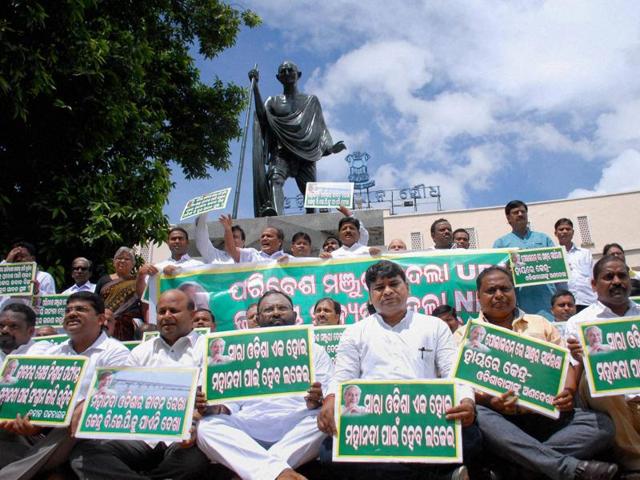
Odisha had been crying foul over Chattisgarh’s decision to maximise use of its share of the Mahanadi water for irrigation and industrial use by building reservoirs and inter-linking some of the river’s tributaries, saying it will reduce river flow and deplete Hirakund Dam.
Not perturbed by Odisha’s clamour, Chhattisgarh has started construction of six barrages — primarily for industrial use. Some of these projects were approved by the CWC after seeking comments from Odisha.
In addition, survey has started on four projects diverting water from Arpa river, a tributary of Mahanadi, and the Pairi-Mahanadi river-linking project.
The projects are basically to store excess monsoon water in the Mahanadi for use in lean period and will help industry and agriculture, a Chhattisgarh government official said. There will be no effect on water-flow to Odisha, he added.
In a presentation to the Water Resources ministry, the Chattisgarh government said the barrages will have a total capacity of 274 mcm (million cubic meter), much less than the lost storage in Hirakund due to siltation.
{{/usCountry}}In a presentation to the Water Resources ministry, the Chattisgarh government said the barrages will have a total capacity of 274 mcm (million cubic meter), much less than the lost storage in Hirakund due to siltation.
{{/usCountry}}This means the dam does not have capacity to store excess water. Hirakud, built on Mahanadi in Odisha in 1957, had lost 995 mcm, which is 18% of its 5,518-mcm storage capacity.
“What we are taking from Mahanadi is not from Odisha’s share,” the official said. “In fact, the live storage capacity of our dams on the river have also done down by 345 mcm due to siltation. The storage capacity of new barrages would be less than that.”
The Chattisgarh government also claimed that Odisha’s own data shows an increase in the river’s non-monsoon water-flow, meaning its projects do not endanger the Hirakund.
Odisha, on the other hand, questioned the Chattisgarh government’s approach of treating the impact of each project individually and not in an integrated manner.
The water resources ministry officials said Odisha wants a cumulative impact study of all projects that have been developed by Chhattisgarh on the flow of water to Hirakund, rather than individual—on the ground that these projects “dramatically” reduce the water flow.
“The differences are huge between the two states, and could not be resolved,” the official said with reference to tripartite meeting at the ministry last week. “We have assured Odisha that the CWC will examine their claim that water flow to Hirakund will reduce if Chattisgarh is allowed to build the projects.”
The ruling BJD in Odisha had turned the Mahanadi dispute into a political issue to hit BJP — the party in power in Chhattisgarh — that aspires to form the next government in one of India’s poorest states. Elections in the state will happen with general polls in 2019.
Adversely hit, the Odisha BJP on Friday accused chief minister Naveen Patnaik of striking a secret deal with his Chhattisgarh counterpart Raman Singh, saying the CM of the BJP-ruled state has forgotten about the issue now.
Patnaik has already met Prime Minister Narendra Modi. His party MPs stalled Lok Sabha proceedings for a day, accusing the Centre of being biased in favour of Chhattisgarh.