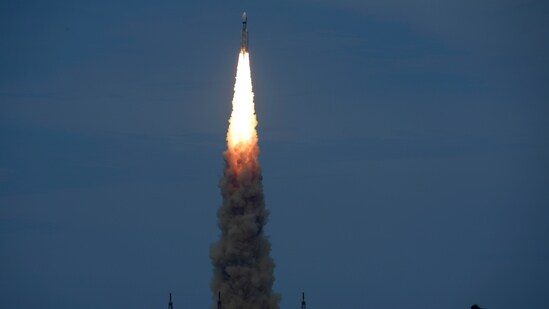
The Indian Space Research Organisation (ISRO) successfully launched its third lunar mission Chandrayaan 3 on board the heavy-lift GSLV Mark 3 (LVM 3) rocket from the Satish Dhawan Space Centre in Andhra Pradesh’s Sriharikota on Friday. Around 20 minutes after the spacecraft took off, the ISRO announced that Chandrayaan-3 is in its precise orbit and has begun its journey to the Moon. It added that the health of spacecraft is “normal”.
Also read: Nambi Narayanan calls Chandrayaan-3 a game-changer, says 'India will inspire…'
About Chandrayaan-3
Chandrayaan-3's journey from Earth to the moon is estimated to take about a month and the landing is expected on August 23, covering a distance of over 300,000 km. Upon landing, the spacecraft is expected to operate for one lunar day - which is approximately 14 Earth days. The spacecraft consists of an indigenous propulsion module, a lander module, and a rover with the objective of developing and demonstrating new technologies required for inter-planetary missions. It also carries a Spectro-polarimetry of Habitable Planetary Earth (SHAPE) payload to study the spectral and polarimetric measurements of earth from the lunar orbit.
According to ISRO, the spacecraft weighs around 3,900 kilograms.
{{/usCountry}}According to ISRO, the spacecraft weighs around 3,900 kilograms.
{{/usCountry}}The mission is ISRO's follow-up attempt after the Chandrayaan-2 mission failed to do a soft landing on the lunar surface in 2019. If Chandrayaan-3 is successful, it will make India the fourth country after US, China, and Russia, to land its spacecraft on Moon.