
 E-Paper



CJI NV Ramana says effective judiciary can help in economic growth
CJI NV Ramana implores the central government to ensure financial autonomy of the judiciary if a “different outcome” is to be expected from the judicial system


An inadequately supported judiciary not only impacts the gross domestic product (GDP) of a country but also costs it foreign investments, Chief Justice of India (CJI) NV Ramana rued on Saturday, as he implored the central government to ensure financial autonomy of the institution if a “different outcome” is to be expected from the judicial system.
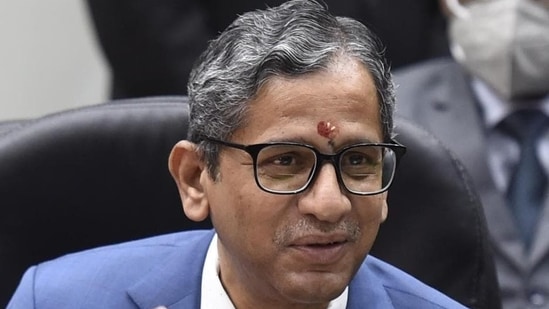
“An effective judiciary can aid in the effective growth of the economy. According to international research published in 2018, failure to deliver timely justice cost the country as much as 9% of annual GDP. Moreover, the impact of an under-supported judiciary is also seen on the foreign investments. Without adequate infrastructure we cannot aspire to fill this gap,” said the CJI, speaking at Aurangabad at the inaugural ceremony of two new wings of the annexe building of the Aurangabad Bench of the Bombay High Court.
Justice Ramana laid emphasis on what he called “a deeper structural problem that has plagued judicial infrastructure development in our country since independence”, lamenting lack of good infrastructure has been making it difficult for the courts to effectively perform their function.
“Judicial infrastructure is important for improving access to justice and to meet the growing demands of public that is more aware of its rights and is developing economically, socially, and culturally. It is baffling to note that the improvement and maintenance of judicial infrastructure is still being carried out in an ad-hoc and unplanned manner,” he said.
Asserting that courts are essential for any society governed by the rule of law, the CJI pointed out that court buildings are not merely structures made of mortar and bricks, but they assure the constitutional guarantee of right to justice and assure all seekers of justice that they need not worry about the might of the state.
“If we want a different outcome from the judicial system, we cannot continue to work in these circumstances... Good judicial infrastructure for courts in India has always been an afterthought. It is because of this mindset that courts in India still operate from dilapidated structures, making it difficult to effectively perform their function,” rued justice Ramana.
Underlining that the courts in India have always stood up whenever individuals or society were at the receiving end of executive excesses, the CJI maintained that institutionalising the mechanism for improving judicial infrastructure is the best gift that the people and country should get in this 75th year of India’s Independence.
The CJI has sent a proposal to establish the National Judicial Infrastructure Authority of India (NJIAI) to the law ministry. “I urge the Hon’ble minister of law and justice to expedite the process and ensure that the proposal to create NJIAI with statutory backing is taken up in the upcoming winter session of the parliament,” he said.
Law minister Kiren Rijiju was present at the event. Maharashtra chief minister Uddhav Thackeray, Supreme Court judges Uday U Lalit, Dhananjaya Y Chandrachud, BR Gavai and AS Oka and Bombay high court chief justice Dipankar Dutta also attended the function.
In his address, the CJI appealed for removing the stigma attached with citizens approaching courts for redressal of grievances. “It is a common notion that only criminals or victims of crime approach the court. People take pride in stating that we have never seen a court building in our lifetime. But, it is high time that we make efforts to remove the taboo associated with approaching courts for the affirmation of their rights,” he said.
Justice Ramana added that the common man deals with multiple legal issues during his lifetime and, therefore, she must never feel hesitant to approach the courts, as people’s faith in the judiciary is the biggest strength of a democracy.
Statistics laid out by the CJI during his address
* Sanctioned strength of judicial officers: 24,280
* number of court halls available: 20,143 (including 620 rented halls)
* 26% of court complexes do not have separate toilets for women
* 16% do not have toilets even for men
* 46% of court complexes do not have purified drinking water facility
* 95% of court complexes do not have basic medical facilities
* 68% of court rooms do not have separate record rooms
* 49% of court complexes do not have a library
* 73% of court rooms do not have computer placed on the judge’s dais with video-conferencing facility


